

Skilled nursing facilities today rely on multiple digital systems to manage care delivery, billing, staffing, and compliance. Yet many SNFs still operate with fragmented platforms that do not communicate well with each other. This makes system integration critical for modern operations. SNF API integration offers a practical way to connect these systems by allowing software applications to exchange data securely and automatically.
In simple terms, SNF API integration enables different tools such as EHRs, billing platforms, and reporting systems to “talk” to each other. Without this connection, facilities face ongoing challenges such as fragmented systems, interoperability gaps, compliance pressure, and operational inefficiencies. As regulatory requirements increase and staffing shortages persist, integration has become a foundational need rather than a technical luxury.
Problems with Traditional SNF System Connectivity
Many SNFs still rely on manual or semi-automated data movement between systems. Staff often re-enter the same information into multiple platforms, increasing workload and the risk of errors.
Disconnected EHR, billing, and operational platforms also delay access to patient and financial data. When census updates, claims status, or care documentation are not synchronized in real time, leaders lose visibility into daily performance. Limited interoperability makes it harder to respond quickly to issues such as denied claims, staffing gaps, or compliance audits.
These challenges directly affect efficiency, care coordination, compliance, and financial performance. Manual processes slow workflows, create inconsistent records, and expose facilities to regulatory risk. Over time, this leads to higher administrative costs and missed revenue opportunities.
Common Pitfalls in SNF API Integration
Not all integration efforts succeed. One common issue is the use of custom-built, brittle integrations that work only for a single system pairing. These connections often break during software upgrades and require constant maintenance.
Another pitfall is the lack of standardization. Without consistent data formats, SNFs struggle to scale their integrations across multiple vendors. Poor scalability limits long-term growth and makes expansion into new technologies difficult.
Security and compliance risks also arise when APIs are implemented without proper controls. Inadequate authentication, missing audit trails, and weak monitoring expose facilities to HIPAA violations. Vendor lock-in can further restrict flexibility, making it difficult to change platforms without rebuilding integrations from scratch. These factors limit real business value and prevent SNFs from realizing the full potential of interoperability.
A Smarter Way Forward with Modern API Integration
Modern SNF API integration technology is designed to overcome these barriers. Secure APIs provide controlled access to data while protecting sensitive patient information. Standardized data exchange models ensure that systems interpret information consistently across platforms.
Real-time synchronization allows updates to flow instantly between EHRs, billing systems, and operational dashboards. Interoperability frameworks support broader connectivity, enabling SNF interoperability through API rather than through manual exports or file transfers.
Together, these capabilities help SNFs operate more efficiently and reliably. Instead of working around system limitations, facilities can build a connected ecosystem that supports clinical and business processes simultaneously.
Key Benefits of SNF API Integration
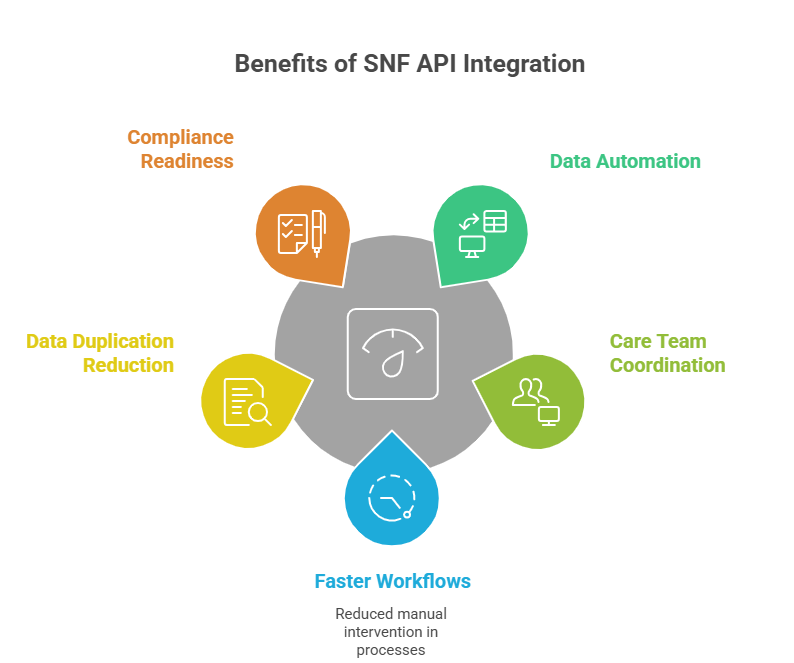
The benefits of SNF API integration for operations are both practical and strategic. Facilities gain improved operational efficiency as data moves automatically between systems. Care teams experience better coordination because clinical and administrative data remains consistent across platforms.
Workflows become faster when admissions, billing updates, and reporting no longer require manual intervention. Data duplication is reduced, lowering the risk of errors. Compliance readiness improves through better documentation and traceability. These outcomes illustrate how SNF API integration improves operational efficiency in daily practice.
Essential Features of a Secure SNF API Platform
When evaluating what features are essential in a secure SNF API integration platform, several capabilities stand out. Data encryption protects information in transit and at rest. Role-based access ensures that only authorized users and systems can retrieve specific data. Audit logs provide visibility into data usage and support compliance reviews.
Continuous monitoring helps detect unusual activity and performance issues. Scalability allows the platform to grow as the skilled nursing facility technology stack expands. Together, these features address the need for secure SNF API integration for compliance while supporting long-term interoperability goals.
Business Impact and ROI
Understanding the business case is critical for leadership. What is the ROI of implementing API connections for SNF EMR systems? Facilities typically see value through cost savings, improved staff productivity, and fewer errors in claims processing and reporting.
Interoperability benefits include faster access to Medicare and payer data, such as SNF Medicare API for patient status updates. By reducing administrative burden and rework, SNFs free up staff time for higher-value activities. Over time, these gains translate into measurable financial and operational improvements, supporting the broader case for implementing SNF EMR API connections.
A Practical Path Forward
For decision-makers asking, “What are the best SNF API integration solutions for B2B healthcare?” or “How to ensure HIPAA compliance with SNF API data exchange?”, the answer lies in choosing platforms built specifically for healthcare interoperability. Comparing SNF integration platforms should focus on security, scalability, and healthcare-specific standards rather than generic connectivity tools.
Modern skilled nursing facility API integration solutions are increasingly designed to support EHRs, revenue cycle systems, and operational analytics in a unified environment. This approach also addresses common challenges of SNF API integration and how to solve them by replacing isolated connections with structured, governed data exchange
Enabling Integration Through End-to-End Automation
ValueDX supports skilled nursing facilities with end-to-end SNF automation combined with secure API-based integrations. By enabling interoperability across systems, ValueDX helps organizations move toward data-driven operations, seamless system connectivity, and scalable SNF automation. For facilities seeking a practical path to SNF interoperability through API, integrated automation can simplify both clinical and administrative workflows while maintaining compliance.
Learn more at:
https://valuedx.com/skilled-nursing-facilities-automation-solutions-snf/
Author – Chaitanya Thorat
Read our next blog – Click here