

Skilled Nursing Facilities (SNFs) operate in an environment where census volatility, staffing shortages, reimbursement pressure, and regulatory oversight collide daily. Yet many facilities still rely on static reports or spreadsheets to plan their future. This gap between operational complexity and planning capability is exactly where SNF forecasting analytics becomes critical.
SNF forecasting analytics uses data-driven models to predict future census levels, staffing needs, revenue trends, and resource utilization. When implemented correctly, it helps facilities plan proactively. When handled poorly, it creates blind spots that impact both care quality and financial stability.
What Is SNF Forecasting Analytics?
SNF forecasting analytics combines historical data, operational inputs, and predictive techniques to estimate future performance. Unlike traditional reporting which only explains past results forecasting focuses on what is likely to happen next.
Modern skilled nursing facility forecasting tools typically analyze:
- Census and admissions trends
- Staffing availability and labor costs
- Payer mix and reimbursement patterns
- Seasonal and market-driven fluctuations
This allows SNFs to anticipate challenges before they appear on financial statements.
Why Many SNFs Struggle With Forecasting
Despite growing awareness, many facilities fail to realize the full value of forecasting analytics due to common structural issues.
Fragmented Data
Census, staffing, and financial data often live in separate systems. Without integration, forecasts are incomplete or inaccurate.
Overreliance on Historical Averages
Many SNF financial forecasting systems rely heavily on past averages. These models fail to account for sudden census changes, staffing shortages, or reimbursement shifts.
Manual, Spreadsheet-Based Forecasting
Manual forecasting introduces errors, limits scalability, and consumes valuable leadership time—especially across multi-facility operations.
Lack of Scenario Planning
Most SNFs forecast only a single outcome, leaving leadership unprepared for best-case or worst-case scenarios.
How Predictive Analytics Improves SNF Census Forecasting
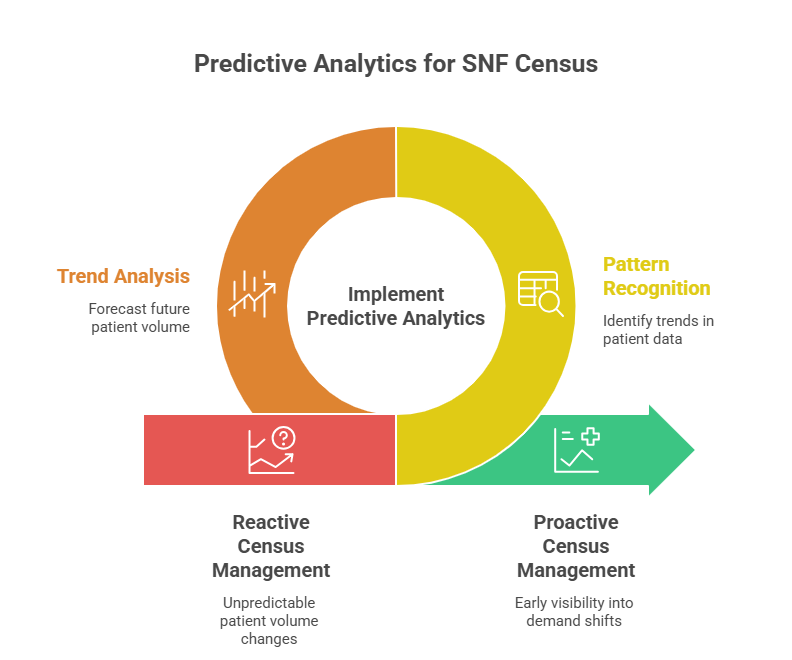
Predictive analytics for SNF census forecasting uses pattern recognition and trend analysis to anticipate patient volume changes. Instead of reacting to census drops or spikes, facilities gain early visibility into:
- Seasonal demand shifts
- Referral pattern changes
- Occupancy risks and opportunities
This enables better staffing alignment and resource planning.
Manual vs Automated SNF Forecasting: A Clear Comparison
| Area | Manual Forecasting | Automated Forecasting |
|---|---|---|
| Data Sources | Disconnected, siloed | Integrated across systems |
| Accuracy | Dependent on human assumptions | Continuously refined by data |
| Scalability | Limited, time-consuming | Easily scalable across facilities |
| Scenario Planning | Rare or manual | Built-in “what-if” modeling |
| Decision Speed | Slow, reactive | Fast, proactive |
The Role of AI in Skilled Nursing Facility Resource Forecasting
The benefits of AI for skilled nursing facility resource forecasting extend beyond prediction. AI-driven models adapt as new data becomes available, identify anomalies early, and help leadership evaluate multiple scenarios simultaneously.
Instead of replacing human expertise, AI strengthens decision-making by providing timely, evidence-based insights.
Why SNF Forecasting Analytics Is Becoming Strategic
SNF financial analytics and future trends point toward tighter margins, workforce instability, and increasing compliance demands. Facilities that continue to rely on manual forecasting will struggle to remain resilient.
Those that adopt adaptive, data-driven forecasting models gain:
- Better financial visibility
- Improved staffing efficiency
- Reduced operational surprises
- Stronger long-term planning
SNF forecasting analytics is no longer just a reporting tool it’s a strategic capability. Facilities that want better visibility, stronger planning, and fewer surprises must rethink how they forecast operations and finances.
If your organization is still relying on manual forecasting or disconnected systems, it may be time to explore a smarter, automated approach to SNF forecasting analytics.
Author – Pramod Ishwarkatti
Read our next blog – Click here