

Skilled Nursing Facilities (SNFs) are operating in a more complex environment than ever before. Staffing shortages, tighter reimbursement rules, rising operating costs, and increased regulatory oversight all place pressure on leadership teams to run facilities more efficiently while maintaining quality care. In this environment, relying on intuition or delayed reports is no longer enough.
This is where SNF operational analytics becomes essential. At its core, it uses data from across the facility clinical, staffing, billing, and compliance systems to provide visibility into what is really happening day to day. As operations grow more complex, analytics helps leaders make informed decisions instead of reactive ones.
Yet many facilities still struggle with fragmented data and limited insight. Understanding the problems, the pitfalls, and the smarter way forward is the first step toward meaningful improvement.
Problems with Traditional SNF Operations
Siloed Data and Manual Reporting
Most SNFs collect large amounts of data, but it often lives in separate systems. Census data sits in one platform, staffing in another, and financial metrics in spreadsheets. This siloed structure makes it difficult to see the full operational picture.
Manual reporting adds to the burden. Teams spend hours pulling numbers together, leaving little time to analyze trends or act on insights. As a result, leaders often ask, how does SNF operational analytics improve facility efficiency when so much effort still goes into basic reporting?
Delayed Decisions and Limited Visibility
Without integrated dashboards, decisions are based on yesterday’s data or last week’s. Delayed insight affects staffing levels, admissions planning, and compliance monitoring. Lack of real-time visibility can lead to higher overtime costs, slower discharges, and missed early warning signs.
These issues directly impact efficiency, care quality, and regulatory readiness, making it harder to meet both operational and clinical goals.
Common Pitfalls in SNF Analytics Adoption
Incomplete or Inconsistent Data
Analytics is only as good as the data behind it. In many facilities, data is incomplete or entered differently across systems. This leads to reports that are technically correct but operationally misleading.
Static Dashboards and Spreadsheet Dependence
Some SNFs adopt dashboards that simply display historical numbers. These static tools lack context and do not guide action. Over-reliance on spreadsheets further limits scalability and introduces error risks.
Poor Integration
When analytics tools are not connected to EHR, payroll, and billing systems, leaders still rely on manual reconciliation. This undermines the value of SNF operational analytics software for skilled nursing and prevents true automation.
Together, these pitfalls explain why many facilities struggle to realize the full benefits of operational analytics in SNF environments.
A Smarter, Data-Driven Way Forward
Modern SNF operational analytics technology focuses on integration, automation, and intelligence rather than isolated reports. It brings together operational, financial, and staffing data into a unified view.
How Modern Analytics Helps
- Real-time reporting enables leaders to monitor census changes, staffing coverage, and workflow delays as they happen.
- AI-driven insights highlight unusual patterns such as rising overtime or longer discharge cycles.
- Performance dashboards replace spreadsheets with visual, role-based views of key metrics.
- Predictive analytics supports proactive decisions, such as anticipating staffing needs or identifying operational bottlenecks.
This shift allows facilities to answer practical questions like how can data-driven decision-making optimize SNF operations and how does SNF operational analytics technology improve patient care by ensuring resources are aligned with resident needs.
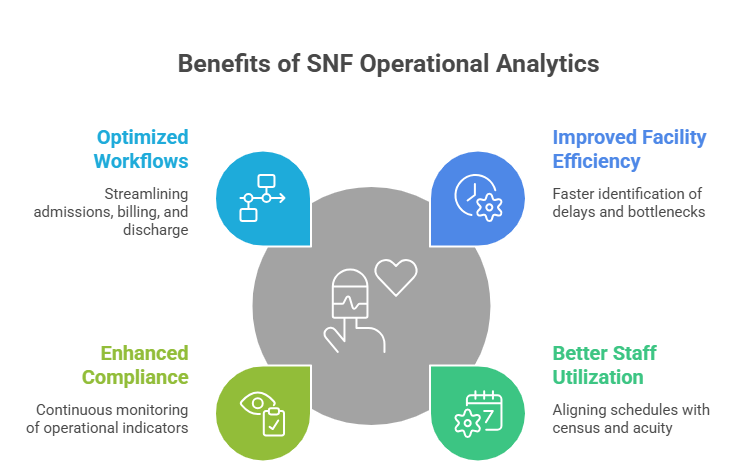
Key Benefits of SNF Operational Analytics
Facilities that adopt modern analytics gain measurable advantages:
- Improved facility efficiency through faster identification of delays and bottlenecks
- Better staff utilization by aligning schedules with census and acuity
- Enhanced compliance with continuous monitoring of operational indicators
- Optimized workflows across admissions, billing, and discharge planning
- Stronger patient care outcomes supported by stable operations
These outcomes are why many organizations explore best SNF operational intelligence platforms B2B when planning digital transformation.
Key Metrics and Dashboards
A strong skilled nursing facility performance metrics dashboard typically includes:
- Census and occupancy trends
- Staffing levels and overtime hours
- Billing cycle time and claim processing status
- Admission-to-bed turnaround time
- Discharge efficiency
- Compliance and audit indicators
These metrics answer a common question: what are the key performance metrics for SNF operational analytics dashboards and help leaders move from reactive reporting to proactive management.
Business Impact and ROI
One of the most frequent questions is what is the ROI of implementing operational analytics in a skilled nursing facility. The return comes from multiple areas:
- Cost control: Reduced overtime and administrative effort
- Productivity: Faster decision cycles and fewer manual reports
- Risk reduction: Earlier detection of compliance gaps and workflow failures
Over time, these gains contribute to the ROI of SNF operational analytics technology, making analytics an operational investment rather than a reporting tool.
A Practical Path Forward with ValueDX
For facilities seeking a unified approach, ValueDX offers end-to-end SNF automation combined with operational analytics. Its solutions integrate workflows across staffing, billing, and compliance while providing real-time insight into performance.
With ValueDX, SNFs can support skilled nursing facility data-driven decision making through:
- Real-time operational reporting
- AI-powered analytics
- Integrated workflow automation
Rather than replacing existing systems, ValueDX enhances them with visibility and intelligence. For leaders asking where can I find SNF operational analytics software for facility management, this approach offers a practical way to modernize operations without disrupting care delivery.
SNF operational analytics is no longer optional—it is foundational to running efficient, compliant, and patient-centered facilities. By understanding the limitations of traditional reporting and avoiding common adoption pitfalls, SNFs can move toward smarter, integrated analytics strategies.
The future belongs to facilities that treat data as an operational asset, using insight to guide staffing, workflows, and care delivery. With the right tools and approach, analytics becomes not just a reporting function, but a driver of sustainable improvement.
Author -Chaitanya Thorat
Read our next blog – Click here