
The accuracy of the Accounts Payable (AP) function plays a critical role in protecting cash flow, maintaining vendor trust, and ensuring financial control. Yet in many organizations, AP remains vulnerable to errors caused by manual invoice handling, inconsistent checks, and fragmented approval processes. These gaps lead to overpayments, delayed reconciliations, audit risks, and unnecessary operational strain.
Automated invoice validation combined with three-way matching has become one of the most effective ways to eliminate these risks and bring discipline back into AP operations.
Why Errors Persist in Traditional Accounts Payable
Manual or partially automated AP environments struggle with consistency. Invoices arrive in different formats, data is keyed in by hand, and validation depends heavily on human review. As volumes increase, so does the likelihood of mistakes.
Common issues include:
- Incorrect invoice amounts or duplicate entries
- Payments released without confirmed receipt of goods or services
- Delays caused by missing documentation
- Limited visibility into invoice status and liabilities
- Difficulty tracing errors during audits
Over time, these issues quietly erode margins and weaken internal controls.
The Role of Automated Invoice Validation
Automated invoice validation introduces structured checks at the moment an invoice enters the system. Instead of relying on manual review, invoices are automatically verified for accuracy, completeness, and compliance with internal policies.
Key validation checks include:
- Required fields such as vendor details, invoice numbers, and dates
- Price and quantity consistency
- Contract and pricing alignment
- Duplicate invoice detection
Invoices that fail validation are immediately flagged and routed for review before any payment risk is introduced.
How Three-Way Matching Strengthens Financial Control
Three-way matching is the cornerstone of strong AP governance. It ensures that payment is released only when three documents align:
- The purchase order, confirming what was authorized
- The goods receipt, confirming what was delivered
- The vendor invoice, confirming what is being billed
Automated systems perform this comparison instantly. If quantities, pricing, or terms do not match, the invoice is held and escalated. This prevents overpayments, fraudulent invoices, and payments for undelivered goods.
When enforced consistently, three-way matching shifts AP from reactive error correction to proactive prevention.
Operational Benefits of Automation
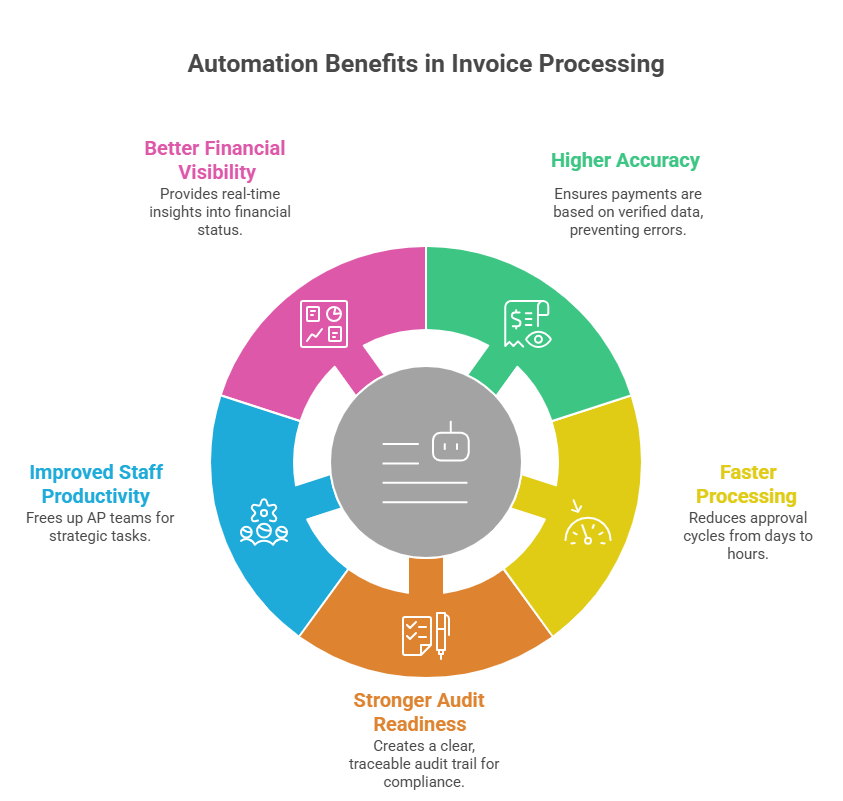
When invoice validation and three-way matching are automated, the impact extends well beyond error reduction.
Higher Accuracy
Payments are based on verified data, not assumptions. Errors are stopped before they affect cash flow.
Faster Processing
Invoices move through the system without manual bottlenecks, reducing approval cycles from days to hours.
Stronger Audit Readiness
Every validation step is recorded, creating a clear, traceable audit trail.
Improved Staff Productivity
AP teams spend less time chasing discrepancies and more time managing exceptions and improving controls.
Better Financial Visibility
Leadership gains a real-time view of liabilities, commitments, and upcoming cash requirements.
Manual Validation vs Automated Three-Way Matching
| Area | Manual Process | Automated Process |
|---|---|---|
| Error detection | Often after payment | Before payment |
| Processing speed | Slow and inconsistent | Near-instant |
| Control enforcement | Depends on staff | System-enforced |
| Audit readiness | Fragmented | Centralized |
| Scalability | Requires more staff | Handles volume growth |
Practical Impact in High-Volume Environments
In industries such as healthcare, manufacturing, and retail, invoice volumes are high and margins are sensitive. Automated validation ensures that every purchase is paid correctly and every delivery is confirmed before funds are released.
This level of control is especially critical where compliance, supplier diversity, and cost containment are ongoing priorities.
Why SNFs Should Adopt Intelligent Document Processing Now
The future of skilled nursing will be defined by speed, accuracy, and efficiency. Intelligent Document Processing is not just a cost-saving initiative it is a strategic enabler that improves care delivery, strengthens compliance, and enhances staff productivity.
By adopting AI-driven eFax classification today, SNFs bridge the gap between outdated, document-heavy workflows and a fully digital, intelligent operating model built for tomorrow.
Author – Pradeep Dhakne
Read our next blog – Click here