
In today’s rapidly evolving UAE economy, businesses are navigating a regulatory environment that is as dynamic as the country’s growth story itself. With diverse industries spanning construction, finance, hospitality, and global trading, compliance has become not just a legal requirement but also a cornerstone of sustainable business operations. The procure-to-pay (P2P) cycle—spanning vendor onboarding, procurement, invoice processing, and payment—sits at the heart of this challenge, acting as both a compliance risk area and an opportunity for governance excellence.
The Unique Compliance Challenges Faced by UAE Companies
Operating in the UAE requires businesses to balance a multi-layered regulatory framework that blends local, regional, and international requirements. Key challenges include:
- Fragmented Local Regulations: Each emirate maintains specific business requirements. Companies operating across Dubai, Abu Dhabi, and other emirates must ensure consistency while adapting to emirate-level rules.
- International Compliance Standards: For multinational operations, compliance must extend beyond local frameworks to include global standards on taxation, transfer pricing, anti-money laundering (AML), and financial reporting.
- Audit Trail Expectations: Businesses must maintain clear, tamper-proof records that satisfy both local authorities and international auditors—ranging from UAE tax authorities to global investors.
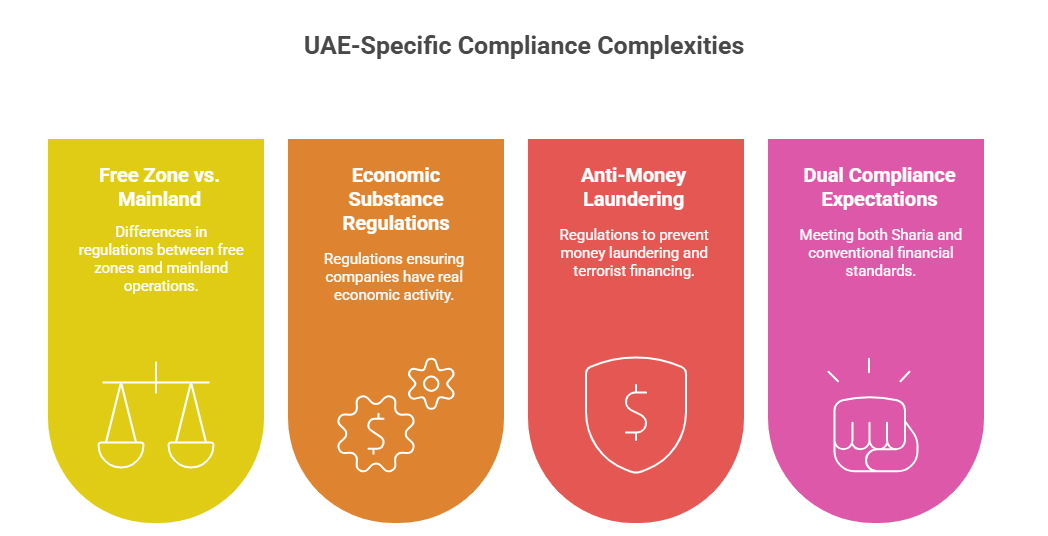
UAE-Specific Compliance Complexities
- Free Zone vs. Mainland Operations
Companies often operate across free zones and the mainland, where regulatory obligations—particularly around ownership, tax filings, and reporting—differ significantly. Maintaining unified compliance across both areas is a constant challenge. - Economic Substance Regulations (ESR)
The UAE’s ESR requires companies engaged in certain activities to demonstrate substantial business presence in the country. This places pressure on organizations to maintain detailed transaction documentation and reporting trails. - Anti-Money Laundering (AML) Compliance
With its position as a global trade and financial hub, the UAE enforces strict AML requirements. Businesses must prove due diligence across their P2P cycle, from supplier vetting to payment monitoring. - Dual Compliance Expectations: Sharia vs. Conventional
Some businesses must demonstrate compliance for both Sharia-compliant financing structures and conventional models, necessitating dual transparency in records and reporting.
Why Traditional Compliance Approaches Fall Short
Manual documentation, fragmented record-keeping, and reliance on human monitoring create blind spots. These gaps:
- Increase exposure to non-compliance penalties.
- Make it difficult to demonstrate adherence during audits.
- Delay the ability to respond to evolving UAE laws, such as VAT amendments or new AML rules.
In a landscape where regulators are enhancing enforcement and penalties, traditional compliance frameworks are no longer sufficient.
How Automated P2P Compliance Systems Transform Adherence
Automation offers a proactive, technology-driven approach that strengthens compliance and reduces regulatory risks. Key advantages include:
- Comprehensive Transaction Monitoring: Every procurement and payment is logged, validated, and stored with complete visibility.
- Automated Compliance Checking: Rules engines can be configured against UAE-specific requirements such as VAT filing formats or ESR documentation, ensuring issues are flagged before submission.
- Intelligent Risk Assessment: Advanced analytics detect unusual transactions, helping businesses prevent fraud and meet AML obligations.
- Real-Time Audit Trail Maintenance: A continuous, verifiable audit log is created across all entities—mainland and free zone—reducing audit preparation time and cost.
Compliance Requirements Relevant to UAE Businesses
Automated P2P systems can be tailored to meet critical UAE obligations, such as:
- VAT Compliance & Documentation – Automated invoice capture ensures VAT data is properly recorded and reconciled for FTA filings.
- Economic Substance Regulation (ESR) – Automated record-keeping provides proof of operational substance through detailed expense, contract, and activity logs.
- AML Reporting – Supplier vetting, transaction monitoring, and suspicious activity reporting can be embedded into the P2P workflow.
- International Transfer Pricing Documentation – Automated systems generate standardized reports aligned with OECD guidelines while meeting UAE’s compliance expectations.
- Financial Sector Regulations – Compliance with Central Bank directives, Dubai Financial Services Authority (DFSA) rules, and Abu Dhabi Global Market (ADGM) standards can be integrated into reporting dashboards.
Sector-Specific Considerations in the UAE
Different industries in the UAE face specialized compliance demands:
- Construction & Real Estate – Automated P2P controls ensure transparent payments on mega-projects, alignment with RERA (Real Estate Regulatory Agency) requirements, and avoidance of inflated costs.
- Financial Services – Systems can align procurement with strict Central Bank AML rules, insurance authority guidelines, and international banking regulations.
- Hospitality & Tourism – Automated expense tracking ensures compliance with Department of Tourism & Commerce Marketing (DTCM) reporting, licensing, and service charge requirements.
- Trading & Import/Export Companies – Customs declarations, import duty records, and shipping documentation can be embedded directly into the P2P cycle for transparency.
Implementation Strategies for the UAE’s Diverse Landscape
For UAE companies, successful P2P compliance automation requires a thoughtful approach:
- Local + International Alignment – Configure systems to capture UAE-specific data while supporting international reporting requirements.
- Cross-Entity Integration – Ensure P2P platforms consolidate compliance data from both mainland and free zone entities.
- Multicultural Business Considerations – Multilingual interfaces, culturally adaptable workflows, and training programs support diverse teams in adopting compliance solutions.
- Scalability for Growth – Automated systems should be flexible enough to adapt to future regulatory changes, whether in VAT rules or global reporting standards.
Turning Compliance into Competitive Advantage
In the UAE’s dynamic business environment, compliance is more than a checkbox—it’s a strategic differentiator. Robust P2P compliance and control systems enable businesses to:
- Ensure seamless adherence to UAE and international regulations.
- Enhance credibility with regulators, investors, and global partners.
- Achieve operational transparency that builds stakeholder trust.
- Position themselves for regional and international expansion with confidence.
By embracing automation, UAE businesses can transform compliance from a reactive burden into a proactive driver of governance excellence—securing long-term growth in one of the world’s most competitive markets.