

The United Arab Emirates (UAE) has become one of the most dynamic business hubs in the world, attracting global corporations, homegrown conglomerates, and a diverse supplier ecosystem spanning the GCC region. With this rapid growth comes the need for enterprises to build more efficient, compliant, and resilient financial operations. At the heart of this transformation lies the procure-to-pay (P2P) process, which connects procurement and finance teams to ensure smooth sourcing, purchasing, invoicing, and payments.
Yet, implementing P2P systems in the UAE is rarely straightforward. Complex VAT regulations, diverse supplier bases, and the operational realities of large multi-entity businesses create unique challenges. In this blog, we’ll examine the most common P2P hurdles faced by UAE enterprises, explore their impact, and outline how modern P2P solutions can help resolve them.
Unique P2P Challenges in the UAE Context
- Multi-Jurisdiction VAT Compliance
Since the introduction of VAT in the UAE and broader GCC, enterprises must carefully manage invoicing and reporting. Errors in VAT coding or missed compliance requirements can lead to penalties and delayed input tax credit claims. - Diverse Supplier Bases Across GCC
Enterprises often deal with thousands of vendors, from global suppliers to local SMEs. Variations in documentation standards, digital readiness, and invoicing practices make supplier management a major challenge. - Multi-Entity Operations
Large conglomerates dominate the UAE’s economic landscape. Managing P2P across multiple legal entities and business units creates added complexity, from approval hierarchies to consolidated reporting.
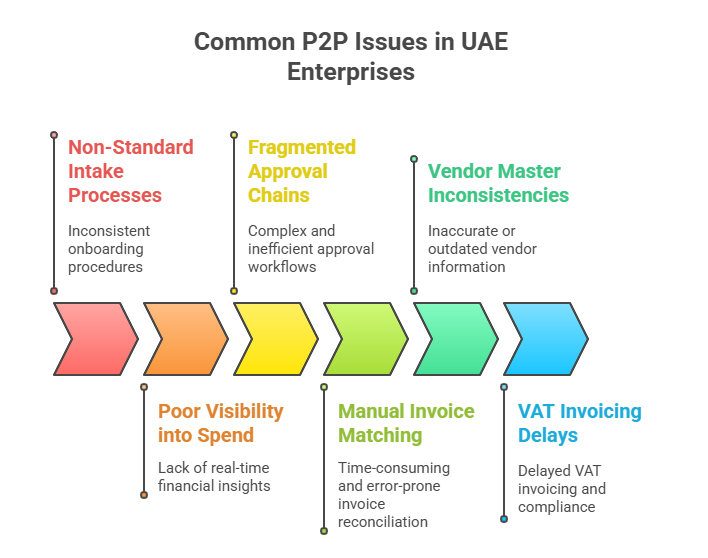
Common P2P Issues in UAE Enterprises
Non-Standard Intake Processes: Requisitions often bypass formal systems, resulting in off-contract spend and inconsistent procurement practices.
Poor Visibility into Spend: Fragmented systems prevent CFOs and procurement leaders from gaining real-time insights into vendor performance, spend categories, or compliance risks.
Fragmented Approval Chains: Email-based workflows and unclear delegation of authority delay invoice approvals and payments, frustrating suppliers.
Manual Invoice Matching: Heavy reliance on manual checks for invoice-to-PO matching increases cycle times, introduces errors, and complicates VAT validation.
Vendor Master Inconsistencies: Missing or incorrect details in vendor master data—such as VAT registration numbers or banking details—cause compliance mismatches and payment delays.
VAT Invoicing Delays: Enterprises often struggle with timely VAT-compliant invoice submissions and validations, leading to risks of penalties and cash flow disruptions.
Procurement and Payment Challenges in the UAE
Procurement and finance teams in the UAE often find themselves burdened by dual challenges: ensuring compliance with VAT invoicing rules while meeting supplier expectations for fast and transparent payments. Vendor master inconsistencies create repeated rework, while manual validation of invoices against VAT rules slows down processing. These delays not only damage supplier relationships but also restrict enterprises from taking advantage of early payment discounts.
How P2P Solutions Address These Challenges
Modern P2P solutions are designed to meet the specific needs of UAE enterprises, bringing structure, compliance, and automation into the process.
- Guided Buying
Guided buying directs employees toward approved suppliers and compliant procurement channels. This ensures that requisitions are standardized, reducing off-contract spend and increasing visibility. - Supplier Self-Service Portals
Supplier portals allow vendors to upload invoices, update master data, and track payment status in real time. For UAE suppliers, this reduces administrative back-and-forth and fosters stronger collaboration. - Automated Matching with VAT Checks
Automation enables three-way matching between purchase orders, goods receipts, and invoices, while simultaneously validating VAT details. This reduces errors, accelerates cycle times, and ensures regulatory compliance. - Proactive Exception Playbooks
Exception playbooks provide predefined workflows to address mismatches or compliance gaps. For example, if an invoice fails VAT validation, the system can automatically route it to the appropriate finance manager for resolution.
Best Practices for P2P in UAE Enterprises
Implementing P2P successfully in the UAE requires more than just technology—it requires tailored strategies that reflect the region’s unique business environment.
- Phased Supplier Onboarding
Rather than attempting to bring all suppliers into the system at once, enterprises should prioritize onboarding high-value vendors first, followed by mid-tier and SME suppliers. This ensures smoother adoption and faster ROI. - Governance for VAT Compliance
Strong governance frameworks must be built into P2P workflows, ensuring VAT validation checks are automated and auditable. Compliance cannot be treated as an afterthought. - Leveraging Analytics for Spend Control
Dashboards and analytics tools provide real-time insights into category spend, vendor compliance, and cycle times. This visibility empowers CFOs and procurement leaders to make data-driven decisions and strengthen financial resilience.
The UAE’s business environment—marked by VAT regulations, supplier diversity, and large-scale conglomerate operations—creates unique challenges for P2P implementation. Non-standard intake processes, poor visibility, fragmented approvals, and manual invoice matching continue to hold enterprises back. However, modern P2P solutions such as guided buying, supplier self-service portals, automated VAT-ready matching, and exception playbooks offer a clear path forward.
By adopting best practices—phased supplier onboarding, VAT governance, and analytics-driven spend control—UAE enterprises can not only resolve P2P challenges but also unlock greater efficiency, compliance, and strategic value. For business leaders, the message is clear: investing in P2P automation is no longer optional, it is a critical enabler of growth and resilience in the UAE’s evolving digital economy.