

Homecare Operational Intelligence: Problems, Pitfalls, and a Smarter Way Forward
The homecare sector is experiencing unprecedented growth, driven by rising patient demand and a shift toward care delivery outside traditional facilities. Yet many agencies remain constrained by fragmented operations, limited visibility, and reactive decision-making. Day-to-day realities include heavy administrative workloads, complex compliance requirements, and constant pressure to optimize caregivers, schedules, and revenue cycles.
Without real-time visibility or predictive capabilities, homecare organizations struggle to scale efficiently. The result is service delays, revenue leakage, compliance exposure, and staff burnout persistent challenges across the industry.
To overcome these limitations, homecare leaders must move beyond basic digital record-keeping and adopt Homecare Operational Intelligence. Understanding homecare operational intelligence: problems, pitfalls, and a smarter way forward is essential for navigating modern care complexity and achieving meaningful digital transformation.
The Operational Pitfalls of Traditional Homecare Systems
Even agencies using basic homecare software or a standard homecare system often encounter inefficiencies rooted in siloed data and manual coordination. The absence of integrated, actionable intelligence prevents proactive, data-driven management.
Why Do Homecare Operational Problems Persist?
- Fragmented Data and Limited Visibility
Scheduling, billing, compliance, and clinical data often reside in separate systems. This fragmentation prevents real-time visibility in homecare, making it difficult to identify missed visits, authorization gaps, or workflow bottlenecks before they escalate. - Inefficient Caregiver and Staff Management
Manually aligning caregiver skills, availability, and geography with patient needs is time-consuming and error-prone. Poor optimization increases travel costs, overtime, and staff fatigue—reducing the effectiveness of caregiver management processes. - Revenue Leakage and Compliance Risk
Delays in eligibility verification, authorization processing, and visit documentation contribute to denied claims and audit exposure. Manual checks undermine the reliability of traditional homecare compliance tools. - Reactive Decision-Making
Without predictive analytics for homecare, organizations respond to staffing shortages, compliance issues, or revenue shortfalls only after they occur—limiting scalability and control.
Intelligent Automation: A Smarter Way Forward
The foundation of Homecare Operational Intelligence is intelligent automation delivered through a next-generation, AI-powered platform. Rather than simply storing data, this approach transforms operational information into decision intelligence for homecare leaders.
How Homecare Operational Intelligence Works
Machine Learning models ingest data across scheduling, EHRs, billing, and patient records in real time. The platform analyzes trends, detects anomalies, and applies automated rules to optimize workflows.
For example, instead of manually reviewing every claim, the system identifies high-risk submissions based on historical patterns enabling automation-led revenue optimization and reducing denials before they occur. This proactive intelligence layer dramatically enhances the value of existing homecare management software.
Benefits of Adopting the Best Homecare Software with Operational Intelligence
A top homecare system built with operational intelligence delivers measurable impact across financial, operational, and clinical performance.
- Enhanced Revenue Cycle Performance
Automated eligibility checks and documentation validation reduce denials and accelerate reimbursement, strengthening homecare revenue management. - Optimized Staffing and Workflow Automation
Homecare workflow automation uses predictive models to optimize schedules, reduce idle time, control travel costs, and ensure required visit frequencies. - Stronger Compliance and Risk Management
AI-driven compliance monitoring continuously audits workflows and documentation, providing real-time alerts and reducing audit exposure beyond what traditional compliance tools can offer.
Improved Care Coordination and Patient Outcomes
With real-time visibility in homecare, teams can ensure timely service delivery, respond quickly to changes, and improve patient satisfaction.
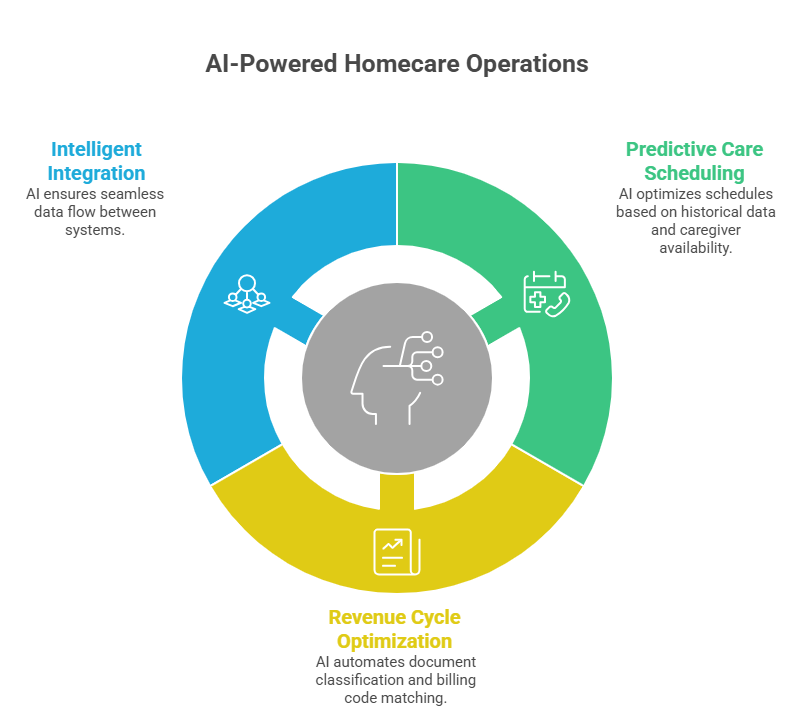
Real-World Use Cases for AI-Powered Homecare Operations
Operational Intelligence enables advanced homecare analytics across mission-critical functions.
Predictive Care Scheduling and Staffing
AI analyzes historical visit data, caregiver availability, and travel patterns to generate optimized schedules. Predictive analytics for homecare allow agencies to anticipate demand spikes, proactively staff, and reduce reliance on overtime or temporary labor.
Revenue Cycle Optimization and Leakage Prevention
Incoming documents such as authorizations and physician orders are automatically classified and matched with billing codes. This reduces manual data entry, improves accuracy, and prevents revenue leakage.
Intelligent Integration Across Systems
Modern homecare integration solutions use APIs to ensure seamless data flow between the core homecare system and external platforms such as accounting, payroll, or labs—creating a unified AI-powered platform.
Manual vs. Automated Homecare Operations
| Feature | Manual Operations (Basic Software) | Automated Operations (Operational Intelligence) |
|---|---|---|
| Scheduling | Manual matching, frequent last-minute changes | Predictive scheduling with optimized routing |
| Claim Submission | Manual checks, high denial risk | Automated validation and pre-submission audits |
| Compliance | Periodic manual audits | Continuous AI-driven monitoring |
| Visibility | Delayed, siloed reportsReal-time dashboards and alerts |
Real-time dashboards and alerts |
Author – Pradeep Dhakne
Read our next blog – Click here