
Claim denials driven by eligibility errors continue to be one of the most preventable sources of revenue loss for Skilled Nursing Facilities (SNFs). Although denials surface weeks later during billing or accounts receivable follow-up, the failure point almost always occurs much earlier—during admission, benefit validation, or payer rule interpretation. As Medicare Advantage enrollment expands and payer policies change more frequently, real-time insurance eligibility SNF verification has become a core control mechanism for SNF claim denial prevention, not a supporting task.
This blog explains how SNF eligibility verification automation, powered by AI, prevents denials, improves billing accuracy, and strengthens revenue cycle performance across skilled nursing operations.
Why Eligibility Errors Remain a Major Denial Driver in SNFs
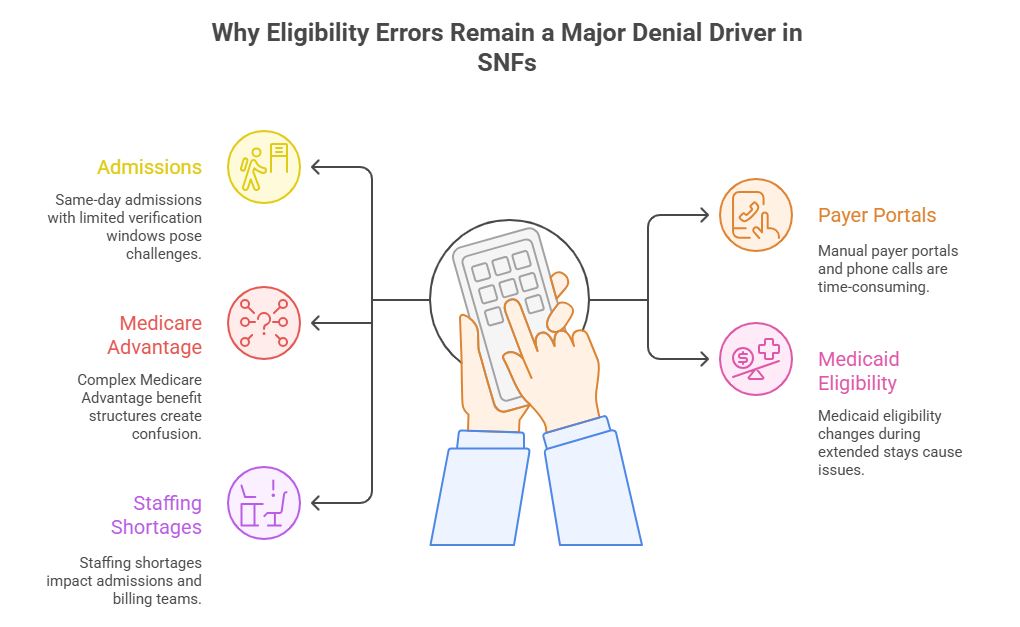
Eligibility-related denials are not isolated mistakes. They are the result of operational constraints common to SNFs, including:
- Same-day admissions with limited verification windows
- Manual payer portals and time-consuming phone calls
- Complex Medicare Advantage benefit structures
- Medicaid eligibility changes during extended stays
- Staffing shortages across admissions and billing team
These realities create eligibility errors SNF billing teams often discover only after claims submission. Typical denial causes include inactive coverage, incorrect payer sequencing, Medicare Advantage plan mismatches, unverified benefits, and missing authorizations.
Without payer verification skilled nursing workflows operating in real time, SNFs remain reactive—managing denials instead of preventing them.
What Real-Time Eligibility Verification Means in the SNF Context
Real-time insurance eligibility verification SNF refers to automated, continuous validation of coverage, benefits, and payer rules at the exact moment operational decisions are made.
Unlike static or batch-based checks, SNF insurance verification automation delivers:
- Active or inactive coverage confirmation
- Accurate payer and plan identification
- Benefit limitations and service exclusions
- Medicare Advantage SNF eligibility check validation
- Medicaid eligibility SNF automation updates
- Real-time payer response SNF AI signals
This capability anchors SNF revenue cycle automation eligibility, ensuring billing workflows rely on verified data rather than assumptions.
SNF Problem → Operational Impact → Automation Solution (Scenario 1)
Problem: Payer Eligibility Mismatch at Admission
SNFs often admit residents using referral data or prior eligibility snapshots. Coverage changes—particularly under Medicare Advantage—may not be detected in time.
Operational Impact:
- Claims denied for incorrect payer or plan
- Rework, resubmissions, and delayed reimbursement
- Increased AR days and administrative strain
Automation Solution:
SNF payer verification automation performs instant eligibility checks at admission. An eligibility verification bot SNF flags discrepancies immediately, helping teams prevent payer mismatch SNF issues before services begin. This is a primary application of SNF denial reduction tools AI.
SNF Problem → Operational Impact → Automation Solution (Scenario 2)
Problem: Benefit and Authorization Gaps
Even with active coverage, benefits may not support the level or duration of care billed. Authorization requirements vary by payer and plan.
Operational Impact:
- Non-covered days written off
- Manual appeals and payer outreach
- Compliance and audit exposure
Automation Solution:
An AI eligibility engine SNF workflows layer continuously validates benefits and authorizations. Through SNF automated payer rules check, facilities can prevent SNF denials with real-time checks instead of post-billing corrections. This directly improves SNF claim accuracy AI tools and first-pass claim acceptance.
How the AI Eligibility Verification Workflow Operates in SNFs
A modern AI eligibility verification workflow spans the full revenue cycle:
Admission & Pre-Admission
- Instant eligibility check software SNF
- Medicare Advantage eligibility SNF AI validation
- Automated Medicaid eligibility updates
During the Resident Stay
- SNF real-time benefits verification AI monitors coverage changes
- Real-time payer response SNF AI detects mid-stay risks
- Eligibility decision support AI SNF alerts staff proactively
Pre-Billing
- Final SNF benefits verification automation
- Eligibility reports SNF workflow shared with billing teams
Claims & AR
- Fewer eligibility-related rejections
- Reduced manual payer calls
- Improved billing predictability
This closed-loop model strengthens SNF billing accuracy tools and supports RCM automation for skilled nursing.
2024–2025 SNF Outlook: Eligibility as a Financial Control Point
Over the next two years, eligibility verification will become even more critical due to:
- Continued growth of Medicare Advantage with plan-level variation
- Increased payer scrutiny tied to eligibility validation
- Margin pressure from labor and compliance costs
- Rising expectations for same-day admissions
SNFs relying on manual processes face higher denial exposure. Those adopting SNF benefits verification technology, eligibility platform for SNFs, and SNF payer rule automation will be better positioned to stabilize cash flow and reduce operational friction.
Practical Checklist: Reducing Eligibility-Driven Denials
SNF leaders can assess readiness using this framework:
- Are eligibility checks performed in real time, not retrospectively?
- Is Medicare Advantage eligibility verified before admission?
- Are payer rules and benefits validated daily?
- Are authorization requirements detected prior to billing?
- Can eligibility reports be accessed directly within SNF workflows?
- Gaps in these areas increase the risk of avoidable denials.
Final Takeaway
Eligibility verification is no longer an administrative step—it is a frontline defense for SNF claim denial prevention. By implementing real-time insurance eligibility verification SNF supported by AI-driven workflows, skilled nursing facilities can reduce denials, improve billing accuracy, and protect revenue before claims ever reach a payer.
In an environment defined by payer complexity and operational strain, real-time eligibility enables SNFs to move from denial recovery to denial prevention.
Author – Pramod Ishwarkatti
Read our next blog – Click here