

In the financially demanding environment of Skilled Nursing Facilities (SNFs), stable cash flow is not optional—it is foundational to operational continuity and quality resident care. SNFs rely on timely reimbursements from a complex mix of payers, including Medicare, Medicaid, Managed Care Organizations, and private insurers. When payments are delayed or denied, the ripple effects are immediate: staffing pressures increase, vendor payments stall, and investments in care delivery are deferred.
As a result, Accounts Receivable (A/R) management has evolved far beyond a back-office accounting function. Today, it stands at the center of financial resilience and long-term sustainability for skilled nursing providers.
Yet, for decades, A/R operations in SNFs have been constrained by manual workflows, fragmented systems, and reactive follow-up processes. These limitations have led to extended A/R days, high denial volumes, and mounting bad debt—making it increasingly difficult for finance teams to maintain predictable revenue streams or meaningfully improve SNF cash flow.
A fundamental shift is now underway. Artificial Intelligence (AI) is transforming how skilled nursing facilities manage, monitor, and recover accounts receivable. Rather than simply accelerating existing processes, AI introduces intelligence into the revenue cycle—enabling proactive intervention, predictive decision-making, and strategic prioritization. This evolution is redefining how AI transforms SNF accounts receivable and setting a new benchmark for A/R recovery strategies in skilled nursing facilities.
Why Traditional A/R Management in Skilled Nursing Is No Longer Sustainable
Skilled Nursing Facilities face a distinct set of billing and reimbursement challenges that traditional A/R methods are poorly equipped to handle. These systemic issues directly contribute to longer A/R days in long-term care and persistent difficulty in reducing nursing home A/R debt.
1. Complex and Continuously Changing Payer Requirements
Each payer category—Medicare Part A, Medicare Part B, Medicaid, Managed Care, and commercial insurers—operates under its own rules, documentation standards, authorization requirements, and reimbursement timelines. These rules are frequently updated, often with limited notice. Manual tracking of these variations across hundreds or thousands of claims inevitably leads to errors, non-compliance, and delayed reimbursements.
2. High Denial Volumes and Resource Drain
Claim denials remain one of the largest obstacles to effective A/R recovery in skilled nursing. Many denials stem from preventable causes such as missing documentation, eligibility mismatches, expired authorizations, or coding inaccuracies. Once denied, claims require manual investigation, correction, and appeal—diverting staff time away from productive activities and significantly increasing operational cost.
3. Lack of Strategic Claim Prioritization
Without data-driven insight, billing teams often treat all outstanding claims equally. Time and effort are spread across accounts with vastly different values, risks, and recovery probabilities. This absence of prioritization clogs the revenue cycle and prevents teams from focusing on high-impact accounts that are critical to accounts receivable success for SNFs.
4. Unpredictable and Slow Cash Flow
When manual processes, denial backlogs, and inconsistent follow-ups converge, cash collections become slow and erratic. This unpredictability explains why nursing homes struggle with A/R and why many facilities operate under constant financial pressure despite strong census and occupancy levels.
How AI Is Transforming Accounts Receivable in Skilled Nursing Facilities
The adoption of AI in SNF financial operations represents a structural upgrade—not just a technological enhancement. AI applies machine learning, predictive analytics, and automation to optimize the entire A/R lifecycle, enabling facilities to improve accounts receivable outcomes in skilled nursing with measurable precision.
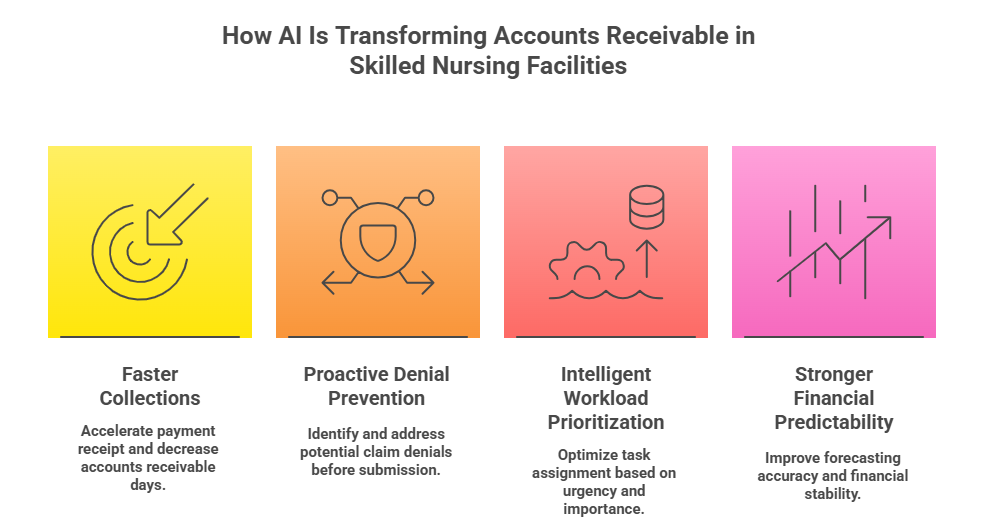
Faster Collections and Reduced A/R Days
AI-driven A/R platforms automate labor-intensive processes such as eligibility verification, claim scrubbing, submission validation, and payer-specific follow-up. Clean claims are submitted faster and tracked systematically, significantly accelerating payment timelines. The result is faster payments for skilled nursing facilities and a sustained reduction in A/R days.
Proactive Denial Prevention
One of AI’s most valuable capabilities is its ability to prevent denials before they occur. By analyzing historical denial patterns across payers, patient profiles, and service types, AI identifies potential risk factors at the claim level. Errors and omissions are flagged prior to submission, dramatically reducing lost revenue and directly supporting efforts to reduce bad debt in skilled nursing facilities.
Intelligent Workload Prioritization
AI-powered collection management for SNFs assigns predictive risk scores to every claim, estimating the likelihood of denial, delay, or non-payment. This enables billing teams to focus their attention where it matters most—high-value and high-risk claims—while low-risk claims move through automated workflows. The result is a significant improvement in accounts receivable efficiency using healthcare AI.
Stronger Financial Predictability
By minimizing preventable denials, accelerating reimbursements, and standardizing follow-up processes, AI delivers tangible benefits for SNF cash flow. Finance leaders gain improved forecasting accuracy, reduced write-offs, and the financial stability required to plan confidently for staffing, growth, and care quality improvements.
Practical Use Cases: AI-Powered A/R Management in Action
The real value of accounts receivable automation for skilled nursing becomes evident when applied across daily operational workflows.
Automated Eligibility Verification and Authorization Tracking
AI continuously validates patient eligibility and monitors authorization status from admission through discharge. This capability prevents common downstream issues such as retroactive denials caused by coverage lapses or expired authorizations.
Intelligent Follow-Up Scheduling
Rather than relying on static follow-up intervals, AI determines the optimal timing, channel, and escalation path for each payer. Automated A/R processes for SNFs ensure follow-ups are timely, compliant, and aligned with payer-specific reimbursement behavior.
Recovery of Aging A/R Backlogs
For facilities burdened by legacy A/R, AI can rapidly analyze years of historical data to identify claims that remain recoverable. This enables organizations to unlock hidden revenue and demonstrates the effectiveness of AI for maximizing SNF revenue recovery.
Early Bad Debt Risk Identification
Machine learning models assess patient financial profiles, payer behavior, and historical trends to predict non-payment risk. Facilities can intervene early with payment plans or financial counseling, reducing reliance on external collections and further lowering bad debt exposure.
| Capability | Manual A/R Management | AI-Assisted A/R Management |
|---|---|---|
| Claim Prioritization | Based on aging or dollar value alone | Predictive risk-based prioritization |
| Denial Handling | Manual research and appeal preparation | Automated root cause analysis and alerts |
| Follow-Up Consistency | Staff-dependent and inconsistent | Automated, payer-specific triggers |
| Cash Flow Predictability | Slow and volatile | Faster, stable, and forecastable |
| Operational Cost | High labor dependency | Lower costs through automation |
| Recovery Rate | Significant write-offs | Reduced A/R days and debt |
Take Control of Your Revenue Cycle
The financial health of a Skilled Nursing Facility depends directly on its ability to manage accounts receivable with precision and foresight. Leveraging technology to optimize skilled nursing billing through AI is no longer a future consideration—it is a strategic necessity.
By adopting AI-driven A/R solutions, SNFs can move beyond reactive collections and build a proactive, insight-driven revenue cycle. The outcome is predictable cash flow, reduced financial risk, and the operational freedom to focus on what truly matters: delivering exceptional resident care.
Author – Nidhi Vyawahare
Read our next blog – Click here