

The accounts payable (AP) function is central to an organization’s financial health. It ensures vendors are paid accurately, cash flow is controlled, and compliance risks are minimized. Yet for many organizations including highly regulated industries such as healthcare AP still relies on processes that are slow, manual, and error-prone.
Early digitization efforts introduced Optical Character Recognition (OCR) to convert paper invoices into digital text. While OCR reduced paper handling, it did little to eliminate manual review, corrections, and approval delays. Today, finance teams are moving beyond basic digitization toward intelligent invoice processing powered by artificial intelligence. This evolution is redefining how accounts payable automation delivers speed, accuracy, and strategic value
Why Accounts Payable Automation Matters
Traditional accounts payable workflows involve multiple steps: invoice receipt, data entry, matching against purchase orders, approvals, and payment execution. When handled manually, this process introduces friction at every stage. Errors in data entry, misplaced documents, approval bottlenecks, and delayed payments are common outcomes.
Automation addresses these issues by replacing repetitive manual tasks with structured, digital workflows. When intelligence is added through AI, automation does more than speed up processing—it enforces controls, improves accuracy, and provides financial visibility that was previously unavailable.
Limitations of Traditional OCR-Based AP Systems
OCR was an important first step in AP modernization, but it has clear limitations. OCR focuses on reading text, not understanding it. Variations in invoice layouts, inconsistent vendor formats, and missing data often require human intervention to correct errors and route invoices properly.
As a result, teams using OCR-only systems still spend significant time validating data, resolving exceptions, and manually managing approvals. These limitations prevent organizations from achieving consistent accuracy, predictable cycle times, or meaningful financial insights.
The Shift to Intelligent Invoice Processing
Intelligent invoice processing represents a fundamental change in how AP operates. Instead of relying on static templates, AI-powered systems understand invoice context, learn vendor patterns, and validate data automatically.
Machine learning enables invoices to be processed accurately regardless of format. Matching against purchase orders and receipts happens in real time. Approval workflows adapt dynamically based on business rules and historical behavior. Exceptions are identified early, allowing finance teams to intervene only when necessary.
This intelligence transforms accounts payable from a transactional function into a source of operational and financial insight.
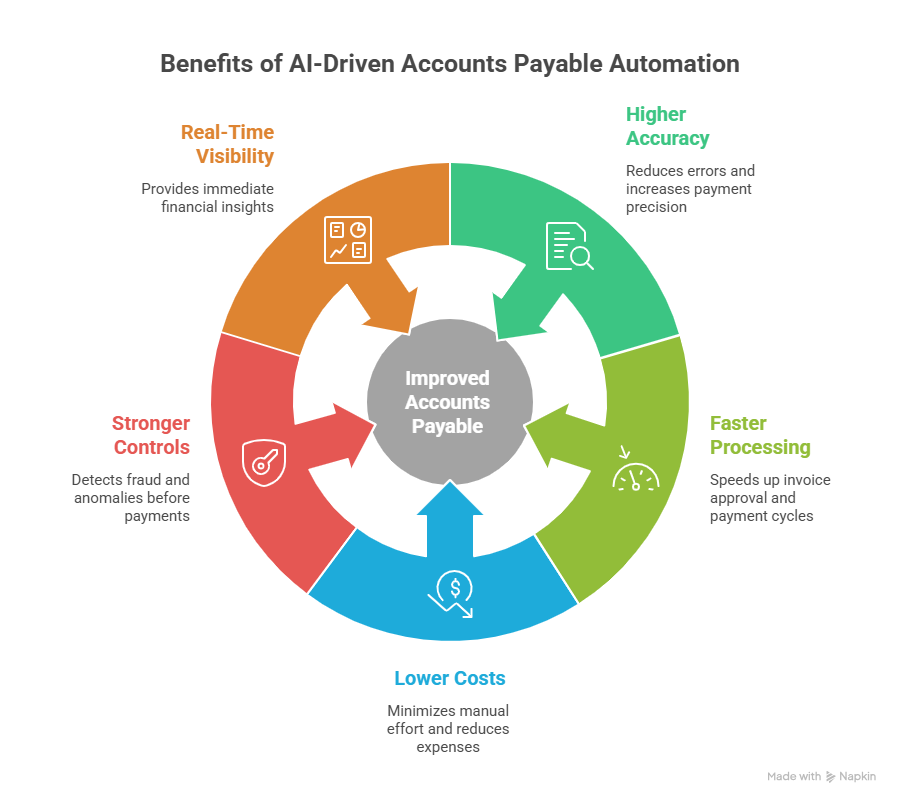
Key Benefits of AI-Driven Accounts Payable Automation
Higher Accuracy
AI dramatically reduces data entry errors and mismatches, improving payment accuracy and vendor trust.
Faster Processing
Automated validation and routing shorten approval cycles, enabling faster invoice turnaround and on-time payments.
Lower Operating Costs
By minimizing manual effort, organizations reduce the cost per invoice and free staff to focus on higher-value work.
Stronger Risk and Fraud Controls
AI continuously analyzes transaction patterns to detect anomalies, duplicate invoices, and potential fraud before payments are released.
Real-Time Financial Visibility
Finance leaders gain immediate insight into liabilities, payment status, and cash requirements, supporting better forecasting and decision-making.
Traditional OCR vs. Intelligent AP Automation
| Area | Traditional OCR | Intelligent Invoice Processing |
|---|---|---|
| Data capture | Text extraction only | Context-aware data understanding |
| Error handling | Manual validation required | Automated validation and correction |
| Workflow | Manual routing | Dynamic, automated routing |
| Visibility | Limited | Real-time insights and analytics |
| Scalability | Constrained by staff | Scales without proportional headcount |
Industry Impact: Accounts Payable in Healthcare
Healthcare organizations manage high volumes of complex invoices while operating under strict compliance requirements. Manual AP processes increase the risk of payment delays, coding errors, and audit exposure.
Intelligent AP automation enables healthcare finance teams to accurately process invoices for supplies, equipment, and services, while maintaining strong controls and audit readiness. Automated matching, coding validation, and approval routing ensure accuracy without slowing down operations—protecting both financial performance and patient care continuity.
Industry Impact: Accounts Payable in Healthcare
Healthcare organizations manage exceptionally complex payables medical supplies, pharmaceuticals, equipment, and services across multiple facilities. AI-driven AP systems automatically classify invoices, validate compliance requirements, and ensure accurate allocation across departments and cost centers.
This level of automation helps healthcare finance teams maintain financial continuity, meet regulatory expectations, and support uninterrupted patient care.
Author – Pradeep Dhakne
Read our next blog – Click here