
In the demanding financial environment of Skilled Nursing Facilities (SNFs), managing Accounts Receivable (A/R) is critical for operational stability. Historically, SNF accounts receivable have been characterized by complexity, high denial rates, and lengthy payment cycles, all contributing to high A/R days and stressed cash flow. Today, however, the industry is witnessing a significant evolution, powered by artificial intelligence. Modern AI accounts receivable SNF solutions are fundamentally changing A/R recovery strategies for skilled nursing facilities, moving facilities from reactive chasing of payments to proactive financial health management. This transformation is key to ensuring long-term financial viability and improved resident care.
The Problem: Why Traditional SNF A/R Management Is Failing
Skilled Nursing Facilities face unique billing hurdles that traditional, manual processes are ill-equipped to handle, leading to persistent challenges:
1. Complexity of Payers
SNFs must navigate a labyrinth of billing rules for Medicare, Medicaid, managed care organizations, and private insurance. Keeping up with constantly changing regulations manually is nearly impossible, resulting in frequent errors and delays in processing.
2. High Denial Rates
Denials—often due to minor administrative mistakes, authorization lapses, or incomplete documentation—force billing staff into time-consuming appeal processes. These appeals contribute to the SNF billing challenges and AI is now addressing this core issue.
3. Inefficient Prioritization
Without data-driven insights, staff spend equal time on all aging claims, regardless of the likelihood of payment. This leads to burnout and a stagnation of the overall revenue cycle, hindering efforts to improve accounts receivable in skilled nursing.
4. Slow Cash Flow
The combination of manual processing, high denial volumes, and inefficient follow-up results in longer A/R days in long-term care, preventing facilities from securing the cash flow necessary for operations and capital improvements.
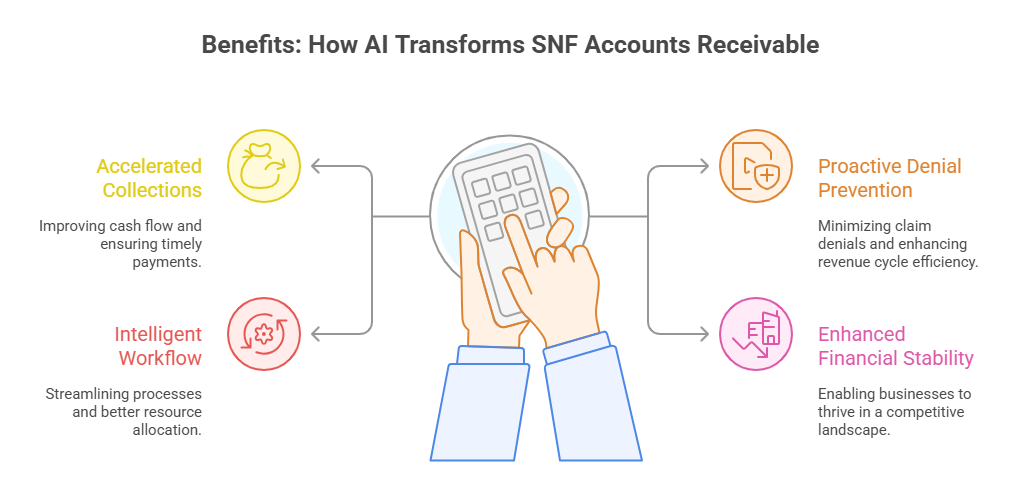
Benefits: How AI Transforms SNF Accounts Receivable
The implementation of AI in SNF financial operations provides a powerful solution to these deep-seated problems. AI doesn’t just automate tasks; it applies machine learning to massive datasets to predict outcomes and optimize workflows, fundamentally changing how AI transforms SNF accounts receivable.
- Accelerated Collections and Lower A/R Days:
AI drastically reduces the time between service delivery and payment. By automating verification, claim scrubbing, and follow-up, AI accounts receivable SNF tools ensure clean claims are submitted faster, contributing directly to lower A/R days in long-term care. - Proactive Denial Prevention:
AI systems analyze historical denial data across specific payers, identifying patterns and flagging potential errors before claim submission. This AI implementation in the skilled nursing revenue cycle dramatically reduces lost revenue, achieving better reducing bad debt for skilled nursing facilities. - Intelligent Workflow:
AI uses predictive analytics for SNF A/R to score claims based on the probability of payment and the urgency required. This enables staff to prioritize high-value, high-risk accounts, maximizing accounts receivable efficiency healthcare AI.
- Enhanced Financial Stability:
By accelerating payment and minimizing losses from bad debt, the benefits of AI for SNF cash flow are tangible, providing the financial predictability skilled nursing homes desperately need.
Use Cases: AI-Powered Collection Management SNF in Action
Effective use of AI translates into specific operational improvements:
1. Automated Eligibility Checks
AI instantly verifies patient coverage and authorization details at admission, catching errors that often lead to denials later in the cycle.
2. Smart Follow-Up Scheduling
AI determines the optimal time and method for pursuing outstanding balances from various payers and responsible parties, essentially providing an automated A/R process for SNFs.
3. Revenue Recovery Maximization
For aging A/R, AI sifts through large backlogs to identify claims that are still reworkable and recoverable, demonstrating AI for maximizing SNF revenue recovery.
4. Bad Debt Prediction
Machine learning models predict which patient accounts have the highest risk of non-payment, allowing facilities to initiate financial counseling or early payment plans, minimizing the transition to costly third-party collections.
Comparison: Manual vs. AI-Assisted A/R Management
| Feature | Manual A/R Management | AI-Assisted A/R Management |
|---|---|---|
| Claim Prioritization | Based on age (oldest) or highest dollar amount; often misses critical deadlines. | Based on predictive risk score; maximizes resources for highest probability of payment. |
| Denial Resolution | Time-intensive manual investigation, documentation, and appeal filing. | Automated root cause analysis; instant alerts; often features one-click appeal generation. |
| Follow-Up | Dependent on staff bandwidth; irregular and prone to human error. | Systematic, automated follow-up triggers based on payer rules and expected payment dates. |
| Cash Flow | Slow, unpredictable, and vulnerable to staff turnover. | Faster, reliable, and predictable due to process standardization and acceleration. |
Taking Control of Your Revenue Cycle
The financial stability of a Skilled Nursing Facility hinges on its ability to effectively manage accounts receivable. By embracing accounts receivable automation for skilled nursing, facilities can transition from simply managing debt to strategically boosting revenue for skilled nursing homes. AI is the engine driving this change, providing the actionable insights and efficiency needed for modern financial success.
Author – Sushrut Ujjainkar
Read our next blog – Click here