

How Generative AI & Machine Learning Are Transforming Fax Processing in SNFs
The Challenge of Document Chaos in Skilled Nursing Facilities
Skilled Nursing Facilities (SNFs) play a critical role in the healthcare ecosystem, yet they continue to struggle with an overwhelming volume of incoming documents. Patient information, referral packets, physician orders, lab results, and billing statements still arrive largely via fax—even in today’s digital environment.
While eFax has eliminated paper, it has not eliminated manual work.
Clinical and administrative staff must still open, read, classify, and route every fax. This manual process is time-consuming, error-prone, and costly. Misfiled documents, delayed admissions, and billing backlogs directly impact patient care, compliance, and revenue cycle performance.
In many SNFs, a significant portion of faxed data is incomplete or unusable—highlighting the urgent need for smarter document management.
Why Is AI-Powered Fax Classification Important for SNFs?
Healthcare today demands speed, accuracy, and compliance, especially with Medicare and Medicaid regulations. Manual fax processing cannot keep pace with operational demands or regulatory expectations.
This is where Intelligent Automation, powered by Generative AI and Machine Learning, enables true SNF digital transformation—by fundamentally changing how incoming eFaxes are processed.
How Generative AI Is Transforming eFax Classification in SNFs
What Is Generative AI eFax?
Generative AI takes fax automation beyond basic rules and templates. Once OCR (Optical Character Recognition) converts fax images into machine-readable text, Generative AI analyzes the document’s context and meaning.
This allows the system to:
- Accurately classify complex, multi-page documents
- Understand unstructured and poorly formatted faxes
- Handle diverse document types with human-like comprehension
Why use Generative AI for eFax in skilled nursing facilities?
Because it delivers significantly higher accuracy—especially for documents that traditional automation struggles to interpret.
The Role of Machine Learning in SNF Fax Classification
How Does Machine Learning Improve eFax Processing?
Machine Learning (ML) acts as the backbone of automated fax classification in SNFs. Using predictive analytics and historical learning, ML models continuously improve their ability to distinguish between document types—such as therapy notes, insurance verifications, or physician orders.
Key advantages of Machine Learning fax classification include:
- Continuous improvement over time
- Faster initial triage and routing
- Reduced dependency on manual review
Can ML reduce manual work in SNF eFax processing?
Yes. ML automates document identification and routing at scale, allowing facilities to process high fax volumes efficiently.
What are the benefits of Generative AI for SNF eFax workflows?
By automating document triage and classification, AI significantly reduces administrative burden. Staff who previously spent nearly half their time on documentation can refocus on patient care and clinical decision-making—helping reduce burnout and improve job satisfaction.
Enhanced Accuracy and Regulatory Compliance
AI-powered classification drastically lowers the risk of misfiling, missing, or delaying critical documents. This consistency supports Medicare and Medicaid eFax compliance and strengthens audit readiness during admissions and care transitions.
Faster Revenue Cycle Management
With Generative AI revenue cycle automation, billing documents such as EOBs, prior authorizations, and payor communications are instantly classified and routed. This reduces processing delays, improves cash flow, and shortens reimbursement cycles.
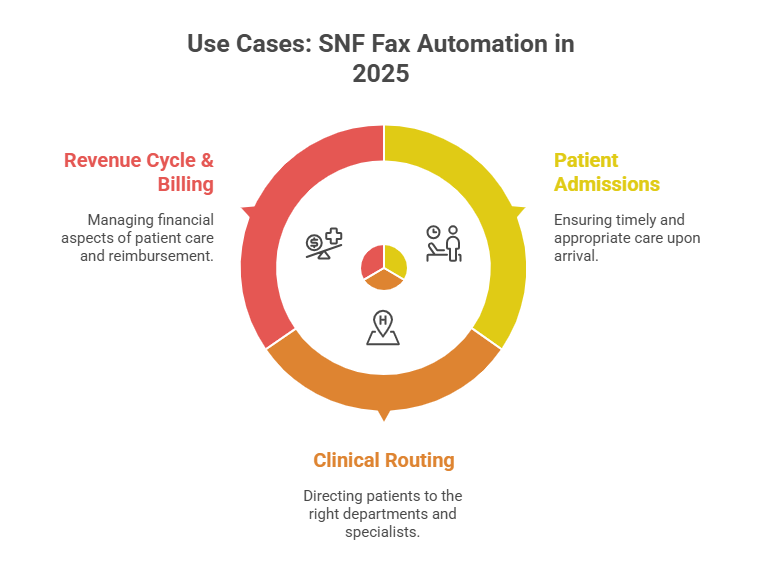
Use Cases: SNF Fax Automation in 2025
- Patient Admissions
AI instantly identifies key admission documents—discharge summaries, insurance cards, referral forms—and routes them to admissions teams, dramatically accelerating intake.
- Clinical Routing
Physician orders, lab results, and patient updates are automatically classified and delivered to the appropriate nursing teams in real time—ensuring faster clinical action.
- Revenue Cycle & Billing
Payor faxes, EOBs, and authorization requests are classified using NLP and OCR, then sent directly into billing systems—minimizing delays and manual entry.
Manual vs. Automated eFax Processing in SNFs
| Feature | Manual eFax Process | Automated eFax Process (AI-Powered) |
|---|---|---|
| Document Identification | Manual review by staff | AI-driven intelligent classification |
| Routing | Emailing, printing, hand delivery | Automated routing using AI rules |
| Processing Time | Minutes per document | Seconds per document |
| Error Rate | High risk of misfiling | Significantly reduced errors |
| Staff Focus | Administrative tasks | Patient care and clinical decision-making |
Transform Your SNF Workflow Today
The future of healthcare operations is intelligent, automated, and AI-driven. By adopting Generative AI and Machine Learning for eFax classification, Skilled Nursing Facilities can eliminate document chaos, strengthen compliance, and dramatically improve operational efficiency.
Empower your teams. Accelerate admissions. Optimize revenue cycles.
Author – Sushrut Ujjainkar
Read our next blog – Click here