

Singapore has established itself as one of Asia’s leading business hubs, hosting multinational corporations, regional headquarters, and fast-growing local enterprises. Companies operating from Singapore are often responsible for multi-country operations across Southeast Asia, making the need for efficient, compliant, and transparent procure-to-pay (P2P) processes more critical than ever. With strict Goods and Services Tax (GST) compliance requirements, pressure for accurate audit reporting, and the necessity to collaborate with both local and regional suppliers, enterprises in Singapore face unique challenges when implementing P2P systems.
This blog explores the common challenges Singaporean enterprises encounter, the issues that undermine procurement and finance efficiency, and the strategies that can help organizations resolve them.
The Regional Context of P2P in Singapore
As a financial and trade hub, Singapore imposes high standards of compliance and accountability. Enterprises must ensure that procurement and payment processes align with GST rules while also adhering to stringent audit frameworks. Moreover, given their role in managing multi-country supply chains, enterprises often need to coordinate with a diverse supplier base that includes both local SMEs and global vendors. Without streamlined systems, this complexity leads to inefficiencies, compliance risks, and strained supplier relationships.
Key P2P Challenges for Singapore Enterprises
- Fragmented Approval Workflows
Many organizations still rely on email-based approvals with unclear authority matrices. This creates bottlenecks, slows down invoice processing, and weakens financial control. - Inaccurate Coding
Errors in expense allocation or incorrect general ledger coding during invoice capture complicate financial reporting and increase audit vulnerabilities. - Insufficient Supplier Participation
Some suppliers, particularly SMEs, are hesitant to adopt digital portals or electronic invoicing tools. This limits automation and forces enterprises to maintain manual, paper-based processes. - GST Invoice Validation Errors
Invoices with missing or incorrect GST information can result in rejections, delayed input tax credit claims, and compliance risks.
Common P2P Issues in Practice
- Delayed Approvals: Bottlenecks in workflows lead to late payments, missed early-payment discounts, and strained supplier relationships.
- Duplicate Payments: Poor controls and manual processes increase the likelihood of duplicate invoices slipping through.
- Audit Vulnerabilities: Fragmented systems and incomplete data trails undermine transparency, exposing enterprises to compliance risks.
How P2P Solutions Address These Challenges
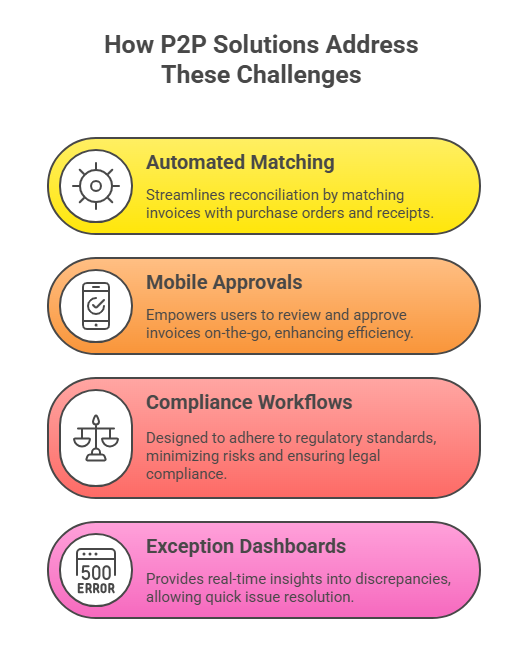
Modern P2P solutions offer a suite of tools tailored to Singapore’s business environment:
Automated Invoice Matching
By automating three-way matching between purchase orders, goods receipts, and invoices, enterprises can minimize errors, accelerate cycle times, and ensure compliance with GST requirements.
Mobile-Enabled Approvals
With mobile accessibility, managers can approve requisitions and invoices anytime, reducing approval delays and ensuring smooth workflows even during travel or remote work.
Compliance-Ready Workflows
GST rules and audit requirements can be embedded directly into P2P workflows, ensuring every transaction is validated in real time. This reduces audit risks and supports faster input tax recovery.
Exception Management Dashboards
Dashboards provide visibility into bottlenecks, mismatches, or compliance risks, enabling finance leaders to take proactive measures and maintain control.
Best Practices for P2P Success in Singapore
Enterprises in Singapore can achieve long-term P2P success by adopting the following best practices:
- Maintain Clean Vendor Masters
Accurate vendor data—covering GST registration numbers, bank details, and contact information—is the foundation of compliance and efficiency. Regular cleansing eliminates duplicates and reduces payment errors. - Run Test Cases for Compliance
Before rolling out automation at scale, enterprises should run test cases simulating GST validations, exception handling, and audit scenarios. This ensures that workflows are both robust and compliant. - Adopt SLA-Based Playbooks
Defining clear service level agreements (SLAs) for approvals and exception handling creates accountability. Playbooks help teams resolve mismatches quickly and consistently. - Integrate Supplier Portals
Supplier portals encourage participation by offering self-service features such as invoice uploads, payment tracking, and master data updates. This improves collaboration, strengthens trust, and reduces disputes.
Enterprises in Singapore face a unique set of P2P challenges arising from fragmented workflows, supplier participation gaps, and stringent GST compliance requirements. Issues such as delayed approvals, duplicate payments, and audit vulnerabilities can undermine efficiency and financial control. However, by implementing P2P solutions—automated invoice matching, mobile-enabled approvals, compliance-ready workflows, and dashboards for exception management—organizations can address these issues effectively.
Best practices such as cleansing vendor masters, running compliance test cases, adopting SLA-based playbooks, and integrating supplier portals ensure that enterprises in Singapore not only overcome P2P challenges but also unlock long-term value through greater efficiency, compliance, and supplier collaboration. For procurement directors, CFOs, and finance leaders, investing in modern P2P systems is no longer optional—it is essential to staying competitive in Singapore’s dynamic business landscape.
Read our next blog – Click here