Complete Guide · Clinical Intake Operations
Automating Clinical Data Extraction from Faxed Referrals: A Complete Guide for Intake Teams
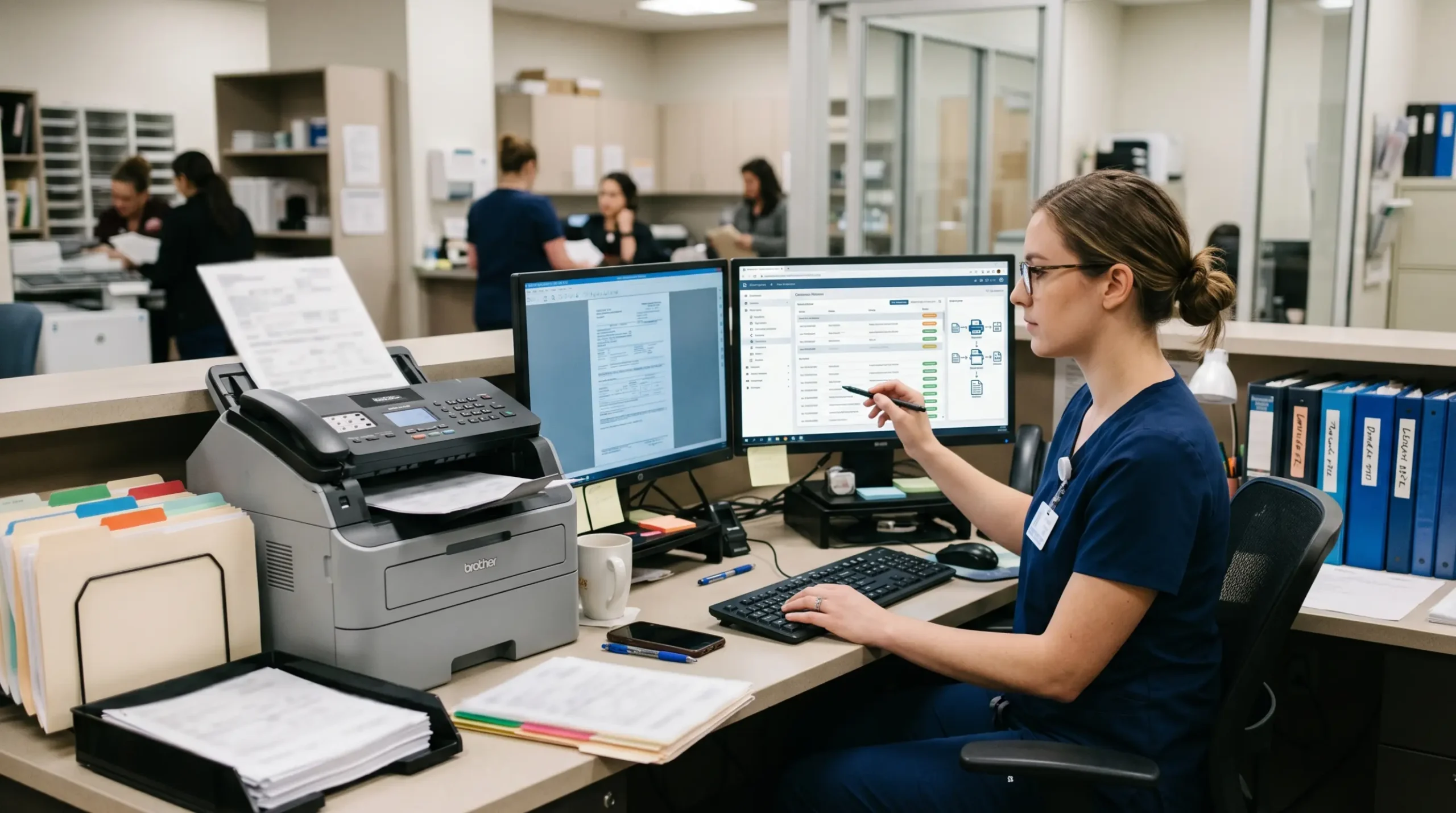
It is 2:30 PM. Three referrals just came in via fax. Your intake coordinator is on page eight of a twenty-six-page packet, manually pulling out diagnosis codes, medication lists, insurance details, and physician orders — all while the hospital case manager is waiting on a response. Sound familiar?
This is the daily reality for intake teams across skilled nursing facilities, palliative care organizations, and post-acute care settings. Faxed referrals are not going away anytime soon. But the way your team processes them absolutely can — and should — change.
Why Faxed Referrals Still Dominate Post-Acute Care Intake
Despite every advancement in healthcare technology, the fax machine remains the primary referral channel in post-acute and long-term care. Hospitals, physicians, and insurance coordinators still send patient information as multi-page fax documents — and intake teams are expected to process them quickly, accurately, and completely.
The problem is not the fax itself. The problem is what happens after it arrives.
Documents come in as unstructured, scanned images. Key clinical information is buried across multiple pages in inconsistent formats. There is no standard layout, no guaranteed order, and no system automatically telling your team where to look. Everything depends on a person reading every single page — manually.
The Real Cost of Manual Clinical Data Extraction
Manual extraction is slow, and in post-acute care, slow has consequences. Every hour your team spends manually reading through faxed referral packets is an hour not spent on clinical coordination, family communication, or relationship building with referral sources.
When referral volume spikes — and it always does — the manual process becomes a bottleneck that delays admissions, frustrates hospital partners, and puts real pressure on your staff.
What Automating Clinical Data Extraction Actually Looks Like
AI-powered clinical data extraction works by combining optical character recognition (OCR) with natural language processing (NLP) to read faxed documents the way a trained human would — just significantly faster and without fatigue.
When a faxed referral arrives, the system ingests the document automatically. It then identifies and extracts the data points your intake team needs most:
- Primary diagnosis and secondary conditions
- Current medications and dosage details
- Functional status and therapy requirements
- Insurance and payer information
- Physician orders and care instructions
- Relevant lab results and clinical notes
This information is organized into a clean, structured summary and surfaced for your team within minutes of the fax arriving. No more page-by-page manual review. No more hunting for information across inconsistent document layouts. Your intake coordinator receives a structured clinical snapshot — and can make a faster, better-informed decision.
How Intake Teams Benefit Beyond Just Speed
The most immediate benefit is time. Referral review that previously took one to two hours per packet can be completed in a fraction of that time. That speed directly improves your referral response rate and strengthens relationships with hospital discharge teams who need answers quickly.
But the benefits go well beyond speed. Automated extraction brings consistency to a process that is currently entirely dependent on individual staff members. Every referral gets reviewed with the same thoroughness regardless of volume, time of day, or staff experience level. High-acuity patients are flagged automatically. Missing documentation is identified before it causes downstream delays. Insurance information is captured accurately from the first touch — reducing the authorization errors that lead to claim denials later.
For administrators, this means better pipeline visibility, stronger compliance documentation, and a team that is not burning out by midweek. For staff, it means less cognitive overload and more time for the work that actually requires human judgment and compassion.
Getting Started With Fax Referral Automation in Your Facility
You do not need to overhaul your entire intake workflow to start seeing results. The most effective implementations begin with a clear understanding of where manual extraction is causing the most friction.
Start by mapping your current fax-to-admission process. Identify exactly where time is being lost and where errors most commonly occur. From there, evaluate AI extraction tools based on their ability to integrate with your existing EHR and admissions platform, their accuracy with unstructured clinical documents, and the quality of support they provide during implementation.
Pilot the solution on a defined referral type before expanding facility-wide. Set clear benchmarks — referral response time, extraction accuracy, staff hours saved — and measure against them consistently.