
Skilled Nursing Facilities (SNFs) play a critical role in post-acute care, yet their day-to-day operations are often constrained by outdated administrative workflows. While many facilities have adopted digital systems, the reality on the ground tells a different story. Large volumes of inbound documents physician orders, lab results, referral packets, insurance verifications, authorizations, and billing paperwork still require extensive manual handling.
This dependence on manual document intake and routing creates operational bottlenecks, increases compliance risk, strains staff, and slows the revenue cycle. Understanding the core problems in traditional SNF management systems is essential to identifying a more sustainable and efficient path forward.
The Operational Reality Inside Most SNFs
Despite investments in EHRs and billing systems, document flow remains one of the weakest links in SNF operations. Much of the information that drives admissions, care delivery, and reimbursement continues to arrive through electronic fax or scanned documents. Staff are required to open, read, identify, and route each document manually.
This process may appear manageable at low volumes, but at scale it introduces systemic risk.
Common Pitfalls in Traditional SNF Management Workflows
Delayed Admissions and Care Initiation
Referral packets and transfer summaries often sit unprocessed due to intake backlogs. Every delay in document review postpones admissions, impacts census, and slows the start of care.
Increased Error and Compliance Risk
Manual classification leads to misfiled or overlooked documents. Missing authorizations, delayed physician orders, or misplaced clinical records can expose facilities to compliance violations and audit risk.
Staff Burnout and Inefficiency
Highly trained clinical and administrative staff spend hours on repetitive document sorting rather than patient care or decision-making. Over time, this contributes to burnout and turnover.
Revenue Cycle Slowdowns
Billing-related documents such as EOBs, prior authorizations, and payer correspondence are frequently delayed in reaching finance teams. This directly impacts claim submission timelines and cash flow.
These challenges persist not because staff are ineffective, but because the systems supporting them are no longer fit for the volume and complexity of modern SNF operations.
Moving Beyond Basic Digitization
Simply scanning paper or receiving documents electronically does not solve the problem. Digitization without intelligence still relies on human effort to interpret and route information.
A smarter SNF management approach focuses on automating document understanding, not just document storage.
Modern SNF platforms now apply advanced automation to recognize document types, extract relevant data, and route information automatically to the correct clinical, administrative, or billing workflows. This fundamentally changes how work flows through the facility.
What a Smarter SNF Management System Looks Like
A next-generation SNF management system treats document intake as an automated front-end process rather than a manual task.
Instead of staff deciding what a document is and where it belongs, the system identifies it immediately upon arrival. Physician orders, lab results, referrals, insurance documents, and billing correspondence are recognized and routed without delay.
Key capabilities include:
- Automatic identification of document type
- Extraction of critical patient and payer information
- Rule-based routing to admissions, nursing, pharmacy, or billing teams
- Seamless handoff into existing EHR and financial systems
This approach reduces processing time from minutes to seconds while dramatically lowering error rates.
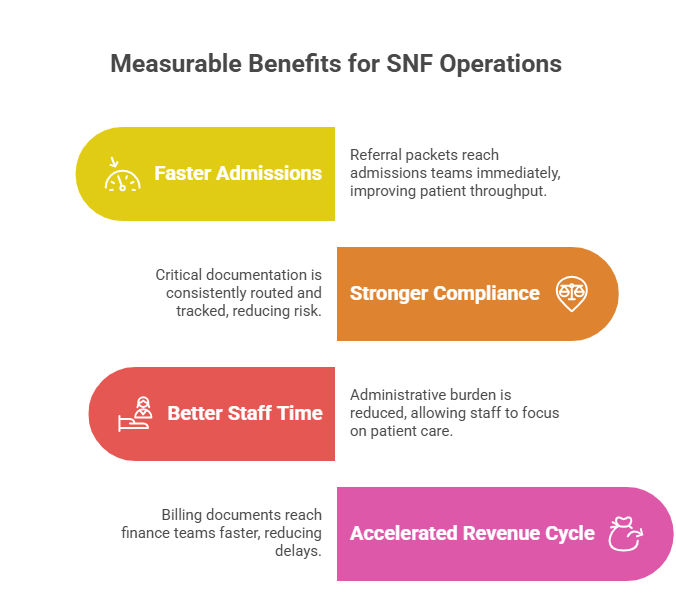
Measurable Benefits for SNF Operations
Facilities that modernize document workflows experience improvements across every major operational area.
Faster Admissions and Improved Census
Referral packets and intake documents reach admissions teams immediately, reducing delays and improving patient throughput.
Stronger Compliance and Audit Readiness
Critical documentation is consistently routed and tracked, reducing the risk of missing authorizations or required clinical records.
Better Use of Staff Time
Administrative burden is reduced, allowing staff to focus on patient care, care coordination, and exception management rather than document sorting.
Accelerated Revenue Cycle
Billing documents reach finance teams faster, reducing delays in claim submission and reimbursement.
These gains compound over time, creating a more resilient and scalable operation.
Practical Use Cases Inside SNFs
Clinical Operations
Physician orders, lab reports, and care updates are delivered directly to nursing or pharmacy workflows, reducing turnaround time and improving care coordination.
Admissions and Intake
Referral packets and insurance verifications are routed instantly to intake teams, enabling faster admission decisions and smoother patient transitions.
Billing and Reimbursement
Payer communications, EOBs, and authorization requests are directed straight into billing workflows, reducing manual entry and follow-up delays.
Importantly, these improvements do not require replacing existing systems. Modern SNF platforms integrate with current EHRs and financial systems, enhancing them rather than disrupting them.
Manual vs. Automated Document Processing
| Area | Manual Processing | Automated Processing |
|---|---|---|
| Document identification | Human review | Instant system recognition |
| Routing | Manual forwarding | Automatic routing |
| Processing Time | Minutes per document | Seconds per document |
| Error risk | High | Low |
| Staff effort | Administrative, repetitive work | Patient care and oversight |
A Smarter Way Forward for SNFs
SNF leaders are under growing pressure to improve efficiency, maintain compliance, and protect margins while delivering high-quality care. Manual document handling is no longer sustainable at scale.
A modern SNF management system must go beyond basic digitization and address the root cause of operational friction: unstructured document intake.
By adopting intelligent automation at the front end, facilities can eliminate document chaos, accelerate workflows, reduce risk, and create an operational foundation that supports both clinical excellence and financial stability.
The smarter way forward is not adding more staff or more manual checks—it is redesigning how information flows through the organization.
Author – Pradeep Dhakne
Read our next blog – Click here