

Electronic Medical Records (EMRs) are central to daily operations in Skilled Nursing Facilities (SNFs). From clinical documentation and care coordination to billing and compliance, EMRs are meant to simplify work and improve outcomes. Yet for many SNFs, EMRs operate in isolation disconnected from billing systems, staffing tools, analytics platforms, and other operational technologies.
This disconnect is where SNF EMR integration becomes critical.
SNF EMR integration refers to the ability of an EMR system to seamlessly exchange data with other clinical, operational, and financial systems used by a skilled nursing facility. When done correctly, integration improves workflows, reduces manual effort, and supports better decision-making. When done poorly, it leads to inefficiencies, data errors, staff frustration, and missed opportunities for improvement.
This blog explores the problems, pitfalls, and a smarter way forward for SNFs navigating EMR integration.
Understanding SNF EMR Integration in Real-World Operations
At a practical level, SNF EMR integration ensures that patient, clinical, operational, and financial data flows automatically between systems without manual intervention.
Modern SNF EMR integration solutions often connect EMRs with:
- Billing and RCM systems
- Staffing and scheduling platforms
- Pharmacy and lab systems
- Analytics and reporting tools
- Admission, discharge, and transfer (ADT) systems
The goal is not simply technical connectivity, but workflow optimization across departments.
Why EMR Integration Remains a Challenge for SNFs
Despite advances in healthcare technology, EMR integration challenges in skilled nursing persist. Several factors contribute to this reality.
1. Disconnected Technology Ecosystems
Many SNFs use multiple vendors for clinical, financial, and operational needs. When these systems are not designed to work together, integration becomes complex and fragile.
2. Manual Data Entry Still Dominates
Without integration, staff must re-enter the same data into multiple systems. This increases the risk of errors, delays care coordination, and consumes valuable staff time.
3. Limited Interoperability
Not all EMR systems offer modern APIs or standardized data formats. This limits how easily SNF EMR integration workflows can be implemented or scaled.
4. Workflow Disruption During Implementation
Poorly planned integration projects can disrupt clinical and administrative workflows, leading to resistance from staff and leadership.
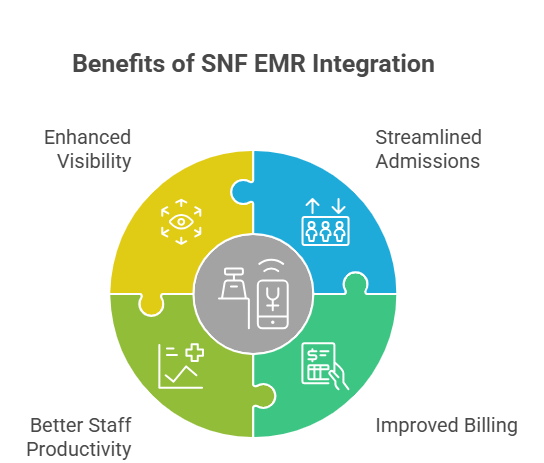
How SNF EMR Integration Improves Operational Efficiency
When implemented thoughtfully, SNF EMR integration workflow optimization delivers measurable benefits across the organization.
Streamlined Admissions and Documentation
Integrated systems reduce duplicate documentation and ensure patient data is available wherever it is needed—improving speed and accuracy during admissions and care transitions.
Improved Billing and Revenue Cycle Performance
Connecting EMRs with billing systems minimizes claim errors, reduces delays, and supports faster reimbursement.
Better Staff Productivity
Automation reduces administrative burden, allowing clinical and administrative teams to focus on patient care rather than data entry.
Enhanced Visibility for Leadership
Integrated data provides a unified view of operations, enabling better planning and decision-making.
Manual vs Automated SNF EMR Integration: Key Differences
| Area | Manual Processing | Automated EMR Integration |
|---|---|---|
| Data Entry | Repetitive, error-prone | Automated, consistent |
| Workflow Efficiency | Fragmented across teams | End-to-end visibility |
| Staff Time | High administrative burden | Reduced manual effort |
| Scalability | Difficult across locations | Easily scalable |
| Data Accuracy | Inconsistent | High reliability |
The Impact of EMR Integration on Patient Outcomes
One of the most important benefits of SNF EMR integration is its effect on patient outcomes.
Integrated EMR systems support:
- Faster access to accurate patient information
- Improved care coordination across teams
- Reduced risk of documentation errors
- Better compliance with care plans
By ensuring clinicians have timely and complete data, integration directly contributes to safer and more effective care delivery.
Choosing the Right SNF EMR Integration Approach
When evaluating SNF EMR integration solutions, facilities should focus on more than just technical compatibility.
Key considerations include:
- Ability to integrate with existing SNF systems
- Support for standardized data exchange
- Minimal disruption to clinical workflows
- Scalability for future growth
- Strong security and compliance controls
The best EMR systems for skilled nursing facilities are those that fit into the broader operational ecosystem rather than operating as standalone tools.
Why EMR Integration Is Becoming a Strategic Priority
As SNFs face growing regulatory pressure, staffing shortages, and margin constraints, disconnected systems become a liability. SNF EMR integration is increasingly viewed not just as an IT initiative, but as a strategic enabler.
Facilities that invest in integrated, automated workflows gain:
- Greater operational resilience
- Improved compliance readiness
- Better staff satisfaction
- Stronger financial performance
SNF EMR integration is no longer optional for facilities aiming to improve efficiency, care quality, and long-term sustainability. While many SNFs still rely on disconnected systems and manual workarounds, a smarter, automated integration approach can transform daily operations.
If your facility is struggling with fragmented workflows or manual data entry, it may be time to explore a more integrated approach to SNF EMR integration.
Author – Pramod Ishwarkatti
Read our next blog – Click here