Last Tuesday, I was sitting across from Priya at a small café near her office in Pune. She’d been running the AP department at a growing textile company for three years, and frankly, she looked exhausted. Her coffee had gone cold while she told me about the sleepless nights she’d been having.
“I keep thinking about what happened to my friend’s company in Mumbai,” she said, stirring her cup absent-mindedly. “They tried implementing some AP system last year. Complete disaster. Their ERP went down for two weeks. Vendors were calling every hour asking about payments.”
I’ve heard this story dozens of times. The fear is real, and honestly? It’s completely justified.
Why Most AP Implementations Are Complete Disasters
Look, I’m not going to sugarcoat this – most Accounts Payable automation projects are absolute nightmares. I’ve seen companies in Bangalore spend ₹75 lakhs on systems that never worked properly. One manufacturing company I know had to hire temporary staff for four months just to handle the backlog.
The pattern is always the same: promises of quick implementation, then months of delays, system crashes, angry vendors, and finance teams ready to quit. But here’s what really gets me – it’s not because AP automation is inherently complex. It’s because most companies approach it completely wrong.
How We Actually Do Things at ValueDX
When I started working with ValueDX, I was skeptical. Another AP automation company making big promises? But then I saw their first implementation, and I realized they’d figured out something everyone else was missing.
Instead of the usual “blow everything up and start over” approach, they do something brilliant – they build your new system alongside your old one. Sounds simple, right? But nobody else does it this way.
Your team keeps doing exactly what they’ve always done. Priya’s people were still processing invoices manually, vendors were still sending documents the same way, nothing changed. But in the background, ValueDX was setting up their entire automation system.
They mapped out how invoices flow through Priya’s company, figured out who approves what, and configured the system to handle all their GST and TDS requirements. All without touching their existing ERP.
“I keep thinking about what happened to my friend’s company in Mumbai,” she said, stirring her cup absent-mindedly. “They tried implementing some AP system last year. Complete disaster. Their ERP went down for two weeks. Vendors were calling every hour asking about payments.”
I’ve heard this story dozens of times. The fear is real, and honestly? It’s completely justified.
Why Most AP Implementations Are Complete Disasters
Look, I’m not going to sugarcoat this – most Accounts Payable automation projects are absolute nightmares. I’ve seen companies in Bangalore spend ₹75 lakhs on systems that never worked properly. One manufacturing company I know had to hire temporary staff for four months just to handle the backlog.
The pattern is always the same: promises of quick implementation, then months of delays, system crashes, angry vendors, and finance teams ready to quit. But here’s what really gets me – it’s not because AP automation is inherently complex. It’s because most companies approach it completely wrong.
How We Actually Do Things at ValueDX
When I started working with ValueDX, I was skeptical. Another AP automation company making big promises? But then I saw their first implementation, and I realized they’d figured out something everyone else was missing.
Instead of the usual “blow everything up and start over” approach, they do something brilliant – they build your new system alongside your old one. Sounds simple, right? But nobody else does it this way.
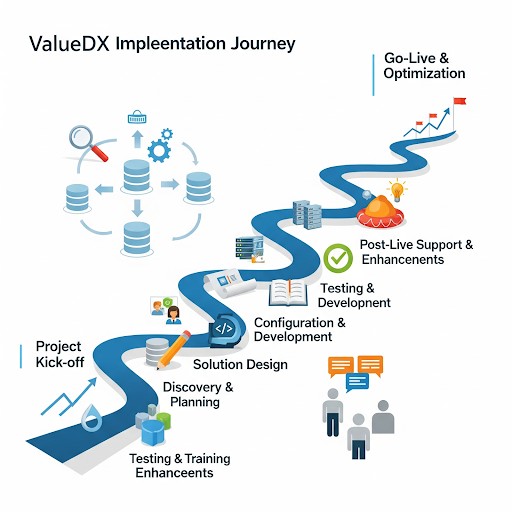
Week One: Building While You Sleep
Your team keeps doing exactly what they’ve always done. Priya’s people were still processing invoices manually, vendors were still sending documents the same way, nothing changed. But in the background, ValueDX was setting up their entire automation system.
They mapped out how invoices flow through Priya’s company, figured out who approves what, and configured the system to handle all their GST and TDS requirements. All without touching their existing ERP.
Weeks Two and Three: Testing in Parallel
This is where most implementations fall apart. Companies try to integrate everything at once, and chaos follows. ValueDX does the opposite – they create a perfect copy of your environment and test everything there first.
They processed hundreds of Priya’s old invoices through the new system, verified every GST calculation, tested every approval workflow. Meanwhile, business continued as usual.
Week Four: The Go-Live That Wasn’t
I was there the morning ValueDX flipped the switch. Honestly, it was almost boring. Vendors submitted invoices exactly like they always had – some through email, others through the web portal, a few even through WhatsApp.
But instead of someone manually typing data into spreadsheets, the system just… handled it. Priya called me that afternoon. “Wait, that’s it? We’re live?” She sounded almost disappointed there wasn’t more drama.
The Numbers That Actually Matter
Three months later, I visited Priya again. This time, she looked like a different person. Relaxed, confident, actually smiling when she talked about work.
Before ValueDX: processing invoices took 45 minutes each, costing ₹2.8 lakhs monthly in labor. GST and TDS errors happened 12-15 times every month. Vendors complained constantly about delays, and month-end closing took over a week.
After implementation: same invoices process in 3 minutes, costs dropped to ₹60,000 monthly. Compliance errors? Zero. Vendor complaints disappeared, and they close books in two days instead of eight.
But the real change wasn’t operational – it was psychological. Priya’s team went from being the department everyone avoided to being the efficiency heroes everyone wanted to learn from.
Beyond Go-Live: When Things Get Really Interesting
Most companies think implementation ends at go-live. That’s when the real value begins.
The system learns how your business works. By month three, accuracy goes from good to exceptional. Three-way matching happens without human intervention. Your Accounts Payable team stops doing data entry and starts doing actual analysis.
By month six, you’re making smarter financial decisions. You can see cash flow patterns you never noticed before, identify which vendors offer the best early payment discounts, and spot potential issues before they become problems.
The Support That Makes Everything Work
Here’s something that really impressed me about ValueDX – they don’t just hand you a system and disappear. When GST rates changed last year, Priya didn’t have to do anything. The system updated automatically. When new TDS rules came out, same thing – handled seamlessly.
Their support team understands Indian business requirements. When you call with a question, you’re talking to someone who actually gets it.
Why This Approach Actually Works
The secret isn’t just the technology – it’s the implementation philosophy. Instead of forcing your business to adapt to their system, they configure their system to work with your business.
No upfront fees, no hidden costs, no risk. They literally don’t get paid unless you see results. That kind of confidence only comes from knowing their approach works.
If you’re sitting where Priya was six months ago – worried about implementation disasters, concerned about downtime, afraid of vendor disruption – stop worrying. The technology exists today to make this transition smooth and risk-free.
Read our next blog – Click here