
You know what’s funny? Last Tuesday, I’m sitting in this tiny café in Koregaon Park, Pune, talking to Rajesh about his textile business. Poor guy looks exhausted – tells me he’s been up till 2 AM matching GST numbers again. His business is doing well, about 50 people, but he’s personally checking every single invoice because “automation is for big companies, not guys like me.”
Fast forward three hours, I’m on a Zoom call with this CFO from a massive Mumbai conglomerate. Fifteen thousand invoices a month, offices everywhere, the works. And guess what she asks me? “Are you sure your system can handle our scale? We’ve tried others and they just can’t cope.”
I’m sitting there thinking – seriously? Both these smart business people are asking me the same question, just from opposite ends!
The “Am I Big Enough?” Myth That’s Costing You Money
Look, I get it. I really do. When you’re running a smaller operation, you think Accounts Payable automation is this fancy thing only the big boys can afford. And when you’re running a large enterprise, you assume most solutions will buckle under your complexity.
But here’s what’s killing me – while everyone’s worrying about size, they’re hemorrhaging money on manual processes that make absolutely no sense in 2025.
Let me tell you what happened with Rajesh. We sat down with his books, and I nearly choked on my chai. This guy was paying his accounts team ₹50,000 every month just to push paper around. Fifty thousand! That’s not counting the times they messed up GST filings or missed early payment discounts because invoices got buried under paperwork.
Small Business, Big Problems (And Even Bigger Solutions)
“I can’t afford to automate,” Rajesh kept saying. I had to laugh – not at him, but at the situation. “Bro,” I said, “you can’t afford NOT to automate.”
Here’s what’s crazy about small to mid-size businesses – you guys are actually perfect for automation because every rupee counts. When we showed Rajesh how our system works, his first reaction was priceless: “Wait, it reads handwritten invoices too? In Marathi?”
I mean, come on. His local vegetable vendor writes bills in Marathi, his fabric supplier sends typed English invoices, and his transport guy emails photos of receipts. Traditional systems would have a heart attack. Our AI? It just processes everything like it’s no big deal.
What Rajesh got (and what every small business gets):
- No more staying up late for GST reconciliation
- WhatsApp invoice submissions (his vendors love this!)
- Automatic TDS calculations that actually work
- Zero upfront investment – we only get paid when he saves money
Three months later, Rajesh texts me: “Dude, my CA is shocked. Everything’s perfect, and I’m playing cricket again on weekends.”
Enterprise Headaches I’ve Seen (And Solved)
Now, about that Mumbai CFO – let’s call her Priya. At the first meeting, she hits me with this list: “We have suppliers in Gujarat who only write in Gujarati, vendors in Chennai with Tamil invoices, international suppliers with complex contracts, and our Bangalore office processes everything differently.”
I’m nodding along, thinking, “Lady, you just described our AI’s favorite breakfast.”
What really got her attention wasn’t our tech specs – it was when I told her about another enterprise client who went from 12 full-time Accounts Payable processors to 3 supervisors. Not because people got fired, but because those 9 people moved to strategic finance roles where they actually add value.
“You’re telling me,” Priya said, “that I can keep my team but make them do work that actually matters?”
Exactly.
The enterprise transformation looks like this:
- Month 1: System learns your unique supplier patterns
- Month 2: Processing speed increases 10x across all locations
- Month 3: Your Accounts Payable team becomes strategic advisors, not data entry clerks
- Month 6: You’re wondering why you waited so long
Why Size Really Doesn’t Matter (The Numbers Don’t Lie)
I’ve worked with everyone from 10-person startups to 10,000-employee corporations. You know what I’ve learned? The problems are identical – just the scale changes.
Whether you’re processing 50 invoices or 50,000, you’re dealing with:
- Vendors who can’t follow your “standard format” (newsflash: there’s no such thing)
- Compliance nightmares that keep you up at night
- Manual data entry that makes smart people do dumb work
- Cash flow visibility that’s somewhere between “poor” and “non-existent” Our AI doesn’t care if you’re small or large. It just works.
One participant shared how their automation partner set up the system in 10 days flat—zero downtime—and billed them only for invoices actually processed. “That’s when I knew they had skin in the game,” he said.
The message was clear: partners who demand heavy upfront fees are passing risk back to you. The real partners share the risk.
Manual vs. Automated – Straight from the room
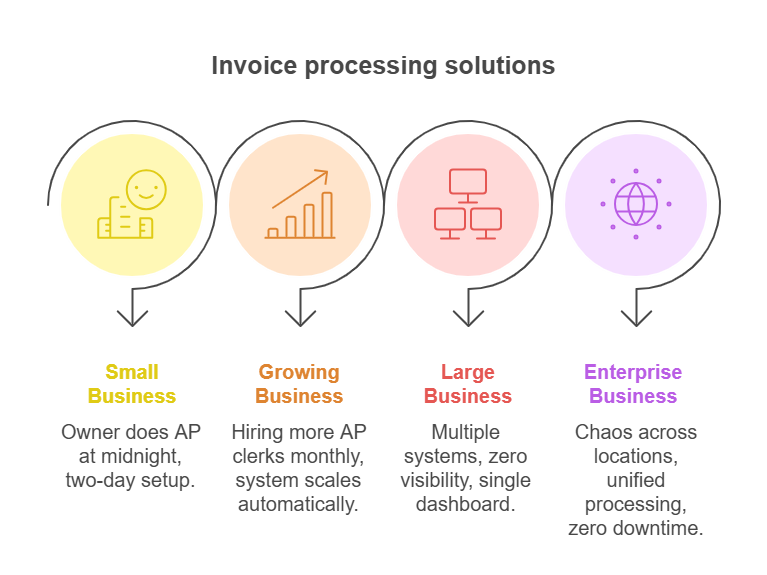
| Your Reality | Manual Hell | ValueDX Magic |
|---|---|---|
| Small Biz (50-500 invoices) | Owner doing AP at midnight | 2-day setup, immediate relief |
| Growing (500-2K invoices) | Hiring more AP clerks monthly | System scales automatically |
| Large (2K-10K invoices) | Multiple systems, zero visibility | Single dashboard, real-time insights |
| Enterprise (10K+ invoices) | Chaos across locations | SUnified processing, zero downtime |
The “Aha!” Moment That Changes Everything
Want to know when businesses really get it? It’s not when I show them fancy demos or share impressive metrics. It’s when they realize that they’re spending more money on manual processing than automation would cost.
Rajesh had his moment when he calculated that his weekend GST marathons were costing him ₹2,000 in overtime every month. “For ₹24,000 a year, I could have bought two bikes for my kids instead of buying headaches for myself.”
Priya’s moment came when she realized her 12-person AP team was essentially running a very expensive data entry service. “We’re paying ₹48 lakhs annually for work that AI can do in minutes.”
Traditional AP vs. AI-Powered Reality Check
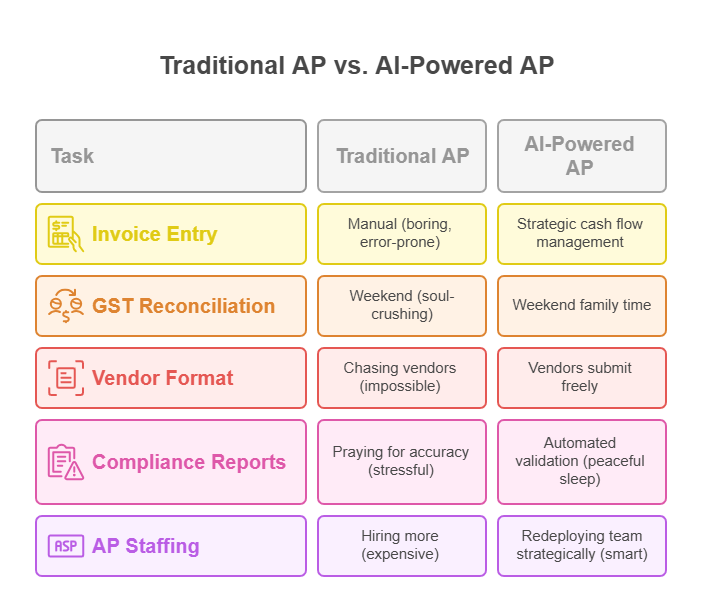
| What You’re Doing Now | What You Could Be Doing |
|---|---|
| Manual invoice entry (boring, error-prone) | Strategic cash flow management (interesting, profitable) |
| Weekend GST reconciliation (soul-crushing) | Weekend family time (life-changing) |
| Chasing vendors for correct formats (impossible) | Vendors submit however they want (liberating) |
| Praying compliance reports are right (stressful) | Automated compliance validation (peaceful sleep) |
| Hiring more AP staff (expensive) | Hiring more AP staff (expensive) Redeploying team strategically (smart) |
The Real Question You Should Be Asking
Here’s what I tell everyone, from Rajesh to Priya: Stop asking if you’re the right size for automation. Start asking if you’re ready to stop losing money, time, and sanity to manual processes.
Because honestly? If you’re processing invoices manually in 2025, you’re not too small for automation, you’re too smart to keep doing dumb work.
Last month, I got a message from a 15 person engineering firm in Bangalore: “We thought we were too small. Turns out, we were just small enough to see immediate impact.” Their Accounts Payable processing went from 8 hours weekly to 1 hour. That’s 7 hours of engineering brilliance returned to actual engineering.
Your Next Move (Spoiler: It’s Simpler Than You Think)
Look, I’m not going to give you some corporate sales pitch. Here’s the deal: ValueDX works for businesses our size because we built it that way. Whether you’re Rajesh with his growing textile business or Priya managing enterprise complexity, the system adapts to you.
No upfront costs. No complex implementations. No risk.
You start seeing results before you invest anything significant. If it works (and trust me, it will), you scale up. If somehow it doesn’t (hasn’t happened yet), you haven’t lost anything.
The only question left is: Are you ready to stop doing work that AI can do better, faster, and cheaper than humans?
Because your business size isn’t holding you back – your hesitation is.
Read our next blog – Click here