
The Reality of Manual RCM in US Healthcare
Across US healthcare organizations, revenue cycle teams are operating under increasing strain. Denial rates continue to rise, accounts receivable days stretch longer, and experienced billing staff are harder to retain. At the same time, payer rules change frequently, compliance expectations are tighter, and even small errors can lead to significant revenue leakage.
Many hospitals, physician groups, MSOs, and billing companies still rely heavily on manual RCM processes—spreadsheets, siloed systems, and labor-intensive workflows. While these methods may have worked in the past, they struggle to keep up with today’s complexity and volume.
This has led many healthcare leaders to ask a critical question: Is it time to move from manual revenue cycle management to automated RCM platforms? This blog breaks down that comparison and explains why automation is becoming essential in 2025.
Understanding Manual RCM vs. Automated RCM Platforms
Manual revenue cycle management relies on human-driven processes across patient access, coding, claims submission, denial handling, and AR follow-ups. These workflows often depend on individual expertise, repetitive data entry, and reactive issue resolution.
In contrast, automated RCM platforms use technology-driven workflows to manage the entire revenue cycle end to end. Rather than automating one task at a time, Healthcare RCM Automation connects front-end, mid-cycle, and back-end processes into a single, intelligent system.
The difference isn’t just speed—it’s consistency, visibility, and control across the full revenue lifecycle.
Side-by-Side Comparison: Automated RCM vs. Manual Processes
Process Efficiency and Speed
Manual processes slow down as volumes increase. Automated RCM platforms streamline workflows, reducing handoffs and accelerating claim movement from intake to payment.
Accuracy and Error Reduction
Human-driven data entry increases the risk of coding errors and claim rejections. Automated Revenue Cycle Management applies consistent rules and validations, improving first-pass acceptance rates.
Denial Prevention and Management
Manual denial management is reactive and time-consuming. Automated platforms identify issues earlier, prioritize high-impact denials, and support faster resolution.
Accounts Receivable Performance
Manual AR follow-ups often depend on staff availability. Automation ensures consistent follow-up, reducing AR days and improving cash flow.
Operational Cost and Resource Utilization
Manual RCM requires more staffing to scale. Automated RCM platforms allow organizations to handle higher volumes without proportionally increasing costs.
Compliance and Audit Readiness
Manual documentation increases compliance risk. Automation improves traceability, documentation consistency, and audit preparedness.
Scalability and Flexibility
Manual workflows struggle to adapt to payer changes or organizational growth. Automation scales more easily across locations, specialties, and payer mixes.
Visibility and Decision-Making
Manual reporting is delayed and fragmented. Automated platforms provide real-time insights that support proactive decision-making.
Why Manual RCM Is No Longer Sustainable in 2025
As healthcare margins tighten, manual RCM becomes increasingly difficult to sustain. Staffing shortages make it risky to depend on individual knowledge. Revenue delays impact cash flow predictability. Compliance exposure grows as processes become more complex.
In 2025, manual revenue cycle management doesn’t just limit efficiency—it introduces financial and operational risk. Providers need systems that can scale, adapt, and deliver consistent outcomes without overburdening teams.
How Automated RCM Platforms Drive Measurable Business Outcomes
End-to-end RCM automation directly supports financial stability and operational resilience. Healthcare organizations using automation commonly achieve:
- Faster reimbursements through cleaner claims and quicker follow-ups
- Reduced denial rates by identifying issues before submission
- Shorter AR cycles, improving liquidity
- Lower operating costs through reduced rework and manual effort
- Improved staff productivity, allowing teams to focus on high-value work
- Better patient billing experiences with clearer, more accurate statements
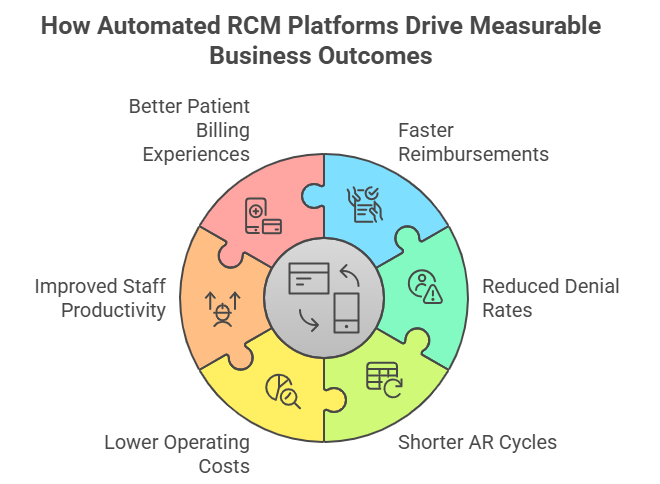
These outcomes are critical for organizations aiming to improve US Healthcare RCM performance without increasing administrative burden.
How ValueDX Delivers End-to-End RCM Automation
ValueDX is designed to support healthcare organizations across the entire revenue cycle, not just isolated steps. Rather than offering fragmented tools, ValueDX provides end-to-end RCM automation that connects patient access, billing, collections, and reporting into a unified framework.
Key strengths of the ValueDX approach include:
- Comprehensive revenue cycle coverage from front-end to back-end
- Intelligent automation that adapts to payer and process variations
- Scalability for hospitals, physician groups, and MSOs
- Compliance-focused design aligned with US healthcare requirements
By eliminating manual bottlenecks and standardizing workflows, ValueDX helps providers improve revenue predictability while allowing teams to focus on strategic and patient-facing priorities.
Author – Chaitanya Thorat
Rethink Your Revenue Cycle Strategy
As healthcare organizations plan for 2025 and beyond, the comparison is becoming clear. Manual RCM processes struggle to deliver the speed, accuracy, and scalability modern healthcare demands. Automated RCM platforms offer a path to stronger collections, fewer denials, and more resilient operations.
If your organization is ready to move beyond reactive revenue cycle management, exploring ValueDX’s end-to-end RCM automation is a logical next step toward sustainable financial performance.
Read our next blog – Click here