

Skilled Nursing Facilities (SNFs) balance two equally demanding priorities—delivering quality patient care while managing complex administrative workloads. One of the most persistent operational challenges is document intake. Physician orders, referrals, authorizations, clinical notes, and billing records continue to arrive via eFax in large volumes every day.
When handled manually, this constant stream of documents consumes valuable staff time, strains operational capacity, and introduces avoidable risks to compliance and care coordination. The future of SNF automation lies in replacing manual document handling with AI-powered eFax classification and Intelligent Document Processing (IDP) turning document chaos into structured, automated workflows.
The Hidden Cost of Manual eFax Processing in SNFs
In today’s healthcare environment, speed and accuracy directly impact patient outcomes and financial performance. Yet many U.S. SNFs still rely on staff to manually open each incoming eFax, identify the document type, match it to the correct patient, and route it to the appropriate department or EMR module.
This approach creates several systemic problems:
- Reduced Operational Efficiency
Administrative staff and clinicians spend hours on repetitive document sorting instead of patient-focused activities, limiting overall productivity. - Higher Risk of Errors and Delays
Misclassified or delayed documents can disrupt care continuity and lead to missed deadlines for Medicare and Medicaid submissions. - Staff Burnout
Constant manual review of high-volume faxes contributes to fatigue, dissatisfaction, and increased turnover.
For SNF leaders planning for intelligent automation and digital maturity, continuing with manual document workflows is no longer viable.
Intelligent Document Processing: The Foundation of Automation in SNFs
Why is Intelligent Document Processing critical for skilled nursing facilities?
Intelligent Document Processing (IDP) uses AI technologies such as machine learning, optical character recognition (OCR), and natural language processing (NLP) to convert unstructured eFax data into structured, actionable information in real time.
How AI eFax classification changes the workflow
When a fax arrives, AI models instantly analyze the document’s content and layout to determine what it is—whether it’s a physician’s order, referral packet, therapy note, authorization request, or billing document. Key data points, such as patient identifiers and document metadata, are extracted automatically.
Once classified, the system routes the document to the correct EMR location, workflow queue, or staff member—without any human intervention. This shift fundamentally transforms SNF document workflows from reactive and manual to proactive and automated.
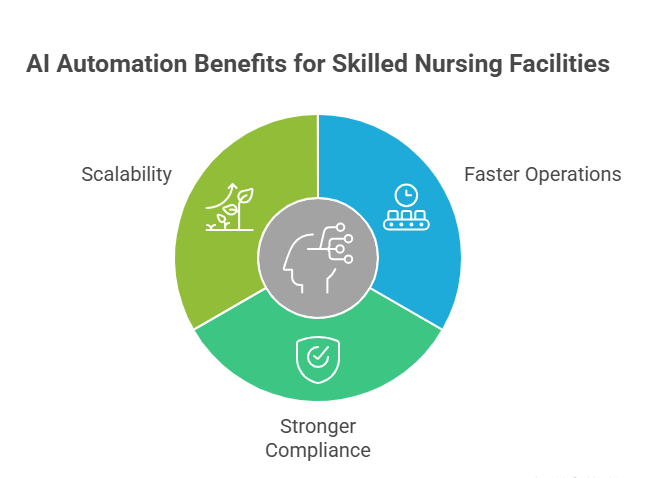
Key Benefits of AI Automation for Skilled Nursing Facilities
1. Faster, More Efficient Operations
AI-powered automation reduces document processing time from hours to seconds. Staff are freed from repetitive administrative work and can focus on patient care, clinical decision-making, and resident engagement.
2. Stronger Compliance and Lower Risk
Automated, rule-based document handling ensures consistency and traceability. Documents are processed promptly and routed accurately, reducing the risk of missing regulatory deadlines and improving compliance with Medicare and Medicaid requirements.
3. Scalability for the Future
AI-driven IDP platforms scale effortlessly as patient volumes and document loads increase. SNFs can grow without adding proportional administrative headcount, supporting long-term operational resilience and readiness for future healthcare demands.
Manual vs. AI-Powered eFax Processing in SNFs
| Feature | Manual eFax Handling | AI-Driven eFax Automation |
|---|---|---|
| Document identification | Staff manually reads and categorizes | AI instantly classifies documents using machine learning |
| Routing | Manual forwarding or physical delivery | Automated routing based on rules and document type |
| Processing Time | Minutes per document, hours per day | Seconds per document |
| Error risk | High likelihood of misfiling or delays | Significantly reduced through automation |
| Staff effort | Administrative, repetitive work | Focus on patient care and decision-making |
Practical Use Cases for AI eFax Classification in SNFs
Admissions and Intake
AI recognizes referral packets immediately, separates key documents, extracts patient demographics, and triggers intake workflows in the EMR—reducing admission delays and accelerating time to care.
Billing and Revenue Cycle
Claims, authorizations, EOBs, and UB-04 forms are automatically routed to billing teams, minimizing errors and supporting timely, compliant reimbursement processing.
Clinical Communication
Lab results, physician orders, and consult reports are identified and delivered directly to the appropriate clinician or care team, ensuring critical information is acted on without delay.
Why SNFs Should Adopt Intelligent Document Processing Now
The future of skilled nursing will be defined by speed, accuracy, and efficiency. Intelligent Document Processing is not just a cost-saving initiative it is a strategic enabler that improves care delivery, strengthens compliance, and enhances staff productivity.
By adopting AI-driven eFax classification today, SNFs bridge the gap between outdated, document-heavy workflows and a fully digital, intelligent operating model built for tomorrow.
Author – Pradeep Dhakne
Read our next blog – Click here