
Why Revenue Cycle Pressure Is Peaking in 2025
Across the US healthcare landscape, revenue cycle teams are under more pressure than ever. Hospitals and physician groups are facing higher denial rates, delayed reimbursements, rising days in AR, and an ongoing shortage of skilled billing staff. At the same time, payer rules are becoming more complex, compliance expectations are tighter, and patients expect clear, timely, and accurate billing experiences.
For many healthcare organizations, these challenges are no longer isolated issues—they are systemic. Manual processes, fragmented systems, and reactive workflows make it difficult to maintain financial stability while delivering quality care.
This is where RCM automation moves from being a “nice-to-have” technology to a strategic necessity. In this blog, we’ll break down what Revenue Cycle Management Automation really is, how it works end-to-end, and why healthcare providers that delay adoption risk falling behind in 2025 and beyond.
What Is RCM Automation?
RCM Automation refers to the use of intelligent, technology-driven workflows to manage and optimize the entire healthcare revenue cycle—from patient intake to final payment posting and reporting.
Unlike traditional automation that targets only isolated tasks, Healthcare RCM Automation focuses on streamlining the full revenue lifecycle, reducing manual intervention, minimizing errors, and improving financial outcomes.
An effective RCM automation solution typically covers:
- Patient access & eligibility verification
- Medical coding & charge capture
- Claims creation and submission
- Denial identification and management
- Payment posting and reconciliation
- Accounts receivable (AR) follow-ups
- Reporting, analytics, and performance monitoring
The goal is simple but powerful: ensure that every legitimate dollar earned is captured, billed correctly, and collected faster—with less effort from already stretched teams.
How RCM Automation Works: An End-to-End View
True end-to-end RCM automation connects processes, systems, and data across the revenue cycle instead of treating each step in isolation.
Here’s how it works in practice:
1. Front-End Revenue Protection
Automation begins at patient access. Eligibility checks, coverage validation, and demographic verification happen early, reducing downstream denials caused by incorrect or incomplete information.
2. Accurate Coding and Charge Capture
Automated workflows support accurate coding and timely charge capture, helping providers avoid revenue leakage while staying aligned with payer and regulatory requirements.
3. Clean Claims Submission
Claims are automatically validated against payer rules before submission. Errors are flagged early, reducing rework and increasing first-pass acceptance rates.
4. Intelligent Denial Management
When denials occur, automation identifies root causes, prioritizes high-impact claims, and routes them for faster resolution—often before cash flow is significantly impacted.
5. Faster Payment Posting and AR Follow-Ups
Payments are posted automatically, and outstanding balances are tracked in real time. Automated follow-ups ensure AR doesn’t age unnecessarily.
6. Actionable Reporting and Visibility
Revenue leaders gain clear visibility into KPIs such as denial trends, AR days, and collection performance—enabling proactive decision-making.
The result is faster claim turnaround, fewer errors, improved cash flow, and far greater control over the revenue cycle.
Why Healthcare Providers Struggle Without Automation in 2025
Without Automated Revenue Cycle Management, many providers are stuck reacting to problems instead of preventing them.
Common challenges include:
- Increasing denial rates driven by complex and frequently changing payer rules
- Workforce burnout, as staff spend hours on repetitive, manual tasks
- Rising operational costs due to inefficiencies and rework
- Compliance risks from inconsistent documentation and process gaps
- Limited visibility into where revenue is delayed or lost
In 2025, continuing with manual or fragmented processes doesn’t just slow operations—it directly threatens financial sustainability.
Why RCM Automation Is a Must-Have in 2025
The healthcare financial landscape has fundamentally changed. Value-based care models, tighter margins, and growing patient financial responsibility demand a smarter approach to revenue management.
RCM automation for healthcare providers delivers measurable outcomes that manual processes simply cannot match:
- Reduced denials through proactive validation and rule-based workflows
- Shorter AR days with faster claim resolution and follow-ups
- Improved collections by ensuring cleaner claims and timely billing
- Better patient satisfaction through accurate, transparent billing
- Stronger compliance posture across payer and regulatory requirements
In short, automation enables healthcare organizations to scale operations without scaling costs or risk.
How ValueDX Enables End-to-End RCM Automation
ValueDX goes beyond task-based automation to deliver comprehensive, end-to-end RCM automation designed specifically for US healthcare providers.
Rather than offering disconnected tools, ValueDX provides an integrated approach that supports the entire revenue cycle—from patient access to final reconciliation.
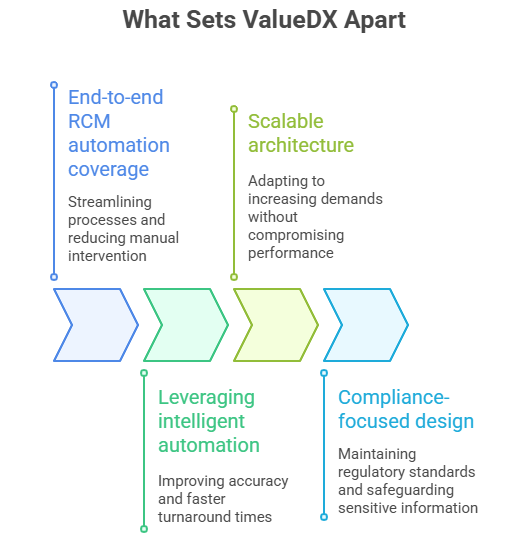
What Sets ValueDX Apart:
- End-to-end RCM automation coverage across front-end, mid-cycle, and back-end processes
- Intelligent automation that adapts to payer rules and operational workflows
- Scalable architecture for hospitals, health systems, physician groups, and MSOs
- Compliance-focused design aligned with US healthcare regulations and payer standards
By automating high-volume, error-prone tasks, ValueDX helps providers eliminate manual bottlenecks, improve revenue predictability, and allow revenue cycle teams to focus on high-value, strategic work.
Real Business Benefits for US Healthcare Providers
Healthcare organizations leveraging Healthcare Revenue Cycle Optimization through automation consistently see:
- Faster reimbursements and improved cash flow
- Lower denial rates and reduced rework
- Decreased operational costs
- Higher staff productivity and reduced burnout
- Data-driven insights for smarter financial decisions
- A more accurate and patient-friendly billing experience
These benefits aren’t theoretical—they directly impact financial stability and operational resilience.
Rethink Your Revenue Cycle with ValueDX
In 2025, revenue cycle challenges are too complex—and margins too tight—to rely on manual processes or disconnected systems.
ValueDX empowers healthcare leaders to modernize their revenue operations with end-to-end RCM automation that delivers higher collections, fewer denials, and scalable, compliant performance.
If you’re ready to transform how your organization manages revenue, now is the time to explore what intelligent RCM automation can achieve.
Read our next blog – Click here