

A few months ago, I met the CFO of a Pune-based manufacturing firm who sighed, “Our invoices are sent on time, but payments drag for 45–60 days. By the time we reconcile, we’ve already lost visibility of our cash flow.” This story isn’t unique — across India, finance teams in Bangalore, Mumbai, and Delhi face the same challenge: long payment cycles, manual follow-ups, and compliance headaches.
Here’s the thing — in 2025, these challenges are no longer just operational; they’re strategic. The companies winning the finance game are the ones embracing O2C automation to drive real-time visibility, faster cash recovery, and smarter financial decisions.
What O2C Automation Really Means
At its simplest, Order-to-Cash (O2C) refers to the complete process from order creation to cash realization — from generating a sales order and issuing an invoice to collecting payment and reconciling it in your books.
O2C automation streamlines this entire cycle using technology — automating invoice generation, tracking payments, reconciling transactions, and alerting teams when customers delay payments. It’s not just about speed; it’s about giving CFOs a clear, real-time view of their finance operations.
Imagine your system automatically reminding clients about overdue invoices, matching payments to orders instantly, and updating your cash position live — no spreadsheets, no chasing emails. That’s what automation delivers.
Why Manual O2C is Broken in India
Here’s where the cracks show in traditional Indian finance operations:
- GST & e-Invoicing Complexity: Businesses must issue compliant e-invoices, validate them through GSTN, and maintain digital trails — a nightmare if done manually.
- High DSO (Days Sales Outstanding): Many Indian firms still wait 45–75 days for receivables, locking up crores in working capital.
- Fragmented ERP Systems: Finance, sales, and operations rarely share the same platform, leading to reconciliation delays.
- Multiple Invoice Formats & Languages: Vendors and customers operate across regions and languages — adding to process complexity.
- Manual Reconciliation: Payments often arrive without clear references, and accountants spend hours matching them.
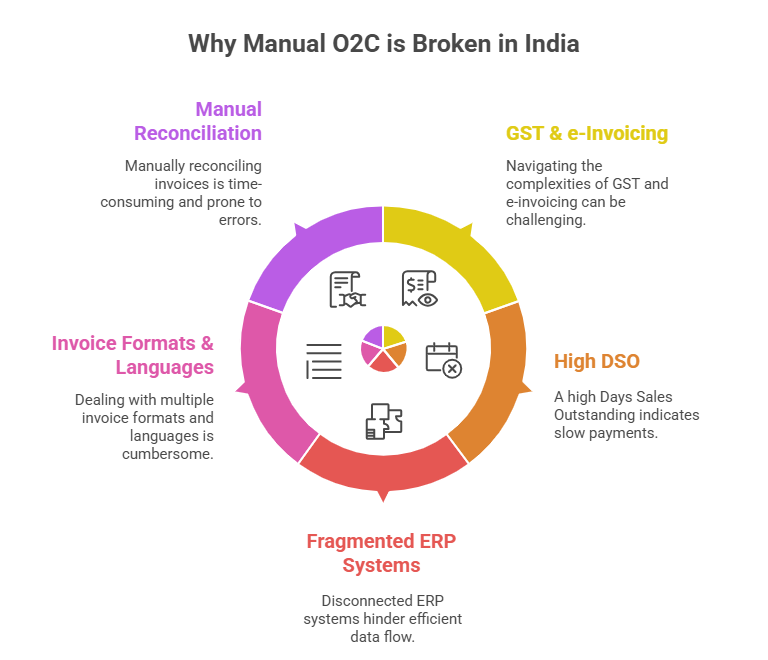
The result? Blocked cash flow, poor visibility, and strained vendor relationships.
2025 Automation Trends to Watch
Having worked with several finance teams, I can tell you — 2025 is going to be the turning point for finance automation in India. Here are the trends redefining O2C and digital finance:
1. AI-Powered Collections and Reminders
No more generic payment chasers. AI now personalizes collection reminders based on customer payment behavior, history, and credit risk — reducing friction and accelerating payments.
2. Digital Invoicing & Compliance Automation
Automated invoicing systems now integrate directly with GST and e-invoicing platforms, ensuring compliance and instant validation without human effort.
3. Predictive Analytics for Receivables and Cash Flow
Finance leaders can now forecast cash inflows accurately — identifying at-risk accounts, expected delays, and opportunities for early payment discounts.
4. Integrated B2B Payment Platforms
O2C automation now connects with UPI for Business, bank APIs, and digital wallets, making payments faster and reconciliation automatic.
5. The Rise of Digital Finance Ecosystems
2025 will see a shift toward connected digital finance — where B2B finance, accounting, and compliance systems talk to each other seamlessly, giving CFOs complete visibility.
Impact in Numbers (India Context)
Let’s talk about the numbers that matter most — results Indian businesses are seeing today:
| Metric | Before O2C Automation | After O2C Automation |
|---|---|---|
| Days Sales Outstanding (DSO) | 60 days | 25–30 days |
| Manual Reconciliation Time | 3–5 hours/day | <30 minutes/day |
| Overdue Receivables | ₹2 crore | ₹50 lakh |
| Cash Flow Visibility | Limited | Real-time |
| Collection Efficiency | 65% | 90%+ |
One IT services company in Bangalore reduced DSO from 62 days to 28 days and freed up ₹1.8 crore in working capital within the first six months of O2C automation.
O2C as the Future of Finance
Here’s the truth — O2C automation isn’t just a process upgrade; it’s a transformation enabler. It bridges the gap between sales and finance, delivering insights that drive business decisions.
In 2025, the future of finance in India will be defined by automation — where data moves instantly across systems, compliance is built-in, and finance teams spend time analyzing rather than reconciling.
B2B finance leaders who adopt O2C automation early will gain a competitive advantage — unlocking cash faster, improving liquidity, and building customer confidence.
This is financial automation in its purest form — smart, scalable, and strategic.
Actionable Next Steps for Indian Finance Leaders
- Pilot O2C Automation: Start with your receivables process; measure impact on DSO and cash flow.
- Integrate with GST & e-Invoicing Systems: Ensure all invoices are validated automatically through GSTN.
- Track Key Metrics: Focus on DSO reduction, collection efficiency, and working capital freed (₹ value).
The Bottom Line
I’ve seen it firsthand — businesses that automate their order-to-cash process not only survive but thrive. As 2025 unfolds, O2C automation will be the backbone of smarter, more agile finance operations in India.
If your company still depends on manual reconciliation, it’s time to step forward. The future of digital finance is about visibility, speed, and intelligence — and automation is how you get there.
Embrace the change now — because in 2025, finance won’t just be about managing money, but mastering momentum.
Read our next blog – Click here