
Turning Compliance from a Risk into a Revenue Enabler
Skilled Nursing Facilities (SNFs) operate at the intersection of patient care, reimbursement complexity, and regulatory scrutiny. Among all governing bodies, the Centers for Medicare & Medicaid Services (CMS) exerts the most significant influence on financial performance. Even minor lapses in compliance can trigger payment delays, denials, audits, or direct monetary penalties each of which erodes margins and strains liquidity.
For SNF leaders focused on sustainable growth, reducing CMS penalties is no longer simply a compliance objective; it is a core Accounts Receivable (A/R) recovery strategy. Yet traditional compliance approaches manual audits, post-payment reviews, and reactive appeals are increasingly ineffective against evolving CMS rules, tighter timelines, and heightened enforcement.
This is where Artificial Intelligence (AI) is redefining the landscape. Modern AI-driven compliance platforms enable SNFs to shift from reactive penalty management to proactive penalty prevention. By embedding intelligence into documentation, billing, authorization workflows, and interoperability processes, AI helps facilities minimize regulatory exposure while accelerating cash flow.
This article examines how AI enables CMS penalty reduction for SNFs, addresses the systemic causes of non-compliance, and supports stronger Medicare billing accuracy without increasing administrative burden.
Why CMS Penalties Persist in Skilled Nursing Facilities
CMS penalties rarely arise from a single failure. Instead, they are the cumulative result of fragmented workflows, delayed visibility, and manual decision-making in a highly regulated environment. SNFs face several recurring compliance risk factors that directly impact A/R performance.
Documentation Gaps and Inconsistencies
CMS reimbursement depends on precise, timely, and clinically substantiated documentation. In many SNFs, documentation is distributed across multiple systems and completed under tight staffing constraints. Missing notes, delayed entries, or inconsistent clinical language can undermine medical necessity and trigger audits or recoupments.
Meeting Medicare documentation requirements consistently through manual review alone is increasingly unrealistic.
Elevated Medicare Denial Rates
High denial volumes especially for Medicare Part A and Part B—are often early indicators of systemic compliance breakdowns. Repeated denials for coding errors, eligibility issues, or insufficient documentation not only delay payments but also increase the likelihood of payer scrutiny and penalties.
Manual denial management processes are slow, error-prone, and reactive, allowing underlying issues to persist.
Prior Authorization Failures
As CMS and managed Medicare plans expand prior authorization requirements, SNFs face greater risk when approvals are incomplete, improperly documented, or not aligned with services rendered. Even a single authorization lapse can result in non-payment or post-payment penalties.
Without automation, tracking authorization validity across patients and services is operationally burdensome.
Interoperability and Data Exchange Weaknesses
CMS increasingly enforces interoperability standards related to data accuracy, exchange, and traceability. Disconnected EHRs, billing platforms, and payer portals make it difficult to demonstrate compliance or respond efficiently to audits, increasing financial exposure.
Lack of Real-Time Compliance Visibility
Traditional A/R reporting often highlights problems only after claims are denied or payments are delayed. By the time issues surface, the facility is already exposed to penalties, lost revenue, or compliance escalation.
To reduce CMS penalties effectively, SNFs need real-time insight—not retrospective analysis.
How AI Reduces CMS Penalties Across the Revenue Cycle
AI-driven compliance solutions address these challenges at their root by embedding intelligence directly into A/R and billing workflows. Rather than relying on staff to manually interpret complex rules, AI systems continuously validate, predict, and correct compliance risks before they result in penalties.
Automated Accuracy and Regulatory Alignment
AI engines continuously cross-check claims, codes, and documentation against current CMS guidelines. As regulations evolve, AI models update validation logic automatically, ensuring ongoing alignment without manual rule maintenance.
This level of automated verification significantly reduces submission errors, strengthens Medicare billing integrity, and minimizes exposure to compliance penalties.
Predictive Denial Prevention
Unlike traditional denial management, AI analyzes historical claim outcomes and payer behavior to identify denial risk before claims are submitted. Potential issues—such as missing documentation, incorrect coding, or authorization mismatches—are flagged in advance.
By correcting these risks proactively, SNFs reduce denial volumes and avoid the downstream penalties associated with repeated non-compliance.
Intelligent Documentation Validation
AI-driven documentation tools review clinical notes in real time, identifying gaps related to medical necessity, length of stay justification, and CMS-required elements. Staff receive immediate prompts to complete or clarify documentation before billing occurs.
This ensures Medicare documentation standards are met consistently, without increasing manual workload.
Faster Payments and Improved Liquidity
Fewer errors and denials translate directly into faster claim acceptance and payment. As A/R days decline, SNFs experience stronger cash flow and improved liquidity—critical for staffing stability, quality initiatives, and operational resilience.
AI-driven A/R optimization turns compliance into a financial advantage rather than a cost center.
Enabling Focus on Quality Outcomes
By automating compliance and billing checks, AI reduces administrative pressure on clinical and revenue cycle teams. This allows staff to devote more time to resident care, quality improvement, and performance metrics that CMS evaluates during surveys and audits.
Practical AI Use Cases for CMS Penalty Avoidance
AI is not theoretical it is already transforming day-to-day SNF operations across multiple compliance touchpoints.
AI-Powered Claim Scrubbing
Before submission, AI automatically reviews claims for coding accuracy, medical necessity validation, authorization completeness, and payer-specific rules. Errors are corrected upfront, reducing both denials and audit risk.
Compliance Risk Forecasting
Predictive analytics models identify which claims, residents, or workflows carry elevated compliance risk. Leadership teams gain early warning signals and can intervene before penalties materialize.
Automated Appeals and Resubmissions
When denials occur, AI assembles and submits corrected appeals with supporting documentation rapidly and accurately. This shortens recovery timelines and improves appeal success rates while maintaining CMS compliance standards.
Interoperability and Data Integrity Management
AI facilitates seamless, accurate data exchange between EHRs, billing platforms, and payer systems. This improves traceability, audit readiness, and adherence to CMS interoperability mandates.
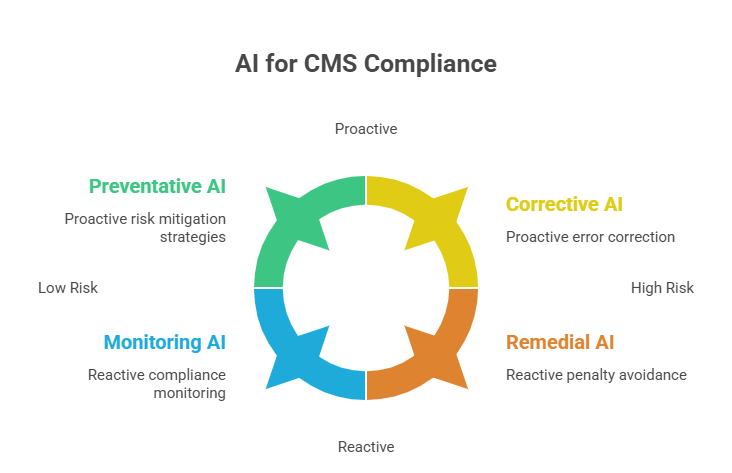
Manual Compliance vs. AI-Driven Compliance: A Strategic Comparison
| Area | Traditional Manual Approach | AI-Driven Compliance Model |
|---|---|---|
| Accuracy | Dependent on human review; inconsistent | Continuous, rules-based validation |
| Processing Speed | Slow and labor intensive | Real-time, automated workflows |
| Penalty Exposure | Issues identified after failure | Risks identified before submission |
| Staff Utilization | High administrative burden | Staff focus on exceptions only |
| Scalability | Difficult as regulations grow | Easily adapts to volume and complexity |
Proactive Compliance Starts Now
CMS penalties do not have to be an unavoidable cost of doing business. With the right AI-driven compliance strategy, Skilled Nursing Facilities can prevent fines, reduce denials, accelerate A/R recovery, and strengthen financial performance all while maintaining regulatory confidence.
If your organization is ready to move from reactive compliance management to intelligent, automated prevention, now is the time to act.
Contact us today to learn how AI-powered A/R and compliance automation can protect your revenue, reduce CMS penalties, and future-proof your SNF operations.
Author – Nidhi Vyawahare
Read our next blog – Click here