

A while back, I met the CFO of a mid-sized company in Pune. His team was stuck processing thousands of invoices every month. Some arrived by courier, some over email, and quite a few through WhatsApp photos. When we spoke, he half-joked, “I feel like we’re running an invoice processing factory, not a finance department.”
That comment summed up what I’ve heard again and again across businesses in Mumbai, Bangalore, and Delhi. Finance professionals aren’t short of skills or commitment — what slows them down is the mountain of manual work. That’s why so many leaders today are exploring Accounts Payable automation.
But here’s the big question: with so many solutions in the market, how do you actually choose AP automation platform for your business?
Why Manual AP Drains Time and Money
If you’ve ever been part of a manual AP process, you already know how painful it is. Invoices are typed in one by one. Payments keep getting delayed because approvals take forever. Vendors start calling daily for updates. And when GST or TDS errors sneak in, penalties hit hard.
During audit season, the stress doubles — half the files are buried in email threads or scattered across systems.
When you calculate the wasted effort, penalties, and processing costs, many Indian companies end up losing ₹50–60 lakhs every year just on inefficiencies. That’s money that could have gone into growth.
What to Check Before Choosing a Platform
How to Choose AP Automation Platform Effectively
Here are six essentials that make all the difference:
- Smart Invoice Capture
The system should read invoices in any format — scanned PDFs, Excel sheets, handwritten copies, or invoices in regional languages. Rigid OCR systems don’t cut it anymore. - Compliance Built for India
GST, TDS, e-invoicing — these should be automated, not handled manually. Otherwise, you’ll still be stuck fixing errors every filing cycle. - Vendor-Friendly Uploads
Not every vendor will log into a portal. Many prefer WhatsApp or just send an email. The right tool should support all those channels. - ERP Compatibility
Your existing SAP, Oracle, or Tally setup shouldn’t break. Integration has to be smooth and quick, without months of downtime. - Real-Time Dashboards
Beyond processing invoices, the system should give finance leaders visibility on liabilities, pending approvals, and cash flow in real time. - Fair Pricing
Avoid platforms that demand heavy upfront fees. Look for outcome-based pricing — pay when you see results.
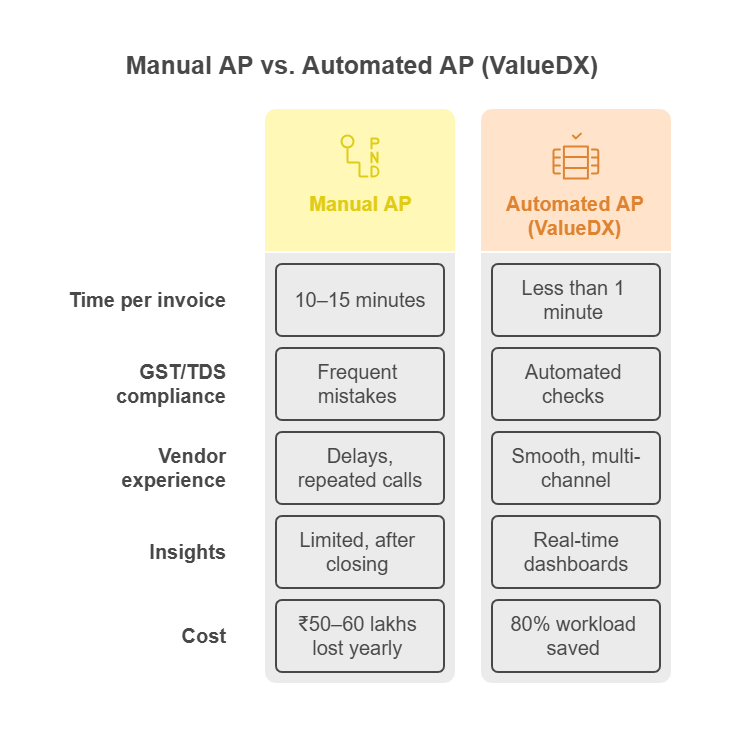
A Quick Side-by-Side
| Factor | Manual AP | Automated AP (ValueDX) |
|---|---|---|
| Time per invoice | 10–15 minutes | Less than 1 minute |
| GST/TDS compliance | Frequent mistakes | Automated checks |
| Vendor experience | Delays, repeated calls | Smooth, multi-channel |
| Insights | Limited, after closing | Real-time dashboards |
| Cost | ₹50–60 lakhs lost yearly | 80% workload saved |
What Businesses Actually See
One manufacturing company in Pune was taking about two weeks to clear invoices. After implementing automation, the cycle dropped to just two days.
A Bangalore IT services firm told me they used to spend 8–10 days every month reconciling GST data. With automation, the same task now takes just a couple of hours.
Most companies I’ve worked with see ROI inside the first quarter. The savings usually run into lakhs, but the real win is peace of mind for the finance team.
Why ValueDX Works Well in India
A lot of platforms promise automation, but here’s what makes ValueDX stand apart:
- Cuts 80% of AP workload, freeing finance staff for higher-value work.
- Handles GST, TDS, and e-invoicing within the platform.
- Goes live in days, not months, with zero downtime.
- Follows outcome-based pricing — no upfront cost.
- Accepts invoices by email, WhatsApp, or web.
- Works seamlessly with Tally, SAP, Oracle, and more.
For many finance leaders, it’s not just automation. It’s finally getting control of compliance and cash flow.
Final Thoughts
Choosing an Accounts Payable automation system isn’t about buying flashy software. It’s about finding a partner who understands Indian compliance, vendor behavior, and the pace at which your business runs.
Companies that make the right choice stop treating AP as a back-office task and start using it as a way to strengthen decision-making.
So ask yourself: Do I want my finance team stuck in paperwork, or guiding smarter business choices?
The answer usually speaks for itself.