

Claim denials remain one of the biggest revenue challenges for Skilled Nursing Facilities (SNFs). Despite experienced billing teams, many organizations still rely on manual denial resolution, reactive workflows, and after-the-fact corrections. This approach not only increases write-offs but also delays collections and strains staff capacity.
Today, predictive AI models and AI bots for denial management are changing how SNFs proactively manage risk. By identifying claims most likely to get denied before submission, AI enables faster interventions, better compliance, and stronger cash flow.
This blog explains why SNFs should use AI for denial management, how predictive analytics works, and how AI compares to manual denial resolution.
The Growing Problem of Denials in Skilled Nursing Facilities
SNF denials often stem from:
- Incomplete or inconsistent documentation
- Authorization and eligibility gaps
- Missed payer-specific billing rules
- Coding inaccuracies and timing errors
Traditional workflows depend heavily on staff experience and retrospective reviews. This makes it difficult to predict denial risk, especially with changing Medicare and Medicaid rules. As a result, denial teams spend most of their time fixing problems instead of preventing them.
This is where predictive AI denial models step in.
What Are Predictive AI Models in SNF Denial Management?
Predictive AI models use machine learning denial patterns in SNFs to assess risk before a claim is submitted. By analyzing historical claims data, payer responses, denial codes, and documentation quality, AI can flag claims that are most likely to be denied.
Key capabilities include:
- Predictive Analytics for denial appeals
- AI-driven risk scoring for each claim
- Early identification of compliance gaps
- Automated recommendations for corrections
This approach shifts denial management from reactive to proactive.
How Predictive AI Identifies High-Risk SNF Claims
1. Machine Learning Analysis of Denial Patterns
AI continuously studies historical Medicare and Medicaid denials to recognize recurring trends. These machine learning denial resolution models identify which combinations of diagnosis, length of stay, therapy minutes, and documentation issues increase denial probability.
2. Real-Time Risk Scoring Before Submission
Each claim is assigned a risk score using predictive analytics denial appeals logic. High-risk claims are flagged for review, allowing teams to intervene before submission.
3. NLP and OCR for Documentation Review
Using NLP denial data extraction and OCR patient records, AI validates clinical notes, physician orders, and therapy documentation for completeness and payer alignment.
4. Automated Recommendations for Fixes
AI systems don’t just identify problems—they suggest next steps. This includes documentation corrections, authorization checks, and compliance fixes, powered by Generative AI denial workflows.
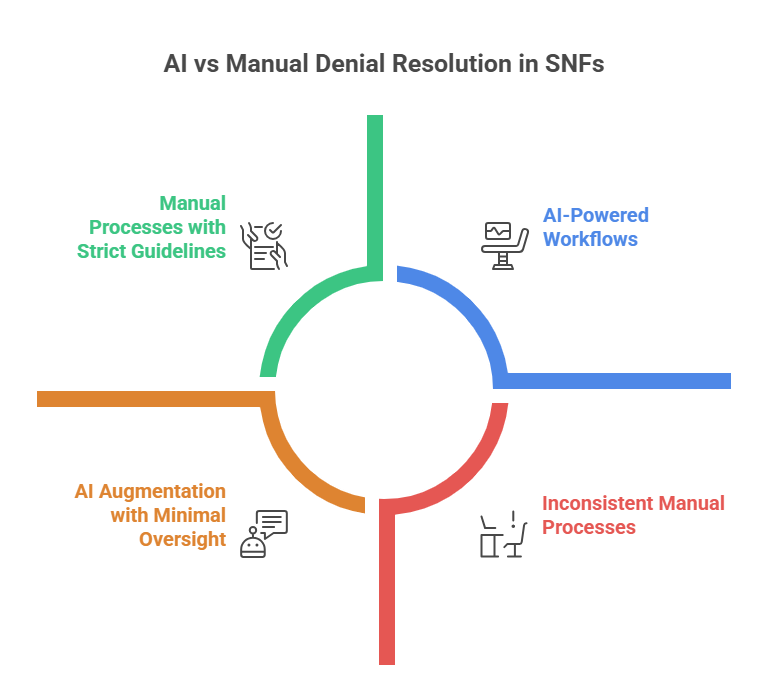
AI vs Manual Denial Resolution in SNFs
Can AI Bots Manage SNF Denials Better Than Staff?
AI bots don’t replace staff they augment them. Unlike humans, AI bots can review thousands of claims simultaneously, applying payer rules consistently and without fatigue.
How Do SNFs Compare AI vs Manual Denial Resolution?
Manual processes rely on staff availability and experience. AI-powered workflows deliver:
- Faster turnaround
- Higher consistency
- Lower rework rates
- Better compliance tracking
This is why AI denial management SNF vs manual comparisons increasingly favor automation.
Benefits of AI Denial Management for SNFs
What Are the Benefits of AI Denial Management for SNFs?
- Reduce SNF denials with AI automation
- Faster denial resolution cycles
- Lower write-offs and revenue leakage
- Improved audit readiness
- Stronger payer compliance
AI also supports improving SNF operational efficiency with AI bots by eliminating repetitive manual tasks.
AI Bots and Automation in Denial Appeals
How Fast Are AI Bots for SNF Denial Appeals?
AI bots process denial appeals in minutes instead of days. Using Robotic Process Automation denial tracking, bots gather documentation, apply payer-specific appeal logic, and submit appeals accurately and on time.
Can SNF Denial Teams Use AI Bots Effectively?
Yes. Most platforms integrate seamlessly with existing RCM systems. Staff focus on exceptions and complex cases while AI handles repetitive workflows.
This balance of human expertise and intelligent automation SNF revenue cycle drives faster revenue recovery.
Compliance and Operational Efficiency Gains
Predictive AI also delivers strong compliance benefits:
- Ensures consistent application of Medicare and Medicaid rules
- Reduces audit exposure
- Improves documentation accuracy
- Supports compliance benefits, AI denial management, SNF
By automating risk detection, SNFs achieve better outcomes with fewer resources.
What Is the Best Denial Management Method for SNFs?
The most effective approach is a hybrid AI-driven model:
- Predictive AI for denial prevention
- AI bots for appeal automation
- Human expertise for complex decision-making
This model outperforms traditional manual workflows and supports scalable growth. As payer scrutiny increases, automated denial management for skilled nursing facilities is no longer optional it’s essential.
Why SNFs Should Use Predictive AI for Denial Management
Predictive AI gives SNFs visibility into risk before revenue is lost. By combining AI bots denial management SNF, machine learning denial resolution, and predictive analytics, facilities can protect margins, speed collections, and strengthen compliance.
Ready to reduce denials and recover revenue faster?
Explore AI-powered denial management solutions designed specifically for Skilled Nursing Facilities. See how predictive AI models, intelligent automation, and AI bots can transform your denial workflows before claims ever get denied.
👉 Request a demo or consultation today and future-proof your SNF revenue cycle.
Author -Sushrut Ujjainkar
Read our next blog – Click here