

Redefining Clinical Efficiency in Skilled Nursing Facilities
Skilled Nursing Facilities (SNFs) function in one of the most demanding segments of healthcare, where clinical excellence, regulatory compliance, staffing stability, and financial performance must coexist under constant pressure. Nurses, therapists, aides, and administrative staff are expected to deliver high-quality resident care while simultaneously navigating extensive documentation requirements, evolving CMS regulations, and increasing reimbursement scrutiny.
In reality, a significant portion of clinical time is consumed not by patient interaction, but by administrative work. Documentation, chart reviews, compliance checks, and information retrieval often overshadow direct care activities. As a result, many facilities struggle with clinician burnout, workflow inefficiencies, compliance exposure, and downstream revenue cycle challenges.
For organizations seeking to improve nursing facility workflow with AI and achieve meaningful clinician burden reduction in SNFs, the adoption of a modern Digital Assistant for Clinicians and Staff represents a fundamental shift. Rather than adding another layer of technology, this solution embeds artificial intelligence directly into daily clinical workflows, acting as an intelligent support system that enhances productivity, accuracy, and compliance without disrupting care delivery.
This comprehensive overview explores the impact of an AI assistant on clinician time in SNFs, detailing how it alleviates operational friction, strengthens regulatory adherence, and connects clinical documentation to financial performance across the care continuum.
Administrative Overload in SNFs
Despite advances in electronic health records and healthcare IT, many SNFs continue to operate with workflows that are inherently inefficient. The burden placed on clinicians is not accidental; it is the result of systemic issues embedded in documentation, compliance, and information management processes.
1. Excessive and Fragmented Documentation
Documentation remains the single largest consumer of clinician time in skilled nursing environments. Nurses and therapists routinely spend 30 to 40 percent of their shifts completing progress notes, care plans, Minimum Data Set (MDS) documentation, and regulatory forms. These tasks are mandatory, highly detailed, and considered mission-critical for reimbursement and compliance.
However, the cumulative effect is significant. Time spent charting reduces time available for resident engagement, clinical assessment, and proactive care interventions. Over time, this imbalance contributes to fatigue, frustration, and declining job satisfaction among clinical staff.
2. Regulatory Complexity and Compliance Risk
SNFs operate under rigorous oversight from CMS and state agencies, where even minor documentation gaps can trigger audits, claim denials, payment delays, or financial penalties. Clinicians are expected to understand and apply thousands of regulatory rules in real time while delivering care in fast-paced environments.
The reliance on human memory and manual checks makes errors inevitable. Compliance challenges are often identified only after documentation is submitted, when remediation becomes costly and disruptive. This reactive approach increases operational risk and exposes facilities to avoidable financial losses.
3. Inefficient Information Retrieval
Accessing relevant patient information should be seamless, yet clinicians frequently spend valuable minutes searching through EHRs to locate prior notes, medication changes, assessment trends, or clinical protocols. This fragmented information retrieval slows clinical decision-making and increases the likelihood of oversight.
In high-acuity situations or during shift transitions, delays in accessing accurate information can directly affect care quality and staff confidence.
4. Direct Impact on Revenue Cycle Performance
Clinical documentation is the foundation of the SNF revenue cycle. Incomplete, inconsistent, or inaccurate charting flows downstream into billing errors, claim rejections, and prolonged accounts receivable cycles. The link between clinical workflows and financial outcomes is undeniable.
Understanding how AI improves SNF accounts receivable recovery begins with recognizing that documentation challenges at the bedside often translate into financial instability at the organizational level.
The Strategic Value of an AI Digital Assistant
An AI-enabled digital assistant addresses these challenges by functioning as an always-on clinical support partner. Rather than replacing staff, it enhances their capabilities by managing administrative complexity and enabling clinicians to focus on patient care.
Key Benefits of an AI Digital Assistant in SNFs
Significant Time Reclamation for Clinicians
Through advanced skilled nursing facility workflow automation, the digital assistant manages repetitive and time-intensive tasks such as note generation, chart summarization, and documentation validation. Clinicians can complete required records in a fraction of the time, dramatically reducing desk work.
This capability is central to AI reducing administrative tasks for nurses, allowing staff to redirect their expertise toward resident care and clinical judgment.
Proactive Compliance and Risk Mitigation
The assistant operates as a real-time compliance safeguard. By leveraging AI tools for healthcare compliance, it continuously evaluates documentation against Medicare guidelines and state regulations as entries are created.
This embedded intelligence supports AI in nursing home health assessments, identifying missing elements before submission and helping facilities avoid audits, penalties, and denied claims. Proactive compliance becomes part of the workflow rather than a downstream correction process.
Improved Accuracy and Clinical Quality
Standardized documentation and intelligent prompts reduce variability and human error. With instant, reliable information retrieval, clinicians can make informed decisions supported by complete and accurate data.
The result is improved care quality, stronger quality measure performance, and enhanced resident safety key benefits of AI in nursing home care that extend beyond administrative efficiency.
Enhanced Staff Satisfaction and Retention
Administrative overload is a primary driver of burnout in SNFs. By equipping teams with the best AI tools for SNF staff efficiency, facilities address one of the root causes of turnover.
When clinicians spend more time with residents and less time managing paperwork, morale improves, engagement increases, and retention stabilizes delivering both human and financial value.
Practical Use Cases: AI Embedded in Daily SNF Operations
A well-designed Skilled Nursing Facility AI implementation guide demonstrates that these assistants are not theoretical innovations but practical tools already delivering measurable impact.
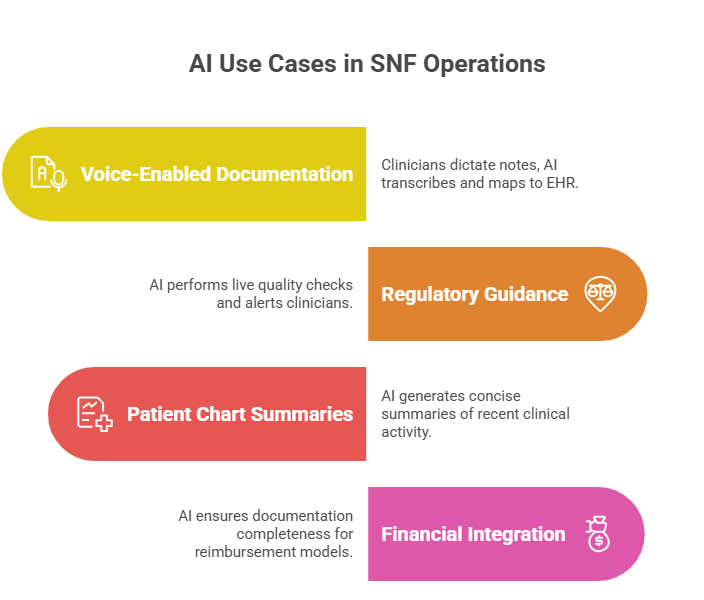
Voice-Enabled Clinical Documentation
Clinicians can dictate notes during or immediately after care interactions. The assistant transcribes, structures, and maps the information directly into the EHR, significantly accelerating how AI streamlines SNF documentation and reducing after-shift charting.
Real-Time Regulatory Guidance
As documentation is entered, the assistant performs live quality checks. If required elements are missing for MDS, PDPM, or billing, the system alerts the clinician immediately with actionable guidance, preventing downstream issues.
Automated Patient Chart Summaries
Prior to rounds, handoffs, or interdisciplinary meetings, the assistant generates concise summaries of recent clinical activity, including vital trends, medication changes, and incident reports—eliminating manual chart reviews.
Clinical-to-Financial Integration
By ensuring documentation completeness for complex reimbursement models, the assistant supports AI-powered claims prioritization in SNFs and strengthens SNF accounts receivable automation AI initiatives. Accurate clinical records directly enable cleaner claims and faster reimbursement.
Manual vs. AI-Enabled Workflow Comparison
| Area | Traditional Manual Approach | AI-Driven Compliance Model |
|---|---|---|
| Documentation Effort | Manual, time-intensive | Automated, voice-assisted |
| Compliance Validation | Post-entry audits | Real-time guidance |
| Information Access | Manual chart searches | Instant retrieval |
| Financial Risk | High denial exposure | Reduced denial risk |
| Staff Focus | Split attention | Patient-centered care |
| Operational Efficiency | Low | High, scalable |
The Future of SNF Clinical Workflows
Operational excellence in Skilled Nursing Facilities no longer depends solely on increasing headcount. It depends on empowering existing teams with intelligent tools that eliminate inefficiency, reduce risk, and elevate care delivery.
A Digital Assistant for Clinicians and Staff enables facilities to move beyond reactive documentation and toward proactive, compliant, and clinician-centered workflows.
If your organization is ready to streamline clinical operations, strengthen financial performance, and support staff with the best AI tools for SNF efficiency, now is the time to take the next step.
Explore the Skilled Nursing Facility AI implementation guide and discover how intelligent automation can reduce administrative burden, improve outcomes, and secure the future of your facility.
Author – Nidhi Vyawahare
Read our next blog – Click here