

How AI Is Transforming Accounts Payable Automation
The accounts payable (AP) function plays a vital role in maintaining an organization’s financial health. It ensures vendors are paid accurately and on time, supports cash flow discipline, and protects the business from compliance and fraud risks. Yet for years, AP has been constrained by manual, paper-heavy workflows that slow operations and introduce unnecessary risk.
Artificial intelligence is fundamentally changing how accounts payable operates. By embedding intelligence into invoice processing, approvals, and controls, AI-driven automation is turning AP into a faster, more accurate, and strategically valuable finance function.
The Limits of Traditional Accounts Payable
In a traditional setup, accounts payable relies on manual invoice intake, data entry, email-based approvals, and spreadsheet tracking. These workflows are difficult to scale and prone to error. Lost invoices, duplicate payments, delayed approvals, and poor visibility into liabilities are common outcomes.
As invoice volumes increase and vendor ecosystems become more complex, these limitations become more costly. Finance teams are forced to spend time resolving exceptions instead of focusing on cash management, forecasting, and strategic analysis. In regulated industries such as healthcare, the consequences are even greater, as compliance and audit requirements add additional pressure to already strained processes.
What Changes When AI Enters the AP Workflow
AI moves accounts payable automation beyond basic digitization. Instead of simply converting invoices into digital records, intelligent systems understand invoice content, context, and patterns.
Invoices are captured automatically regardless of format. Data is validated in real time. Matching against purchase orders and receipts happens instantly. Approval routing adapts dynamically based on historical behavior and business rules. The system continuously learns, improving accuracy and efficiency over time.
This shift introduces true intelligence into accounts payable operations rather than simple task automation.
Key Benefits of AI-Driven Accounts Payable Automation
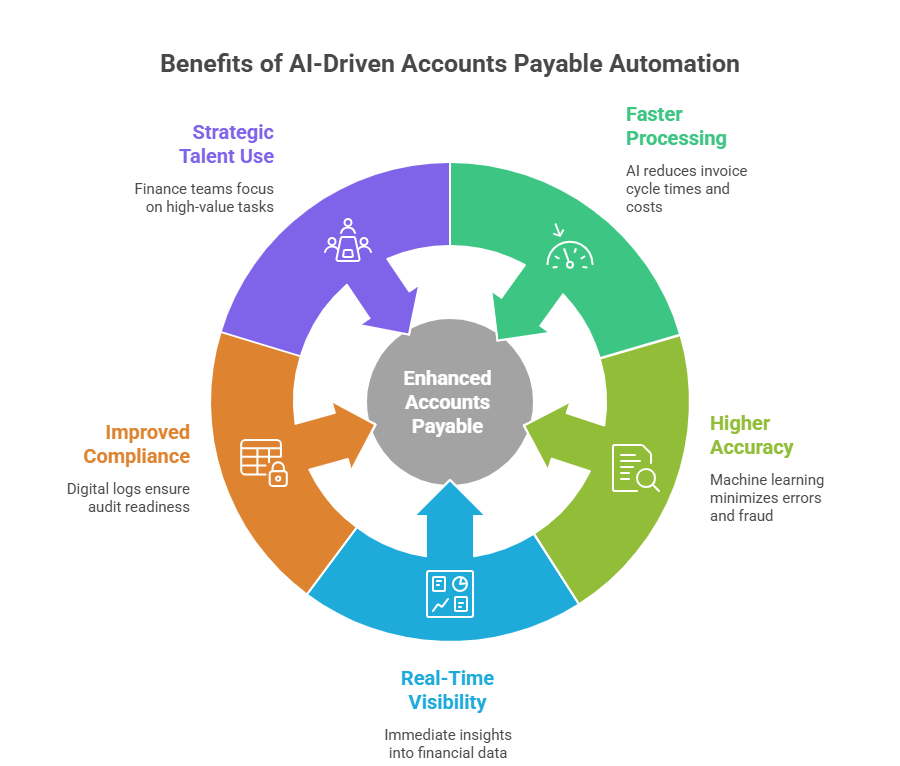
Faster Processing and Lower Costs
AI dramatically reduces invoice cycle times by eliminating manual data entry and approval delays. Processing costs per invoice drop as automation handles high-volume, repetitive work.
Higher Accuracy and Risk Reduction
Machine learning minimizes errors such as duplicate invoices, incorrect coding, or mismatched amounts. Continuous pattern analysis strengthens fraud detection and internal controls.
Real-Time Financial Visibility
Finance leaders gain immediate insight into outstanding liabilities, payment schedules, and spending trends. This visibility supports stronger cash flow planning and working capital decisions.
Improved Compliance and Audit Readiness
Every action in the AP lifecycle is logged digitally, creating a clear audit trail. Policy enforcement becomes consistent and measurable rather than dependent on manual oversight.
Strategic Use of Finance Talent
By removing administrative burden, AP teams can focus on vendor relationships, exception handling, and financial analysis activities that directly support business performance.
Traditional AP vs. AI-Driven AP Automation
| Feature | Traditional AP | AI-Driven AP |
|---|---|---|
| Invoice entry | Manual, error-prone | Automated, highly accurate |
| Processing time | Days or weeks | Minutes or hours |
| Approval tracking | Manual and opaque | Digital and transparent |
| Error and fraud risk | High | Significantly reduced |
| Financial visibility | Retrospective | Real-time |
Industry Impact: Accounts Payable in Healthcare
Healthcare organizations manage exceptionally complex payables medical supplies, pharmaceuticals, equipment, and services across multiple facilities. AI-driven AP systems automatically classify invoices, validate compliance requirements, and ensure accurate allocation across departments and cost centers.
This level of automation helps healthcare finance teams maintain financial continuity, meet regulatory expectations, and support uninterrupted patient care.
Author – Pradeep Dhakne
Read our next blog – Click here