

How AI-Driven Predictive Intelligence is Revolutionizing SNF Reimbursement
Moving the focus from fixing mistakes to preventing them before they ever reach the payer.
In the high-stakes environment of Skilled Nursing Facilities (SNFs), every dollar of reimbursement is hard-earned. Yet, a significant portion of that revenue is constantly under threat from a complex web of claim denials. As Medicare Advantage plans proliferate and regulatory oversight tightens, the margin for error in billing has effectively vanished.
A single overlooked signature or an expired authorization is no longer just a clerical hiccup—it’s a direct hit to the facility's bottom line. Historically, SNFs have treated denial management as a "clean-up" operation. But this reactive cycle is unsustainable. The future of financial stability in post-acute care lies in AI-driven denial prevention.
The True Cost of a Denial: More Than Just a Delayed Payment
When a claim is denied, the financial impact extends far beyond the face value of the reimbursement. Most SNFs fail to account for the "hidden costs" associated with the appeals process:
- Administrative Labor: The average cost to rework a single denied claim is estimated at $25-$30. For a facility processing hundreds of claims, this adds up to thousands in lost wages.
- Days Sales Outstanding (DSO): Denials trap your cash flow in limbo. A high DSO limits your facility's ability to invest in new equipment or staff training.
- Payer Profiling: Frequent errors put your facility on the radar of payers, leading to more frequent audits and more stringent scrutiny on future claims.
The Anatomy of a Denial: Identifying the Primary Culprits
Artificial Intelligence doesn't just categorize denials; it performs deep-dive "root cause analysis" to highlight systemic failures within a facility’s workflow.
1. The Authorization Gap
Denials often occur because an authorization was never obtained, or the length of stay exceeded the approved window. The AI Advantage: Machine learning algorithms track payer-specific authorization windows in real-time, alerting teams before thresholds are reached.
2. Clinical Documentation Deficits
Payers frequently deny claims based on "lack of medical necessity." The AI Advantage: Natural Language Processing (NLP) scans clinical notes as they are written, flagging missing elements or "weak" evidence before the billing cycle begins.
3. Coding Discrepancies and "Dirty" Claims
Mismatched ICD-10 codes trigger immediate automated rejections. The AI Advantage: Intelligent coding validation cross-references clinical records against payer rulebooks to ensure accuracy.
4. Eligibility Volatility
Patient coverage can change mid-month. The AI Advantage: Automated verification tools perform "batch checks" identifying coverage changes instantly to prevent "Wrong Payer" denials.
Moving the Needle: How Predictive AI Stops Denials at the Source
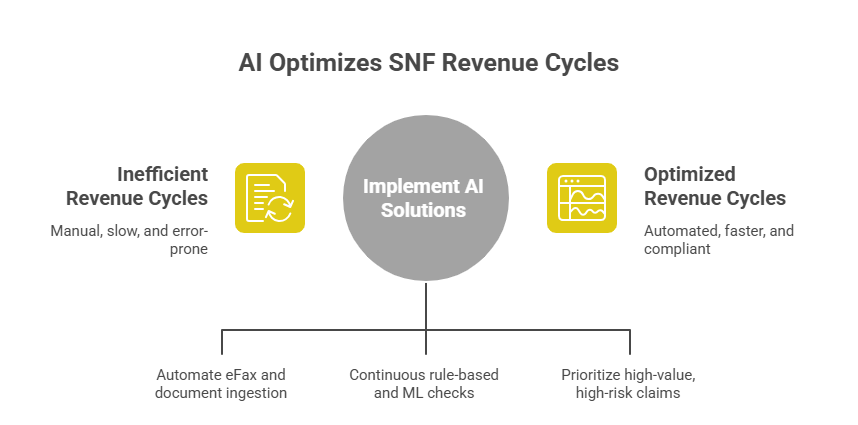
AI doesn't just look at what happened; it calculates what is likely to happen using Predictive Risk Scoring. By analyzing millions of past claim outcomes, AI assigns a "Risk Score" to every claim. If a claim has a high probability of denial, the system flags it for human review before submission.
| Performance Metric | Traditional Manual Process | AI-Enhanced Process |
|---|---|---|
| Identification | Reactive (Post-Denial) | Predictive (Pre-Submission) |
| Review Speed | Days/Weeks (Sample-based) | Seconds (100% of Claims) |
| Error Detection | Human-eye limited | Algorithmically precise |
| Compliance | Periodic Audits | Continuous Monitoring |
| Revenue Impact | High Write-offs | Maximized First-Pass Yield |
The 4 Pillars of Predictive Intelligence
A robust AI system for SNF reimbursement relies on four critical technological pillars that work in tandem to secure your revenue:
1. Pattern Recognition
AI identifies subtle trends—such as a specific payer consistently denying claims for a certain therapy—long before a human manager would notice the pattern.
2. Real-Time Benchmarking
The system compares your facility's performance against industry averages and historical data to identify outliers that represent audit risks.
3. Automated Workflow Routing
Instead of a "first-in, first-out" approach, AI routes the most complex or high-risk claims to your most experienced billing specialists automatically.
4. Self-Learning Loops
As payers change their rules, the AI learns from new denial reasons, updating its "scrubbing" criteria in real-time without manual reprogramming.
Conclusion: Future-Proofing the SNF Revenue Cycle
The complexity of SNF billing is only going to increase. Facilities that continue to rely on manual spreadsheets and "hope" as a strategy for denial management will find themselves struggling with shrinking margins.
Embracing AI-powered denial prevention isn't just about technology; it’s about financial resilience. By identifying risks in real-time and automating the "busy work" of compliance, SNFs can focus on providing high-quality care while ensuring they are actually paid for it.
Frequently Asked Questions
This is the percentage of claims paid on the first submission. AI increases this rate by scrubbing claims for errors and ensuring all clinical "proof" is attached before the payer ever sees it.
No. It empowers them. Instead of spending 80% of their time researching why a claim was denied, they spend their time fixing high-risk claims before they are sent, making their roles more strategic and less clerical.
In most cases, instantly. As soon as data is entered into the EMR or billing system, the AI can cross-reference rules and flag discrepancies immediately.