

Can AI, Predictive Analytics, and Revenue Automation Transform the Future of SNF Reimbursements?
The Future of SNF Reimbursement with AI, Predictive Analytics, and Smart Revenue Automation.
For Skilled Nursing Facilities (SNFs), financial stability depends on the speed, accuracy, and predictability of reimbursements. As regulatory requirements grow more complex and the industry shifts toward value-based care, traditional manual revenue cycle processes are no longer sufficient. The future of SNF reimbursements is being reshaped by advanced technology—specifically the convergence of Artificial Intelligence (AI), Predictive Analytics, and Smart Revenue Automation.
This transformation is critical for SNF executives, clinical leaders, and operations teams seeking to improve reimbursement accuracy, strengthen cash flow, and drive sustainable operational efficiency in SNF revenue management.
How AI Is Redefining SNF Revenue Management
AI-driven automation introduces intelligence, speed, and foresight into the reimbursement process. Intelligent Automation platforms are designed to optimize the entire revenue cycle—from document intake to final payment—while reducing manual effort and error rates.
Why Smart Revenue Automation Matters for SNFs
AI transforms how facilities manage incoming documentation and claims. Using Optical Character Recognition (OCR) and Natural Language Processing (NLP), AI systems instantly read, understand, and classify documents with a level of speed and accuracy that manual workflows cannot match. This capability is foundational to effective SNF payment optimization.
Predictive Analytics: Moving from Reaction to Prevention
Predictive analytics analyzes historical claims, patient demographics, and payer behavior to forecast reimbursement timelines and identify denial risks before claims are submitted. This proactive intelligence enables SNFs to improve clean claim rates, reduce write-offs, and stabilize cash flow—key pillars of the AI-driven future of SNF reimbursement.
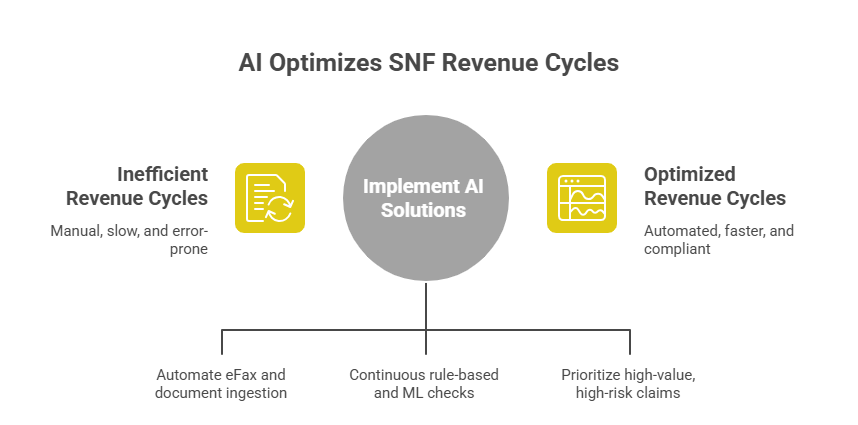
The Strategic Role of AI in SNF Revenue Cycles
AI functions as a digital revenue assistant by automating and optimizing critical workflows:
- Intelligent Document Intake: Automated ingestion and classification of eFaxes and scanned documents.
- Automated Compliance Validation: Continuous rule-based and machine-learning checks to ensure claims meet payer requirements.
- Revenue Cycle Acceleration: Prioritization of high-value and high-risk claims to improve reimbursement speed and outcomes.
Real-World Benefits and Use Cases
Why SNFs Are Adopting AI-Driven Revenue Automation
Facilities that deploy machine learning-powered RCM experience measurable improvements, including increased revenue capture, reduced administrative costs, and higher staff satisfaction as teams shift focus from manual processing to strategic oversight and patient care.
Impact on SNF Cash Flow
By minimizing errors and accelerating claim processing, smart automation increases payment velocity and creates a more predictable revenue stream—strengthening overall financial resilience.
Common AI Use Cases in SNF Reimbursement
- Automated Claims Submission: Claims are prepared and submitted automatically upon patient discharge or status change.
- eFax Automation: Incoming faxes such as physician orders and insurance documents are classified and routed instantly.
- Prior Authorization Management: AI identifies authorization requirements early and initiates workflows proactively.
Manual vs. AI-Powered Reimbursement
| Feature | Manual Reimbursement | AI-Powered Reimbursement |
|---|---|---|
| Document identification | Manual reading and categorization | Automated classification using machine learning |
| Routing | Email, printing, or physical delivery | Rule-based, intelligent digital routing |
| Processing time | Minutes per document; hours per batch | Seconds per document at scale |
| Error risk | High due to manual handling | Significantly reduced through automation |
| Staff focus | Administrative tasks | Patient care and revenue optimization |
Frequently Asked Questions
1. What is eFax automation and why is it important for SNFs?
eFax automation uses AI to ingest electronic faxes, extract key data, classify document types, and route them directly into the appropriate workflow—eliminating manual handling and delays.
2. Can predictive analytics reduce reimbursement risk?
Yes. Predictive models identify denial patterns and payer behaviors, allowing SNFs to correct issues before claims are submitted.
3. How is Generative AI used in SNF RCM?
Generative AI can assist with drafting appeal letters, payer responses, and claim-related communications, reducing turnaround time and administrative workload.
4. How does AI classification improve workflow efficiency?
Machine learning instantly categorizes documents such as physician orders, authorizations, and demographic records, ensuring immediate and accurate routing.
5. Is smart revenue automation suitable for smaller SNFs?
Absolutely. AI platforms are scalable and particularly valuable for smaller facilities with limited administrative resources.