
Why Denial Management Is a Critical Challenge for SNFs
Skilled Nursing Facilities (SNFs) face mounting pressure from rising claim denials, frequent Medicare and Medicaid audits, and increasing compliance complexity. Manual denial management processes often dependent on spreadsheets, payer portals, and human memory are no longer sufficient to keep up with today’s regulatory demands. Billing errors, missed documentation, and lack of audit visibility continue to drive revenue loss.
This is where healthcare automation denial prevention SNF solutions powered by AI are reshaping denial management. A growing number of SNFs are now evaluating AI bots vs manual denial management to determine which approach delivers better compliance, fewer billing errors, and stronger financial outcomes.
Manual Denial Management in SNFs: Where Traditional Methods Fall Short
Manual denial management relies heavily on staff experience, manual audits, and post-denial corrections. While teams work hard, this approach creates significant gaps:
- Limited visibility into SNF compliance data
- Delayed identification of denial risks
- Inconsistent documentation reviews
- Reactive rather than preventive audits
- High dependency on individual staff expertise
Without automated checks, SNFs struggle to maintain reliable denial audit trails, increasing the risk of repeat denials and compliance exposure.
AI Bots for Denial Management: A Smarter, Preventive Approach
AI-powered denial management introduces Intelligent Automation compliance capabilities that continuously monitor claims, documentation, and payer rules. These systems are designed to prevent denials not just fix them.
What Are AI Audit Trails for SNF Compliance?
AI audit trails SNF are automated, system-generated records that track every step of the billing, documentation, and submission process. Unlike manual logs, AI-based audit trails provide:
- Real-time visibility into compliance checks
- Automated tracking of changes and validations
- Clear evidence for Medicare denial audit trails AI
- Support for skilled nursing facility AI compliance requirements
This directly answers the question: What are AI audit trails for SNF compliance? They are a foundational element of denial prevention software for SNFs.
How AI Audit Trails Prevent and Reduce Denials
How Do AI Audit Trails Prevent SNF Denials?
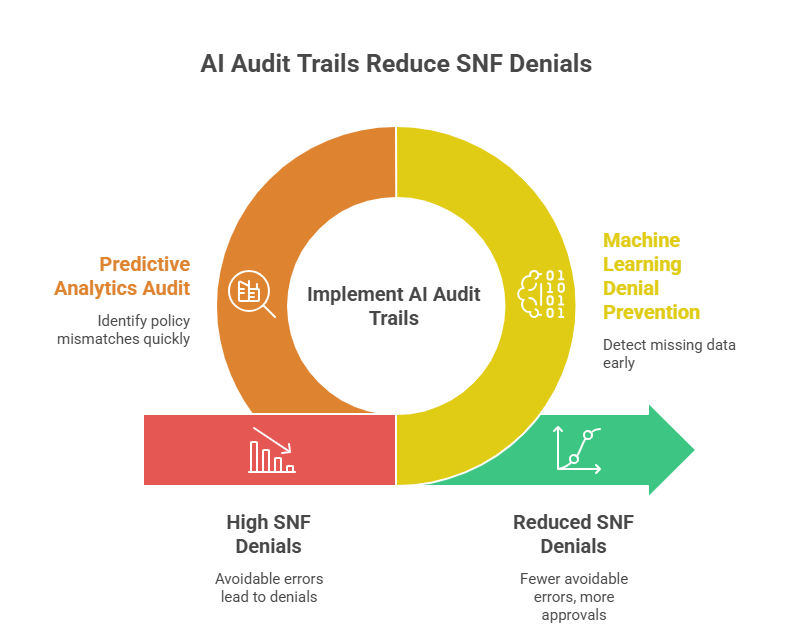
AI audit trails prevent denials by validating claims before submission. Using Machine Learning denial prevention and Predictive Analytics audit models, AI systems detect missing data, authorization gaps, and policy mismatches early reducing avoidable errors.
Can AI Audit Trails Reduce SNF Billing Errors?
Yes. Reduce SNF billing errors AI audit solutions leverage OCR audit trail data and NLP compliance documentation to ensure all required documentation supports the billed services. This significantly lowers rejections tied to incomplete or inconsistent records.
Why Use AI-Based Audit Trails for Denial Prevention?
SNFs use AI-based audit trails because they:
- Reduce manual review workload
- Improve audit readiness
- Support automated compliance SNF billing
- Strengthen denial prevention across Medicare and Medicaid claims
AI Bots vs Manual Denial Management: A Direct Comparison
| Feature | Manual eFax Handling | AI-Driven eFax Automation |
|---|---|---|
| Denial detection | After claim rejection | Predictive, pre-submission |
| Audit trails | Manual logs, inconsistent | Automated AI audit trails SNF |
| Compliance tracking | Periodic reviews | Continuous, real-time |
| Billing error prevention | Reactive | Preventive |
| Operational efficiency | Labor-intensive | Scalable, automated |
How AI Tracks SNF Compliance Data More Effectively
How Does AI Track SNF Compliance Data?
AI systems integrate billing, clinical, and authorization data into a single compliance layer. Using Robotic Process Automation compliance and AI-based audit engines, they track:
- Coverage rules
- Authorization timelines
- Documentation completeness
- Payer-specific requirements
This ensures every claim is backed by a complete, auditable trail—supporting Medicaid compliance automation skilled nursing and Medicare requirements.
Key AI Features That Improve SNF Denial Audit Trails
What AI Features Improve SNF Denial Audit Trails?
The most impactful AI features include:
- AI audit trails SNF with time-stamped validation logs
- Generative AI reporting for audit summaries
- Predictive alerts for denial risk
- Automated exception handling
- Real-time compliance dashboards
These features help improve operational efficiency SNF audit while reducing audit fatigue.
Can SNFs Use AI for Automated Denial Audits?
Absolutely. Can SNFs use AI for automated denial audits? Yes AI systems continuously audit claims without disrupting daily operations. This proactive approach allows SNFs to correct issues before submission, rather than responding to payer rejections later.
Which Works Best for SNFs AI Bots or Manual Processes?
The answer is clear. While manual denial management may still play a role in exception handling, AI bots deliver superior outcomes in denial prevention, compliance accuracy, and operational efficiency. With AI audit trail benefits SNF, facilities gain transparency, scalability, and financial protection that manual processes cannot match.
For SNFs aiming to reduce billing errors, strengthen compliance, and future-proof their revenue cycle, AI-powered denial management is no longer optional it is essential.
Author – Sushrut Ujjainkar
Read our next blog – Click here