
In today’s competitive U.S. B2B landscape, customer experience is no longer confined to marketing or sales—it extends deep into finance operations. CFOs and finance leaders are realizing that back-office processes, especially invoicing, directly influence client trust, satisfaction, and long-term loyalty. A late invoice, a minor error, or unclear billing can create friction, eroding confidence in even the most established organizations. In this context, digital invoicing is emerging as a strategic tool, enabling companies to transform routine financial operations into opportunities for enhancing customer experience.
The Challenges of Traditional Invoicing
Despite advances in technology, many organizations in the U.S. still rely on paper-based or manual invoicing processes. These systems are prone to errors, delays, and inefficiencies that impact both finance teams and their customers. Common challenges include:
- Manual data entry errors: Even a small miscalculation or incorrect tax code can trigger disputes, resulting in additional follow-ups and delayed payments.
- Slow approval workflows: Multi-level invoice approvals can take days, causing invoices to reach clients late.
- Compliance complexities: U.S. businesses must navigate multi-state sales taxes, federal reporting requirements, and increasingly strict financial regulations. Manual systems often struggle to maintain accuracy across these variables.
- Limited visibility for customers: Without digital portals, clients cannot track invoice status in real-time, leading to confusion and repeated inquiries.
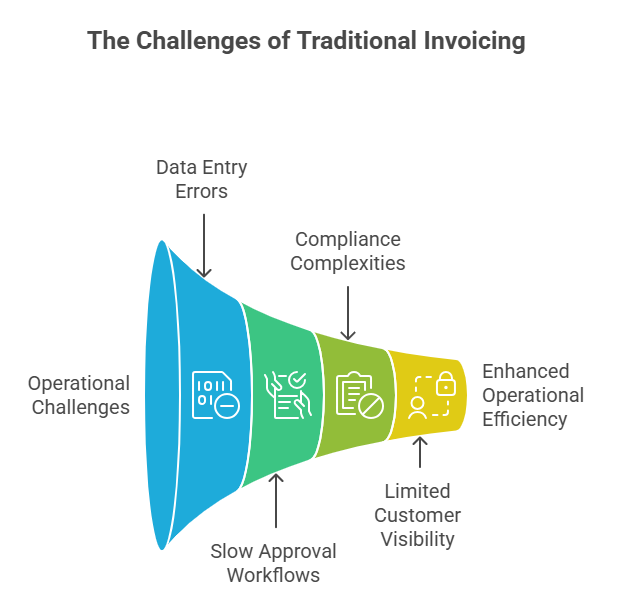
These pain points are more than operational inconveniences—they directly influence how clients perceive your organization. In an environment where every interaction shapes loyalty, inefficiencies in billing can frustrate customers and create unnecessary friction.
Consequences of Poor Invoicing Experience
The impact of invoicing inefficiencies extends far beyond internal workflow frustrations. For CFOs, the consequences are tangible and measurable:
- Delayed payments and stretched cash flow: Errors or late invoices extend the Days Sales Outstanding (DSO), reducing working capital availability.
- Strained client relationships: Inaccurate or unclear invoices lead to disputes, repeated follow-ups, and diminished trust.
- Higher credit risk: When payments are unpredictable, finance teams face increased exposure to bad debts and financial uncertainty.
- Reduced customer loyalty: Clients increasingly prefer suppliers that provide seamless, transparent billing experiences. Failure to meet these expectations can result in lost business opportunities.
For example, a U.S.-based IT services company handling hundreds of client invoices monthly may find that a small percentage of billing errors causes disproportionate delays in cash inflows, negatively impacting its ability to invest in strategic initiatives.
Digital Invoicing: A Strategic Solution
Digital invoicing solutions address these challenges by automating and streamlining the entire Order-to-Cash (O2C) cycle. By leveraging technology, finance teams can ensure speed, accuracy, and transparency, enhancing the overall customer experience.
Key benefits include:
- Faster processing and delivery: Automated systems generate and send invoices instantly, ensuring clients receive accurate billing without delays.
- Accuracy and compliance: Automation minimizes errors, maintains multi-state tax compliance, and reduces the risk of regulatory penalties.
- Customer self-service portals: Clients can view invoices, track payment status, and raise queries directly, reducing friction and improving engagement.
- Real-time visibility and reporting: Finance teams and customers alike gain instant access to invoice status, enabling faster dispute resolution and smoother cash flow management.
Leading U.S. organizations across manufacturing, SaaS, and distribution sectors have embraced digital invoicing to improve client satisfaction. Companies report faster payment cycles, reduced billing disputes, and stronger customer relationships, demonstrating the clear link between operational efficiency and customer loyalty.
Strategic Benefits for CFOs and Finance Leaders
Beyond improving day-to-day operations, digital invoicing delivers strategic advantages for finance leaders:
- Improved cash flow forecasting: Faster, more accurate invoicing allows CFOs to predict cash inflows with greater confidence.
- Reduced DSO: Automation accelerates payment cycles, freeing working capital for strategic investments.
- Enhanced business agility: With clear visibility into receivables, finance teams can respond quickly to client inquiries and evolving market conditions.
- Stronger customer loyalty: A seamless invoicing experience reinforces trust, encourages repeat business, and strengthens long-term client relationships.
By integrating digital invoicing solutions into the broader O2C cycle, organizations position finance as a customer-centric function—one that actively contributes to growth, rather than simply managing transactions.
Conclusion: Future-Proofing Finance Through Customer-Centric Automation
For CFOs and finance teams in the U.S., digital invoicing should be viewed not just as an efficiency tool, but as a strategic enabler of superior customer experience. By automating invoice generation, delivery, and tracking, organizations reduce errors, accelerate payments, and provide clients with the transparency they expect.
Enhancing customer experience with e-invoicing is no longer optional. Businesses that adopt digital invoicing solutions for better customer service position themselves as trusted partners, capable of delivering both financial precision and client satisfaction. In an era where client expectations are high and competition is fierce, digital invoicing is a crucial lever for building loyalty, improving cash flow, and future-proofing finance operations.
Investing in digital invoicing today equips organizations to not only streamline internal processes but also create meaningful, trust-based relationships with their clients—a win-win for both finance teams and the customers they serve.
Read our next blog – Click here