
In today’s regulatory environment, U.S. businesses cannot afford to treat procure-to-pay (P2P) processes as mere back-office functions. Whether you’re a public company navigating Sarbanes-Oxley (SOX) compliance, a healthcare provider bound by HIPAA and FDA requirements, or a government contractor operating under federal procurement regulations, the stakes are high.
The convergence of automation, regulatory scrutiny, and complex multi-entity operations has made P2P compliance both a challenge and a strategic priority. For American companies, ensuring robust controls, complete audit trails, and transparent reporting is not only about avoiding penalties — it’s about reinforcing market credibility and stakeholder trust.
The U.S. Compliance Landscape: What’s at Stake
American businesses face one of the most sophisticated regulatory frameworks in the world. P2P operations intersect with multiple layers of compliance obligations:
- Sarbanes-Oxley Act (SOX): Requires internal control documentation, segregation of duties, and effective monitoring of financial processes.
- SEC Reporting Standards: Demand accurate, timely, and transparent reporting of procurement-related financial data.
- Industry-Specific Regulations:
- FDA for pharmaceuticals and medical devices.
- HIPAA for healthcare providers handling patient-related procurement.
- Banking and financial regulations for financial services firms.
- Foreign Corrupt Practices Act (FCPA): Governs anti-bribery and ethical procurement practices, particularly in global sourcing.
- Federal Procurement Rules: Apply to defense and government contractors, requiring strict adherence to FAR (Federal Acquisition Regulation) and DFARS (Defense Federal Acquisition Regulation Supplement).
The challenge is clear: businesses must not only automate procurement and payments but also prove that those automated systems meet regulatory expectations.
Compliance Challenges in the U.S. P2P Workflows
Despite advances in ERP and automation, many U.S. enterprises struggle with compliance gaps:
- Maintaining SOX-Compliant Internal Controls
- Automated systems must demonstrate clear segregation of duties and approval hierarchies.
- Inadequate system configuration may create control weaknesses flagged during SOX audits.
- Audit Trail Completeness
- Regulators and auditors require end-to-end traceability across requisitions, vendor selection, purchase orders, invoices, and payments.
- Missing or incomplete records increase audit costs and regulatory risk.
- Multi-Jurisdictional Complexity
- Global operations mean reconciling U.S. regulations with international compliance requirements.
- Subsidiaries may operate under different accounting standards, complicating consolidation.
- Documentation for Regulatory Examinations
- Auditors and regulators expect transparent, real-time documentation of procurement decisions, risk controls, and approval processes.
- Manual or fragmented systems often fail to deliver this level of visibility.
- Regulatory Risks in Automation
- Without strong controls, automation can magnify compliance risks by enabling faster execution of non-compliant transactions.
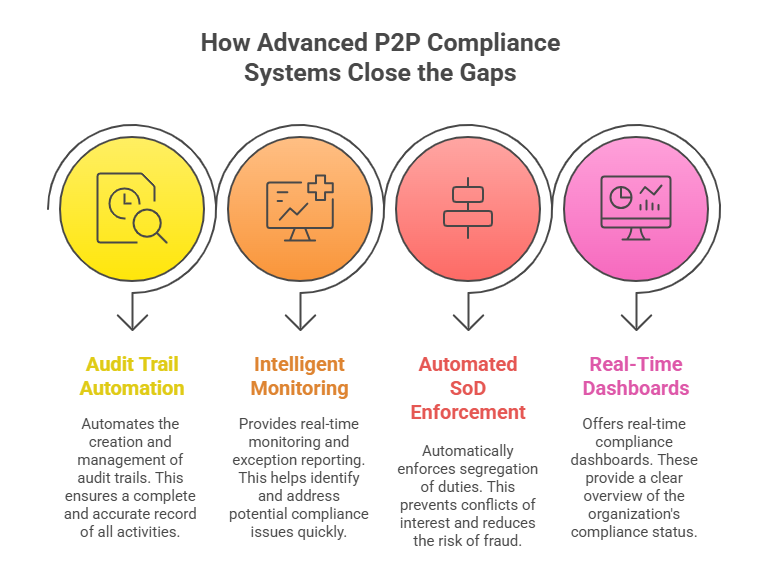
How Advanced P2P Compliance Systems Close the Gaps
Modern P2P compliance platforms are designed to align automation with stringent U.S. regulatory demands. Key capabilities include:
- Comprehensive Audit Trail Automation
- Every procurement decision, approval, vendor interaction, and payment authorization is digitally logged.
- Systems provide immutable records that withstand SOX, SEC, and external audit reviews.
- Intelligent Control Monitoring and Exception Reporting
- Automated monitoring ensures internal controls operate effectively.
- Exception reports highlight anomalies such as duplicate invoices, policy deviations, or unusual vendor activity.
- Automated Segregation of Duties (SoD) Enforcement
- Role-based access ensures no single individual can create, approve, and pay an invoice.
- Systems block or flag SoD conflicts automatically, strengthening SOX compliance.
- Real-Time Compliance Dashboards
- Finance, compliance, and audit teams gain instant visibility into compliance health.
- Dashboards consolidate key risk indicators, pending approvals, and potential compliance breaches.
U.S.-Specific Compliance Requirements Addressed
- SOX Internal Control Documentation: Automated approval workflows and audit trails directly support SOX Section 404 requirements.
- SEC Reporting Accuracy: Transaction-level integrity ensures financial reporting aligns with SEC’s disclosure standards.
- FDA & HIPAA (Healthcare and Pharma): Systems capture procurement evidence needed for FDA inspections and safeguard data in line with HIPAA.
- FCPA Compliance: Automated vendor due diligence and transparent approval logs help prove anti-bribery and ethical sourcing practices.
- Federal Procurement Compliance: Automated systems align with FAR and DFARS requirements, reducing risk for government contractors.
Industry-Specific Implementations
- Healthcare: P2P systems integrate HIPAA-compliant controls, FDA validation for medical procurement, and robust vendor risk monitoring.
- Financial Services: Automation ensures compliance with banking regulations, while providing evidence for OCC and Federal Reserve examinations.
- Public Companies: SOX-driven controls ensure documentation of approvals, segregation of duties, and audit-ready financial data.
- Government Contractors: Automated FAR-compliant workflows manage procurement transparency, cost accounting standards, and subcontractor reporting.
Implementation Strategies for U.S. Enterprises
- Integrate with Major ERP Systems
- Seamless alignment with platforms like SAP, Oracle, and Workday ensures consistent compliance across entities.
- Embed Compliance into Design
- Configure approval workflows and role structures based on SOX and FCPA standards from the start.
- Change Management for Compliance Teams
- Train procurement, finance, and audit teams to leverage dashboards, interpret exception reports, and enforce controls.
- Ongoing Monitoring and Maintenance
- Regularly test and certify internal controls to meet SOX and audit requirements.
- Update system configurations as regulations evolve.
For American businesses, P2P compliance is both a regulatory obligation and a strategic opportunity. Companies that invest in advanced compliance systems reduce audit costs, enhance operational transparency, and build stronger trust with regulators, investors, and stakeholders.
In a market where governance and accountability drive long-term success, robust P2P compliance capabilities are not just safeguards — they are enablers of sustainable competitive advantage and market leadership.
By aligning automation with regulatory rigor, U.S. businesses can turn P2P compliance into a lever for growth, governance, and operational excellence.
Read our next blog – Click here