
Last quarter, I spoke with a CFO from a Chicago-based manufacturing company who told me, “Our revenue looks great on paper — but it’s trapped in receivables.” They had over $4 million in unpaid invoices, some stretching past 90 days, while their finance team wrestled with Excel trackers, IRS compliance checks, and growing DSO pressure.
It’s a familiar story. Across the U.S., from New York to Dallas, CFOs are feeling the squeeze — juggling growth ambitions with delayed payments, compliance risks, and the never-ending chase for cash-flow visibility. This is exactly where O2C automation is changing the game in 2025.
What O2C Automation Really Means
Let’s start with the basics. The Order-to-Cash (O2C) cycle is the heartbeat of any business — from order creation to invoice generation, collections, cash application, and reconciliation.
O2C automation uses technology to streamline and connect these steps end-to-end. Instead of manually tracking payments or verifying invoices, automation tools handle invoicing, send reminders, reconcile accounts, and even forecast cash flow — all in real time.
For modern finance operations, this isn’t just efficiency. It’s control. It’s visibility. It’s the ability to manage liquidity strategically, not reactively.
Why Manual O2C Fails in the U.S.
I’ve worked with finance teams across sectors — from San Francisco tech startups to East Coast distributors — and one pattern is constant: manual O2C processes create friction and financial blind spots.
Here’s where it breaks down:
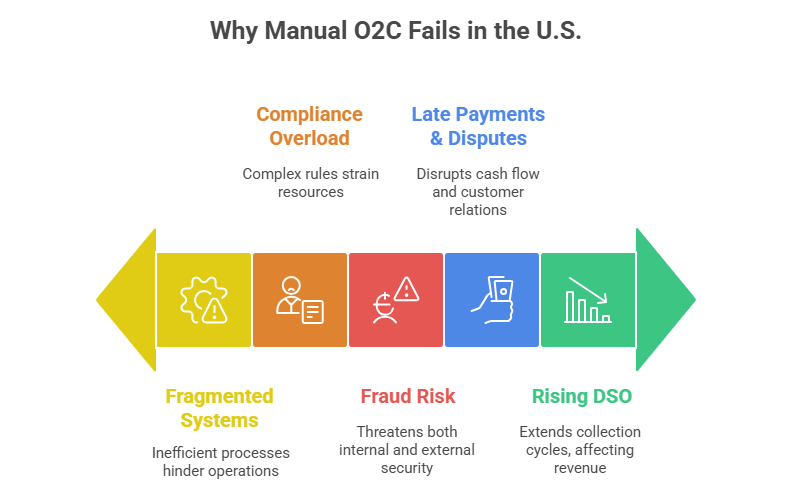
- Rising DSO (Days Sales Outstanding): Many U.S. firms see DSO climb above 55–60 days, tying up millions in working capital.
- Compliance Overload: Between SOX, IRS audits, and 1099 vendor reporting, teams spend hours verifying data instead of managing strategy.
- Late Payments & Disputes: Manual invoicing and follow-ups lead to missed deadlines and strained customer relationships.
- Fraud Risk: Paper-based or email-based invoicing systems remain vulnerable to spoofing and payment fraud.
- Fragmented Systems: Multiple ERPs and CRMs create silos that make reconciliation a full-time job.
Manual O2C isn’t just slow — it’s expensive. A typical U.S. company spends $10–$15 per invoice manually, versus $3–$5 with automation.
2025 Automation Trends to Watch
Here’s what’s defining the 2025 automation trends for O2C and modern finance operations in the U.S.:
1. AI-Powered Collections & Predictive Reminders
Finance teams are now using AI-driven collection engines to predict who’s likely to pay late and trigger reminders automatically. Instead of blanket follow-ups, AI personalizes outreach — improving recovery rates by up to 30%.
2. E-Invoicing & Compliance-Ready Billing
With increasing IRS scrutiny and SOX requirements, e-invoicing is quickly becoming the standard. Automated systems can generate, validate, and deliver invoices compliant with U.S. tax and accounting standards, minimizing audit risk and reducing manual intervention.
3. Predictive Analytics for Receivables and Cash Flow
Data-driven forecasting models now allow CFOs to anticipate future cash gaps. Imagine knowing — weeks in advance — which accounts will likely pay late, giving you time to adjust working-capital plans or credit terms proactively.
4. B2B Digital Payment Platforms
2025 will see widespread adoption of real-time payment systems in B2B finance. Integrations with ACH, FedNow, and virtual card solutions mean faster settlements and fewer reconciliation headaches.
5. Finance Operations Evolving into Digital Finance Ecosystems
Finance is no longer just about transactions; it’s about integration. Leading companies are building connected digital finance ecosystems where ERP, CRM, and payment data flow seamlessly — turning finance into a strategic intelligence hub.
Impact in Numbers: The U.S. Context
The results speak for themselves.
- A New York SaaS company automated its collections and reduced DSO from 60 to 30 days, freeing up $5 million in working capital.
- A Dallas logistics firm cut its cost per invoice from $12 to $4, saving over $250,000 annually in processing expenses.
- A San Francisco-based fintech improved cash-application accuracy from 70% to 95%, shortening month-end close time by five days.
Across industries, U.S. CFOs are reporting 20–40% faster collections, 50% fewer manual errors, and significant compliance gains from adopting O2C automation.
O2C as the Future of Finance
Here’s the big picture: O2C automation is not a back-office tool — it’s a front-line growth enabler.
As the pace of business accelerates, companies that can see their receivables in real time, predict their cash position, and act instantly will dominate their industries.
This is the future of finance — where automation, analytics, and agility converge.
In this landscape, financial automation is no longer about cost reduction; it’s about resilience, scalability, and strategic foresight.
By 2025, every progressive U.S. CFO I’ve spoken with views order-to-cash not as a routine process but as the foundation of B2B finance transformation.
Actionable Next Steps for U.S. Finance Leaders
If you’re looking to modernize your finance operations, here are three steps to start:
- Pilot O2C Automation in Receivables: Begin with automating invoice delivery and payment reminders. Measure impact on DSO and cash-flow cycles.
- Integrate with ERP/CRM and Compliance Tools: Ensure e-invoicing and audit readiness by connecting your automation platform to existing finance systems.
- Track ROI and Build Momentum: Benchmark metrics like cost per invoice, average DSO, and automation coverage — then expand gradually across the order-to-cash cycle.
Each 10-day DSO reduction could unlock $1–$3 million in free cash flow for mid-market companies. That’s the kind of measurable transformation automation brings.
The Future Is Automated
The reality is clear — O2C automation is redefining the speed, accuracy, and intelligence of finance operations in 2025.
For U.S. enterprises navigating inflation, compliance, and competition, automation isn’t optional — it’s the new baseline.
So here’s my message to every CFO reading this:
embrace automation, optimize your order-to-cash process, and step confidently into the digital finance era.
Because in the future of finance, speed and foresight will separate leaders from laggards.
Read our next blog – Click here