
Recently, I spoke with the CFO of a Jurong-based manufacturing firm who sighed, “Our sales keep growing, but our cash isn’t catching up.” Their receivables cycle had stretched to over 70 days, with invoices stuck in GST validation and manual follow-ups. On top of that, the team was juggling multi-currency payments from ASEAN clients and preparing for IRAS audits.
It’s a common reality across Singapore — from fintech firms in Marina Bay to logistics players in Tuas — finance teams are profitable on paper but short on liquidity. That’s where O2C automation is transforming finance operations across the region in 2025.
What O2C Automation Really Means
Let’s start simple. The Order-to-Cash (O2C) cycle is the lifeline of every business — from receiving an order, generating invoices, collecting payments, to reconciling and reporting.
O2C automation means digitizing and connecting all these steps into a unified, intelligent workflow. It’s about moving away from manual spreadsheets and emails toward real-time invoicing, automated collections, and predictive cash-flow visibility.
In Singapore, where regulatory precision and financial discipline define competitiveness, O2C automation has become the engine of modern finance operations. It’s not just about faster invoicing — it’s about enabling CFOs to make proactive, data-driven cash decisions.
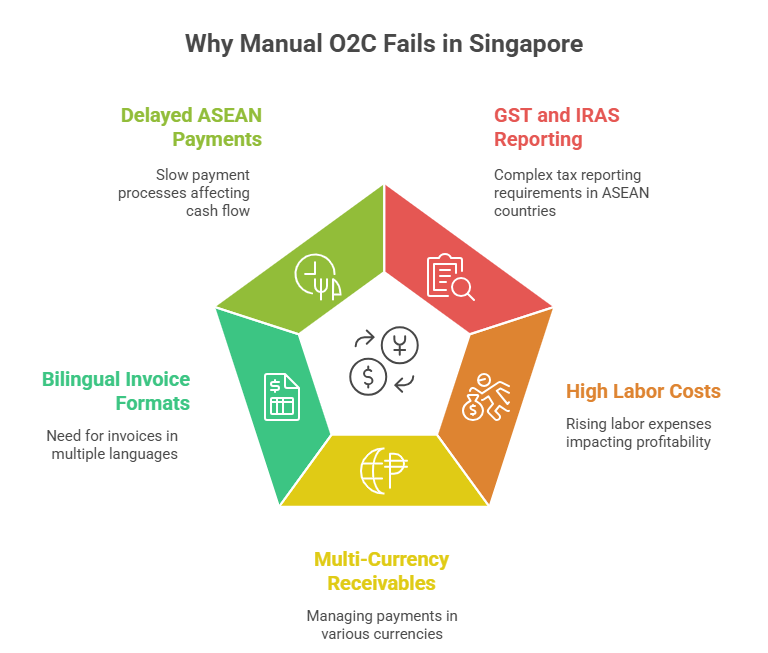
Why Manual O2C Fails in Singapore
Here’s the thing: manual O2C processes may seem manageable in smaller teams, but they create bottlenecks that cost millions in the long run.
Here’s what Singapore CFOs tell me they struggle with most:
- GST and IRAS Reporting Pressure: The Goods and Services Tax (GST) system requires error-free records and regular submissions to IRAS, making manual reconciliation risky.
- High Labor Costs: Skilled finance professionals in Singapore command high salaries, making repetitive invoice and reconciliation work an expensive inefficiency.
- Multi-Currency Receivables: Cross-border trade with Malaysia, Indonesia, and Thailand adds complexity in SGD, USD, and regional currencies.
- Bilingual Invoice Formats: Dealing with vendors or clients who require both English and Mandarin documentation slows validation and review cycles.
- Delayed ASEAN Payments: Intra-ASEAN transactions often experience delays due to varying banking systems, adding uncertainty to cash-flow management.
Put simply, manual O2C is the silent killer of cash velocity — and Singaporean CFOs know that time is literally money.
2025 Automation Trends to Watch
The 2025 trends in automation are reshaping how Singapore’s businesses manage cash, compliance, and customer experience.
Here’s what’s driving the change:
1. AI-Powered Collections and Smart Reminders
Finance teams are deploying AI-driven reminder systems that analyze customer behavior and automatically schedule polite follow-ups — before invoices are overdue. This reduces collection effort and improves on-time payments by up to 30%.
2. GST-Compliant E-Invoicing Automation
As IRAS advances its Nationwide E-Invoicing Initiative (PEPPOL), more companies are automating invoice creation, GST validation, and submission. This not only saves time but ensures bulletproof compliance with tax requirements.
3. Predictive Analytics for Receivables and Cash Flow
Instead of waiting for reports at month-end, CFOs now rely on predictive analytics to identify which customers will likely pay late. This allows finance teams to adjust payment terms and manage working capital proactively.
4. Digital B2B Payment Platforms in ASEAN
Cross-border B2B payment integration is maturing fast. Automated platforms now handle SGD, USD, MYR, and THB transactions seamlessly — reducing settlement times and foreign exchange discrepancies.
5. Singapore’s Shift to Digital Finance Ecosystems
Singapore’s finance sector is moving toward digital finance ecosystems, where ERP, banking, and payment systems connect in real time. O2C automation sits at the heart of this transformation, turning finance into a strategic, digital function.
Impact in Numbers: The Singapore Context
Let’s look at the numbers — because that’s where the story gets real.
A Singapore logistics company recently reduced its DSO from 60 days to 25 days, unlocking over SGD 4.5 million in working capital.
A Marina Bay fintech slashed invoice processing costs from SGD 18 to SGD 6 per invoice using automation — saving nearly SGD 300,000 annually in labor and error costs.
Meanwhile, a Jurong manufacturing group improved cash-application accuracy from 70% to 97%, accelerating month-end closing by four days.
Across the board, CFOs report 30–40% faster collections, 20–35% lower DSO, and measurable compliance improvements with GST and IRAS filings.
That’s not theoretical — that’s financial transformation.
O2C as the Future of Finance in Singapore
From what I’ve seen, O2C automation is no longer a back-office efficiency upgrade — it’s a strategic enabler of growth.
As Singapore continues its push toward becoming Asia’s digital finance hub, automation ensures finance teams are not only compliant but competitive.
This is where financial automation meets B2B finance innovation. CFOs who automate today are building agile, transparent, and data-driven finance functions that can thrive amid economic uncertainty and cross-border complexity.
In essence, order-to-cash automation is becoming a pillar of the future of finance in Singapore’s smart economy.
Actionable Next Steps for Singapore CFOs
If you’re leading finance operations in 2025, here’s how to start moving forward:
- Pilot O2C Automation in Receivables: Begin with digital invoicing and AI-driven reminders. Measure DSO and overdue rate improvements.
- Integrate with ERP and IRAS Systems: Ensure GST validation and reporting are automated for compliance accuracy and audit readiness.
- Leverage Predictive Cash Analytics: Use forecasting models to plan liquidity and improve cash-flow resilience.
Each 10-day DSO reduction could free up SGD 1–2 million in liquidity for a mid-sized enterprise — funds that can fuel expansion, investment, or debt reduction.
Embracing the Digital Finance Future
Here’s my view: 2025 will separate the CFOs who automate from those who stagnate.
In a high-cost, fast-moving economy like Singapore, efficiency and visibility are no longer optional.
O2C automation empowers finance teams to stay compliant with GST, strengthen customer trust, and drive growth through better cash discipline.
So my message is simple — embrace automation, integrate your systems, and prepare your business for the future of finance.
Because in Singapore’s evolving digital finance ecosystem, agility isn’t a luxury — it’s survival.
Read our next blog – Click here