

Skilled Nursing Facilities (SNFs) operate in one of the most complex corners of healthcare. Leaders must balance patient outcomes, staffing constraints, reimbursement models, and regulatory compliance often with limited visibility into day-to-day performance. This is where SNF operational analytics becomes critical. More than just a reporting tool, operational analytics provides the insight needed to run facilities efficiently while supporting quality care and financial sustainability.
Yet many SNFs still struggle to translate raw data into meaningful action. Understanding the problems, pitfalls, and the smarter path forward can help facilities move from reactive management to data-driven decision-making
Common Operational Problems SNFs Face
Most SNFs deal with similar operational challenges. Data is spread across EHRs, billing systems, payroll tools, and manual spreadsheets. This fragmentation creates blind spots in areas such as occupancy rates, staff utilization, claims turnaround time, and compliance metrics.
Staffing inefficiencies are another pressure point. Without clear visibility into workload patterns and acuity levels, facilities risk overstaffing, understaffing, or burnout. At the same time, reimbursement rules and audits require precise documentation and timely reporting. When reporting is delayed or inconsistent, financial risk grows.
These challenges raise a key question: How does SNF operational analytics improve facility efficiency? The answer lies in turning scattered operational data into a single, trusted view of performance.
Pitfalls of Traditional and Manual Reporting
Many SNFs still rely on static reports generated weekly or monthly. While these reports may satisfy basic requirements, they are often outdated by the time they reach decision-makers. Manual data collection also introduces errors and inconsistencies, making it difficult to rely on insights.
Another pitfall is focusing only on historical outcomes rather than operational trends. Traditional reporting shows what happened, but not why it happened or what is likely to happen next. This limits the ability to prevent issues such as staffing shortages, delayed claims, or compliance gaps.
Facilities evaluating SNF real-time operational reporting solutions quickly realize that modern analytics must go beyond spreadsheets. The real value comes from systems that continuously analyze performance and surface insights when they matter most.
How SNF Operational Analytics Solves These Issues
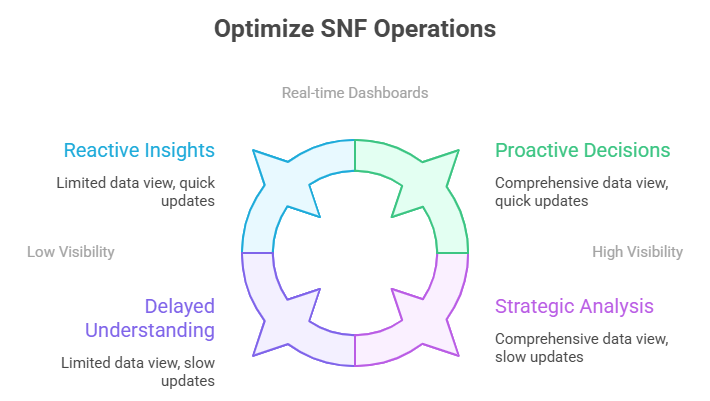
Modern SNF operational analytics software for skilled nursing integrates data from multiple operational systems and transforms it into actionable intelligence. Instead of manually assembling reports, leaders gain access to dashboards that reflect real-time conditions.
This supports skilled nursing facility data-driven decision making by enabling administrators to see patterns in census, staffing ratios, length of stay, and claims processing. When managers can compare trends across shifts, departments, or locations, they can intervene earlier and allocate resources more effectively.
For those asking, How can data-driven decision-making optimize SNF operations? the answer is visibility. With centralized analytics, inefficiencies become measurable, and improvement strategies can be tracked over time
Key Metrics and Dashboards SNFs Should Track
A strong skilled nursing facility performance metrics dashboard should balance clinical, operational, and financial indicators. Key performance metrics for SNF operational analytics dashboards often include:
- Census and occupancy rates
- Staff-to-patient ratios and overtime hours
- Length of stay and discharge turnaround time
- Claims submission and denial rates
- Compliance and audit readiness indicators
Tracking these metrics together helps leaders understand cause-and-effect relationships. For example, staffing patterns can be correlated with patient outcomes or reimbursement delays. Over time, this insight supports better planning and more confident operational decisions.
Benefits of Real-Time Operational Intelligence
One of the biggest advantages of analytics is speed. Real-time insight answers another common question: What are the benefits of real-time operational reporting for skilled nursing facilities? Instead of reacting after a problem occurs, facilities can anticipate it.
Real-time dashboards allow managers to detect workflow bottlenecks, rising labor costs, or documentation gaps before they escalate. This not only improves efficiency but also strengthens compliance and financial control. Facilities exploring best SNF operational intelligence platforms B2B increasingly look for tools that combine automation with continuous insight rather than delayed summaries.
Operational analytics also supports patient care indirectly. When staff are scheduled appropriately and documentation is complete, clinicians can focus more on residents and less on administrative tasks. This explains how SNF operational analytics technology improves patient care by creating smoother operations behind the scenes.
A Smarter Way Forward with AI-Driven Automation
The future of SNF operations lies in pairing analytics with automation. AI-powered systems can extract data automatically, validate it against business rules, and update dashboards without manual intervention. This reduces errors and ensures consistency across departments.
Facilities comparing SNF operational analytics vendors should look for platforms that integrate seamlessly with existing systems and support end-to-end automation. Over time, the ROI of SNF operational analytics technology becomes clear through reduced administrative effort, faster reimbursement cycles, and better resource utilization.
As SNFs face growing pressure to do more with less, operational analytics must evolve from simple reporting to strategic enablement. An end-to-end SNF automation platform powered by AI can improve visibility across operations, boost efficiency, strengthen compliance, and support faster, more confident decision-making. By adopting a smarter, analytics-driven approach, facilities can move beyond firefighting and toward sustainable, data-informed operations.
Author -Chaitanya Thorat
Read our next blog – Click here