
Automate Bank Account Management Across Subsidiary and Loan Accounts
Simplify the way your organization manages multiple bank accounts, loans, and subsidiary accounts. Ensure accuracy, visibility, and compliance while reducing manual effort in reconciliation, posting, and reporting.
The Bank Account Management Challenge
Large enterprises maintain multiple subsidiary bank accounts across geographies and business units.
Loan accounts require constant tracking of repayments, interest postings, and reconciliations.
Manual reconciliations lead to errors, delayed closings, and higher compliance risks.
Lack of centralized visibility makes it difficult to track balances, liquidity, and intercompany transactions.
Managing approvals for account openings, payments, and fund transfers is often slow and fragmented.

Our Solution – Automated Bank Account Management Workflows
Centralized Account Repository
Automated Reconciliation
Loan Tracking & Posting
Approval Workflows
Regulatory Compliance
Real-Time Reporting
Key Capabilities
Subsidiary Account Management
Consolidate balances across all entities for a unified cash position.
Automate intercompany fund transfers with clear audit trails.
Loan Account Automation
Schedule repayments, interest accruals, and principal postings without manual intervention.
Generate automated loan balance confirmations and compliance-ready reports.
Bank Reconciliation Automation
Auto-match bank transactions with ERP ledgers daily or monthly.
Exceptions routed to finance teams with supporting details for resolution.
Compliance & Audit Readiness
Track approvals, account changes, and reconciliations with timestamped audit logs.
Generate standardized reports for regulators, auditors, and internal stakeholders.
Key Benefits
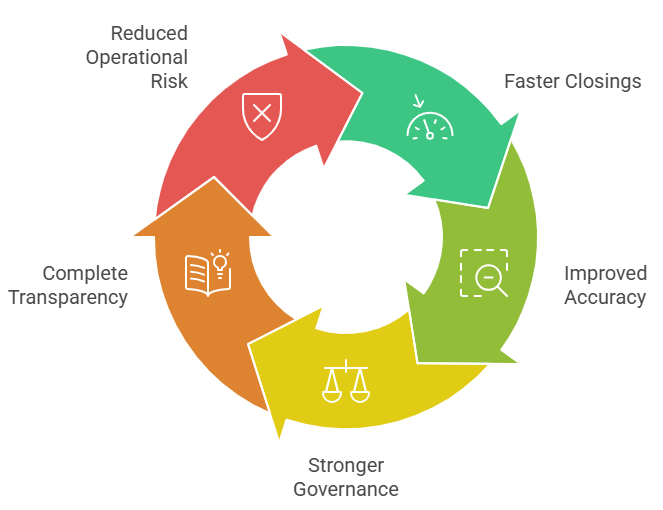
Automate reconciliations and postings to reduce month-end workloads.
Minimize human errors in loan interest, repayments, and intercompany transactions.
Maintain compliance with treasury and accounting standards.
Real-time visibility into subsidiary balances and loan positions.
Automated workflows ensure controls without slowing down approvals.
Automation Capabilities / Technical Blueprint
Reconciliation Engine
ERP & Bank Integrations
Loan Management Module
Approval & Workflow Automation
Dashboards & Alerts

Why Choose Us
Purpose-built workflows for subsidiaries, treasury, and AP teams.
Pre-integrated with leading ERP and banking platforms.
Scalable across multi-entity, multi-country organizations.
Compliance-ready design to meet statutory and audit requirements.
Trusted by enterprises to improve liquidity visibility and control.
FAQs
A subsidiary account records detailed sub-ledgers linked to a main or control account (e.g., vendor, customer, cost centre), whereas a loan account represents a liability or facility extended by a bank or financial institution to a borrower.
Use a subsidiary account when you need separate tracking of transactions for a specific entity, cost centre or division under a main account. Use a loan account when the entity has borrowed funds and must repay over time.
In such cases, you record the lending subsidiary’s account as a loan receivable and the borrowing entity’s account as a loan payable, ensuring consolidation and elimination entries if preparing group financials (i.e., treating as intra-group loan accounts).
Essential controls include periodic reconciliation of subsidiary ledgers to the control account, tracking loan amortisation schedules, monitoring authorizations for inter-entity transfers, and ensuring accurate posting in the general ledger.
Yes — if an internal entity or subsidiary initially uses its sub-account for day-to-day transactions but then receives formal funds which require repayment, it is re-classified as a loan account with principal and interest terms.