
Denied claims remain a major barrier to timely revenue recovery for Skilled Nursing Facilities (SNFs). While many organizations focus on appealing denials after they occur, the real challenge lies in identifying why denials happen and preventing them from recurring. Manual root cause analysis is slow, inconsistent, and heavily dependent on staff expertise often delaying corrective action and increasing write-offs.
As payer rules become more complex and authorization requirements more stringent, SNFs need faster, more accurate ways to identify denial drivers. This is where healthcare automation SNF eligibility and validation, powered by Artificial Intelligence (AI), is transforming denial root cause analysis. By automating eligibility checks, authorization verification, and real-time documentation validation, AI enables SNFs to accelerate revenue recovery while reducing preventable denials.
Why Denial Root Cause Analysis Is Critical for SNF Revenue Recovery
Denial root cause analysis is the process of identifying the underlying reasons claims are rejected such as eligibility mismatches, missing authorizations, or incomplete documentation. When performed manually, this process is reactive and fragmented, often occurring weeks after the original submission.
AI-driven automation changes this model by embedding intelligence directly into front-end workflows. Instead of investigating denials after payment delays occur, SNFs can use AI eligibility validation SNF and Intelligent Automation SNF intake to detect and correct issues in real time dramatically improving cash flow and reducing administrative burden.
How AI Automates Denial Root Cause Analysis in SNFs
AI-powered platforms analyze denial data, patient records, payer rules, and historical outcomes to uncover patterns that lead to revenue loss. This automation allows SNFs to move from denial correction to denial prevention.
Real-Time Eligibility Validation
One of the most common denial drivers is an eligibility mismatch. AI enables real-time eligibility SNF validation by instantly verifying patient coverage against Medicare and Medicaid databases at intake and prior to billing.
This answers key operational questions such as:
- How does AI validate SNF eligibility in real-time?
- How can SNFs use AI for eligibility checks?
Using Machine Learning eligibility models, AI detects inconsistencies in patient demographics, coverage periods, and benefit limits preventing avoidable eligibility denials before claims are submitted.
Automated Authorization Verification
Authorization-related denials are costly and difficult to overturn. AI-powered systems automate SNF authorization verification by continuously monitoring payer-specific rules, approval timelines, and service limits.
Through Intelligent Automation authorization, SNFs can:
- Track authorization status in real time
- Validate services against approved authorizations
- Receive alerts for expirations or mismatches
This directly addresses:
- Can AI automate authorization verification for SNFs?
- Why use AI for fast SNF authorization?
- Can AI prevent SNF authorization denials?
By using Predictive Analytics, authorization success, AI also estimates the likelihood of approval, allowing teams to intervene early when risk is detected.
Real-Time Documentation Validation
Incomplete or inconsistent documentation is another major contributor to denials. AI enables real-time documentation validation SNF by reviewing patient records as they are created not after claims are denied.
Using OCR patient records, NLP document validation SNF, and Generative AI documentation, AI systems automatically:
- Verify completeness of clinical notes
- Match documentation to payer requirements
- Ensure medical necessity is supported
This capability answers:
- What is real-time documentation validation in SNFs?
- What AI tools validate SNF patient documents?
It also supports Medicaid patient document validation AI and AI for Medicare eligibility checks, skilled nursing, improving compliance and audit readiness.
AI-Driven Root Cause Identification
Instead of manually reviewing denial codes, AI performs continuous denial root cause analysis by correlating denials with eligibility errors, authorization gaps, and documentation deficiencies.
Through Real-Time AI documentation check and historical trend analysis, AI identifies recurring failure points allowing SNFs to fix systemic issues rather than repeatedly appealing individual claims. This directly helps prevent SNF authorization denials with AI and supports SNF compliance automation AI initiatives.
Impact on Operational Efficiency and Revenue Recovery
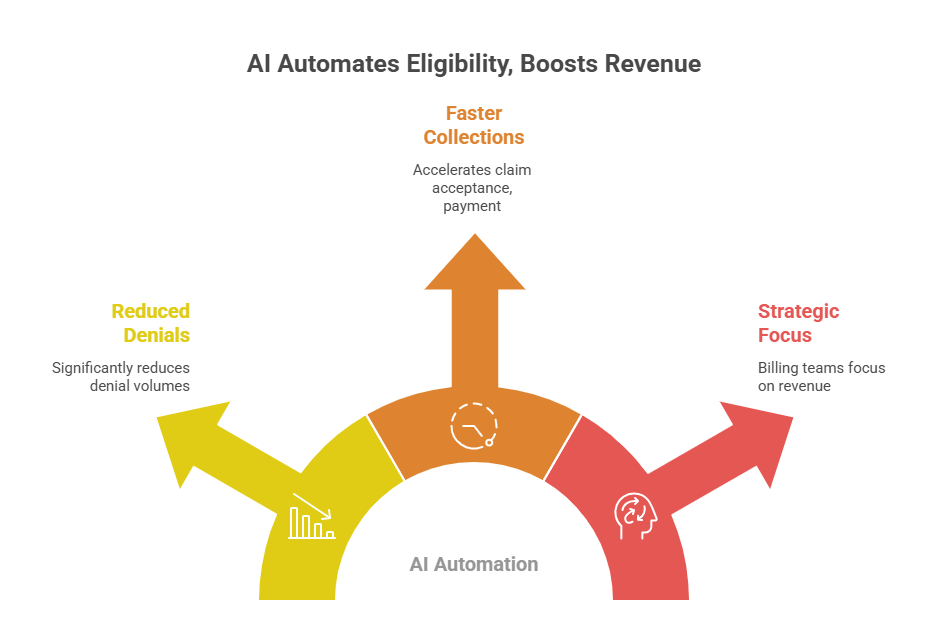
By automating eligibility, authorization, and documentation validation, AI significantly reduces denial volumes and accelerates collections. Billing teams spend less time investigating denials and more time on strategic revenue optimization.
Key benefits include:
- Faster claim acceptance and payment cycles
- Reduced write-offs due to timely issue detection
- Improved operational efficiency SNF validation
- Lower administrative workload without increasing staff
This end-to-end automation strengthens healthcare automation SNF eligibility and creates a scalable foundation for revenue growth.
Manual vs AI-Powered Denial Root Cause Analysis in SNFs
| Aspect | Manual Process | AI-Powered Automation |
|---|---|---|
| Eligibility checks | Manual, post-denial | AI real-time eligibility SNF |
| Authorization verification | Spreadsheet-based | Intelligent Automation authorization |
| Documentation validation | Retrospective audits | Real-time AI documentation check |
| Root cause identification | Time-consuming | Automated pattern detection |
| Revenue recovery speed | Slow and reactive | Faster, proactive |
Faster Revenue Recovery Starts with AI
Automating denial root cause analysis with AI enables Skilled Nursing Facilities to move from reactive denial management to proactive revenue protection. By combining AI eligibility validation SNF, real-time documentation validation SNF, and automated SNF authorization verification, facilities can eliminate preventable denials before they occur.
As payer requirements continue to evolve, AI-powered root cause analysis is becoming essential for SNFs seeking faster revenue recovery, stronger compliance, and long-term financial stability.
Author – Sushrut Ujjainkar
Read our next blog – Click here