The Next Evolution of RCM Automation: Why AI Agents Are Replacing RPA in Hospitals

Your current automation approach is no longer delivering scalable financial impact. Download this C-Suite guide for a strategic comparison of AI Agents vs. Traditional RPA in Healthcare—and learn the proven roadmap to achieving sustainable operational and financial advantage.

Download Free Guide


    U.S. Healthcare Operational Pain Points

    Legacy automation tools were never designed for the complexity of modern Revenue Cycle Management. As a result, health systems continue to face:

    AI Agents vs Traditional RPA in Healthcare automation

    Traditional RPA struggles in dynamic environments creating fragile processes that break under real-world conditions.

    • Escalating administrative costs with little progress toward meaningful cost reduction
    • Ongoing staff fatigue driven by exception handling and repetitive digital work
    • Inconsistent rule execution leading to revenue leakage and elevated denial rates
    • Fragmented automation that fails to support end-to-end RCM workflows

    Why This Topic Matters Now (Regulatory + Cost Pressure)

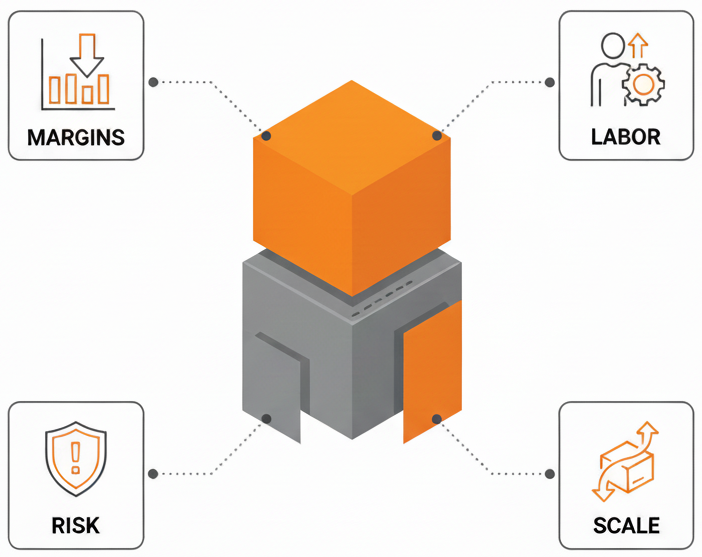
    Margin pressure across US healthcare is forcing leaders to pursue non-linear efficiency gains. At the same time, workforce shortages and regulatory scrutiny are intensifying operational risk.
    • Healthcare platforms can no longer afford automation that simply mimics manual tasks.

    • Selecting the wrong technology today creates long-term financial drag and limits future scalability.
    • This guide explains how to transition from RPA to AI-driven RCM automation—and why this shift is critical to long-term financial resilience.
    Why This Topic Matters Now (Regulatory + Cost Pressure)

    What’s Inside the Gated Asset

    This executive guide delivers practical, decision-ready insights, including:

    Who Should Read This

    This guide is designed for senior healthcare leaders accountable for financial performance, operational efficiency, and enterprise transformation, including:

    Before vs. After Impact: Sample Healthcare Metrics

    See the measurable difference autonomous AI Agents deliver in production environments:
    Why ValueDX: Outcomes Over Tools

    ValueDX delivers more than automation software—we provide a strategic operating model for modern RCM.
    Our autonomous AI platform is purpose-built to manage complexity, eliminate manual administrative work, and strengthen financial performance at scale.
    We partner with healthcare leaders to achieve durable results not incremental automation—positioning organizations for the next generation of hospital back-office transformation.

    FAQs

    RPA lacks adaptive intelligence. It cannot reliably manage variability, unstructured data, or complex exceptions—making it ineffective for high-impact RCM use cases like advanced denial prevention and resolution.
    Understanding the strategic difference ensures leaders invest in automation that scales with regulatory complexity and financial pressure—rather than locking into fragile, outdated solutions.
    AI Agents automate RCM workflows end-to-end, accelerating eligibility verification, claims submission, and denial management—resulting in faster, more predictable collections.
    Autonomous AI introduces continuous learning and decision-making capabilities, enabling higher ROI, better compliance, and long-term operational resilience.
    By absorbing high-volume, repetitive administrative tasks, AI Agents free human teams to focus on complex, value-driven work—significantly improving workforce sustainability.

    Ready to Move Beyond RPA?

    Download the C-Suite Guide: Autonomous AI Agents vs. Traditional RPA in Healthcare