
AI-Powered Healthcare Accounts Receivable Recovery — Reduce A/R Days, Recover Aged Claims, Accelerate Cash Flow

ValueDX AI-Powered Accounts Receivable Recovery changes that trajectory. The platform continuously monitors every open claim, scores each by recovery probability, executes payer follow-ups automatically, and routes exceptions to the right staff member — so your AR team works the claims most likely to pay, not the ones that arrived most recently in the queue.

Accelerate Cash Recovery with ValueDX AI-Powered Accounts Receivable Automation

ValueDX helps healthcare providers recover outstanding balances faster through intelligent AI automation that monitors payer behavior, prioritizes claims and executes follow-ups with precision and transparency.

Why Healthcare Accounts Receivable Keeps Growing Instead of Closing

Discover AI-Powered Healthcare Agents — On Your Terms

The ValueDX AI Experience Center gives your revenue cycle leadership, billing managers, and AR staff a direct view of how accounts receivable recovery automation works against real payer follow-up scenarios — not a simulated dashboard walk-through. Watch the platform ingest an aging AR report, score each claim by payer behavior patterns and recovery probability, execute automated follow-up on high-priority accounts, flag underpayments against contracted rates, and route appeals to the correct staff member — all without a billing coordinator touching a single claim in the queue.

  • Watch self-service video demos at your convenience –See how AI agents automatically prioritize aged accounts, follow up with payers, correct claim errors, and streamline recovery workflows—without human intervention

  • Explore real-world implementations from leading healthcare providers – Learn how hospitals, physician groups, and billing teams use ValueDX to reduce A/R days, improve cash flow, and recover more revenue from both payers and patients

  • Learn how AI-driven agents enhance financial performance and operational efficiency

    How ValueDX AI-Driven Accounts Receivable Recovery Works — The Platform Approach
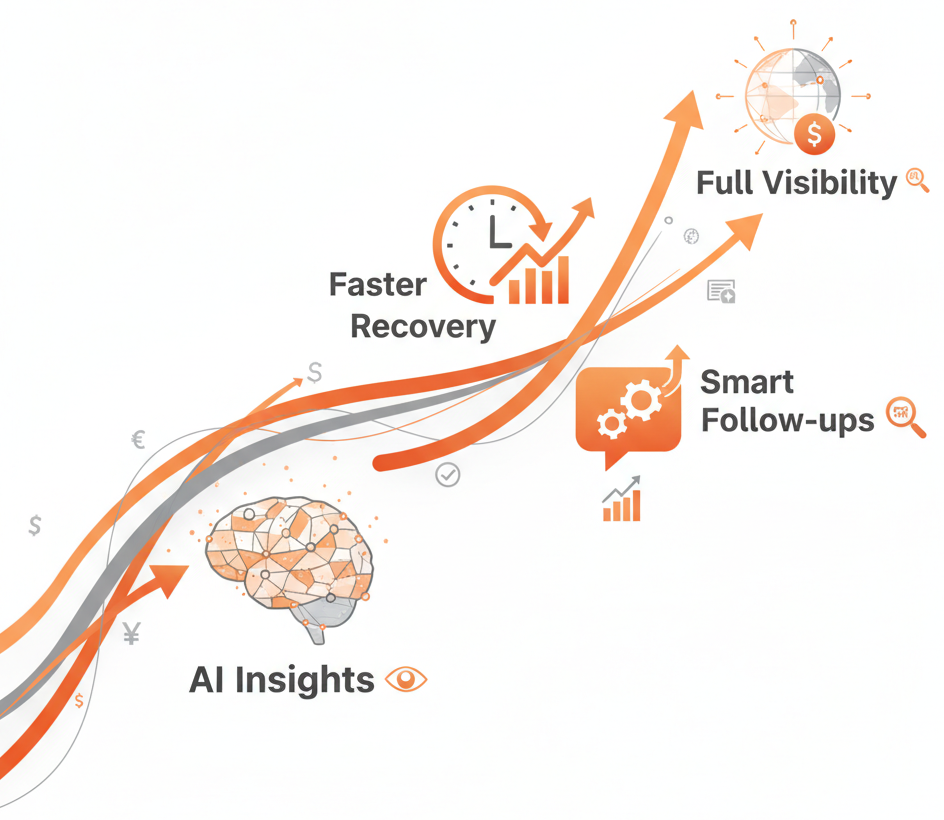
    Accounts Receivable Recovery Services for Healthcare Providers
    • Treats AR recovery as a data intelligence process

    • Ingests and analyzes claims, remittance, denial data

    • Scores claims by recovery probability and timing

    • Automates high-value follow-ups and recovery actions

    • Routes complex cases to staff, improving recovery efficiency

    A Complete AI-Driven Revenue Cycle — How A/R Recovery Connects to Your Financial Ecosystem

    A/R recovery does not exist in isolation — it is the final collection point in a revenue cycle that either sets AR up for clean recovery or hands it a backlog of preventable problems. ValueDX connects accounts receivable recovery to the upstream workflows that generate it: denial management feeds resolution patterns back into claim submission logic, payment posting provides real-time reconciliation against expected remittances, revenue intelligence surfaces the payer performance trends that predict future AR behavior, and compliance automation ensures every recovery action meets regulatory documentation requirements.

    Key Features of ValueDX AI Accounts Receivable Recovery Automation

    • AI scores claims by recovery probability

    • Predicts cash flow with ML forecasting

    • Automates escalation for delayed or disputed claims

    • Handles payer communication via API and EDI

    • Provides real-time payer performance insights

    • Maintains full HIPAA-compliant audit trails

    Key Features AR

    Measurable Outcomes from AI-Powered Accounts Receivable Recovery Automation

    Experience the Power of Healthcare AI Agents Firsthand

    Every platform’s AR recovery challenges vary by payer mix, denial patterns, and workflows. A generic demo doesn’t reflect real impact. ValueDX reviews your AR data, identifies key recovery gaps, and tailors the demo to your actual revenue opportunities.

    • Walk through real-life A/R recovery use cases from hospitals, clinics, and large billing operations –Understand how AI agents identify stalled claims, create follow-up strategies, and automate next-best actions based on payer behavior and denial patterns

    • Interact with AI agents to uncover automation opportunities in your A/R workflows – Discover where delays happen, what can be automated instantly, and how to reduce A/R days through intelligent follow-up and proactive issue resolution

    • Get answers to your questions directly from our experts

    Fill out the form below and we’ll be in touch to schedule a convenient time.

    Let’s explore how intelligent automation can transform your healthcare delivery.

      Frequently Asked Questions — AI Healthcare Accounts Receivable Recovery

      Healthcare accounts receivable recovery is the process of collecting outstanding payments owed to a healthcare provider by insurance payers, government programs, and patients after services have been delivered. It matters because uncollected AR is not simply deferred revenue — it is revenue that depreciates with time. Claims unpaid after 90 days recover at rates 40 to 60 percent lower than claims followed up within the first 30 days, and claims that reach 120 days without resolution frequently hit timely filing limits that make them permanently uncollectable. AI-powered AR recovery automation addresses this time-sensitivity by continuously monitoring every open claim, executing payer follow-ups in the optimal window, and routing escalations before recovery probability declines.

      AI improves healthcare AR recovery by replacing the reactive, volume-limited manual follow-up process with a continuous, data-driven recovery operation. ValueDX AI analyzes every open claim using payer-specific behavioral data, claim age, denial code history, and contractual expected payment amounts to assign a recovery probability score. Claims are then prioritized for automated follow-up — payer inquiries, corrected resubmissions, underpayment disputes — based on recovery likelihood and timing optimization rather than queue position. This means a billing team of the same size recovers more revenue faster, with staff time concentrated on the complex exceptions that require human judgment rather than routine status checks that can be automated.

      Yes. ValueDX denial intelligence automation analyzes denial patterns across payer, denial code, provider, service line, and billing period — identifying the specific recurring issues that generate the most AR leakage. When the same payer denies a specific CPT code combination repeatedly for the same technical reason, the platform does not treat each denial as an isolated event. It identifies the pattern, builds a corrective workflow, and resubmits with the correction applied — while also surfacing the pattern to billing leadership so the upstream submission error can be corrected at the source. This converts denial management from reactive rework into systemic revenue protection.

      Yes. ValueDX integrates with major EHR, practice management, and billing platforms — including Epic, Cerner, Athenahealth, eClinicalWorks, and leading billing system platforms — using HL7 FHIR data exchange and standard X12 EDI transaction sets including 835 remittance files and 276/277 claim status transactions. Integration is designed to work within your existing billing workflow — AR data flows automatically between ValueDX and your systems of record without requiring staff to switch platforms, perform manual data exports, or duplicate information across systems.

      Healthcare providers implementing ValueDX AI-powered AR recovery typically achieve 40–50% reduction in average days in accounts receivable, 35–50% reduction in manual follow-up effort per billing FTE, and measurable improvement in recovery rates on aged claims — including accounts previously categorized as low-priority or unlikely to pay. Most organizations can quantify these improvements within 60–90 days of deployment through direct comparison of AR aging distribution, collection rates by payer, and billing staff productivity before and after implementation. The compounding effect of faster recovery also improves operating cash flow in ways that appear in the balance sheet within the first billing cycle.

      Yes. ValueDX AR recovery automation is fully HIPAA-compliant. All patient data, claim information, remittance details, and payer correspondence processed through the platform is encrypted in transit using TLS 1.2 or higher and at rest using AES-256 encryption. The platform maintains SOC 2 Type II certification, complete audit trails for every AR action, and role-based access controls ensuring that financial and patient data is accessible only to authorized personnel. Every workflow and data exchange is designed to maintain patient information protection and support the organization’s audit readiness for CMS, OIG, and payer contract compliance reviews.

      Most healthcare platforms can go live with ValueDX AR recovery automation within 3–6 weeks of contract execution, depending on the number of payer integrations, EHR connections, and billing system configurations required. ValueDX handles all implementation including data mapping, payer portal integration, user configuration, and staff training. The phased deployment approach prioritizes the highest-impact AR workflows first — typically automated payer follow-up for the top five payers by volume and claim aging analysis for the 60–90 day bucket — so organizations begin recovering measurable revenue before the full platform is operational.

      Start Recovering Outstanding A/R Faster — Schedule Your AI-Powered AR Demo Today

      ValueDX AI-Powered Accounts Receivable Recovery works continuously on every open claim, at a speed and consistency that no manual process can replicate. We will show you exactly how it applies to your current AR aging distribution, your specific payer mix, and the denial patterns that are generating the most leakage in your revenue cycle today. No generic presentation. A live walkthrough built around your actual financial situation. No obligation required.